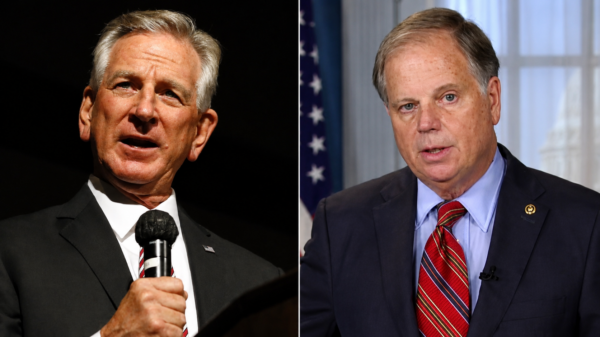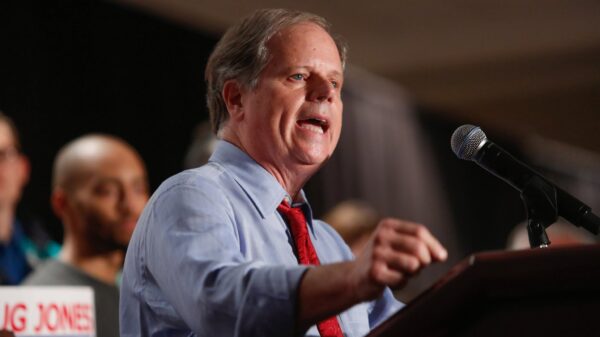




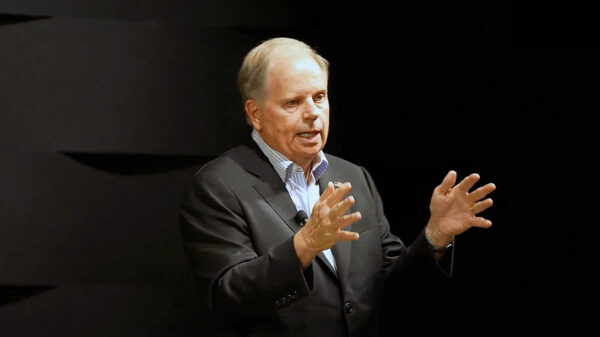


















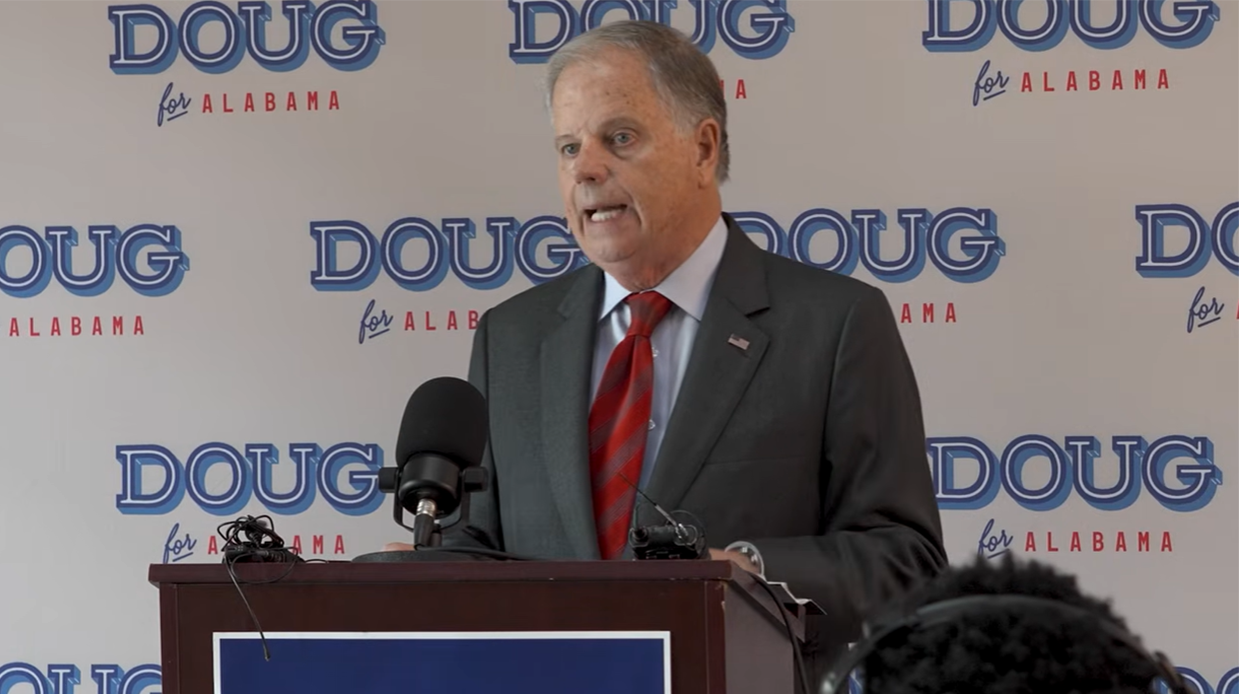
At a recent press conference, Democratic gubernatorial nominee Doug Jones questioned Republican opponent U.S. Senator Tommy Tuberville’s prolific congressional stock trading and personal investments in the AI data center industry.
Jones argued that Tuberville’s support for AI data center development in Alabama raises serious ethics concerns and called for reforms to Alabama’s financial disclosure system to prevent statewide officials from using public office to enrich themselves.
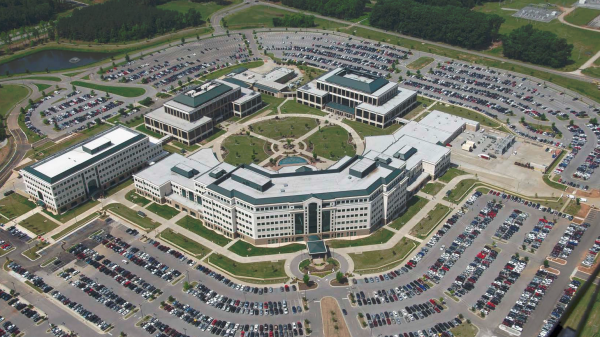
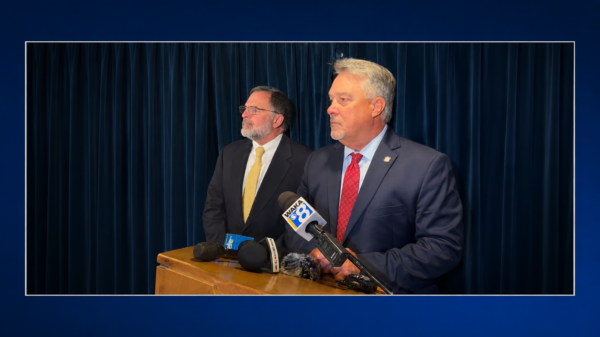
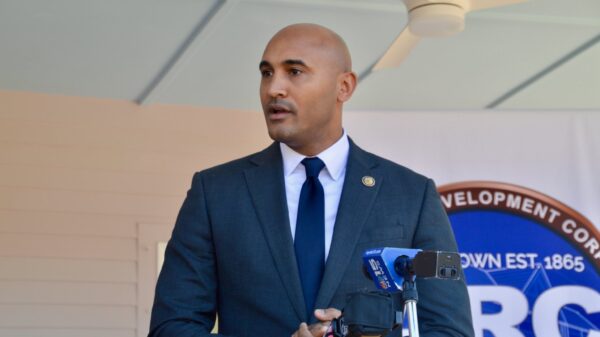
“In Montgomery and across Alabama, developers are being offered tax incentives and breaks and asked to sign nondisclosure agreements so the conversations about proving these data centers are all done behind closed doors and kept secret,” Jones said at Wednesday’s press conference in Birmingham. “Records are being destroyed in town after town. Families are finding out about hyperscale data centers the size of eight Walmart supercenters that are going to go up only after that deal is done, and they’re hearing it through rumor and word of mouth and not their public officials. Leading the charge on all of this is Tommy Tuberville.”
“[Tuberville’s] declared, and I’m quoting, quote, ‘Alabama is doing data centers,’ end quote,” Jones continued. “He’s called the concerns of Alabamians raising noise about water and their power bills, raising concerns about their communities and quality of life, ‘bullcrap.’ That’s what he says to the people of Alabama.”
Jones went on to highlight Tuberville’s status as one of the most prolific stock traders on Capitol Hill, specifically noting more than 250 trades involving companies tied to AI and data center development during Tuberville’s first five years in the U.S. Senate.
“It appears that Tommy Tuberville is such an AI proponent because he has kept right on investing his money,” Jones said. “In his first five years in the Senate, he reported over 1,350 stock trades. Those stock trades were worth between $18 million and $52 million. … Significantly, more than 250 of those trades involve companies substantially involved in AI and data center development. The total value of just the AI and data center trades sits between $5.2 million and $14 million.”
According to Tuberville’s most recent financial disclosures, stocks tied to AI and data centers make up the single largest concentration in the senator’s investment portfolio, Jones said.
“Between $500,000 and $1.5 million in AI and data center-linked stocks he owns right now, today, while he asks Alabamians to trust his judgment about data centers,” Jones said. “Look at the stocks he holds: Google, Microsoft, Oracle, Apple, Qualcomm, Accenture—the big AI names. Now, it’s OK to hold those stocks, but to not tell folks and not understand why he is talking about Big Tech the way he does is wrong.”
Jones also emphasized Tuberville’s holdings in utilities and power companies, which stand to profit from increased data center development.
“Tuberville also owns between $175,000 and $400,000 in utilities, the power companies, and the telecom companies whose profits go up when data centers get built and when electricity prices go up to pay for the next generation,” Jones said.
Jones argued that Tuberville’s personal investments in those industries raise significant questions about the Republican nominee’s ability to govern appropriately on issues related to AI, data center development and utility regulation in the state.
“He says he’s been meeting with these companies and power companies for two years as he’s planning to run for governor,” Jones said. “What is it he’s learning for his investments in these meetings? What commitments is he making to these power companies and particularly Alabama Power Company and the Southern Company?”
Jones also argued that Tuberville’s financial ties to the data center industry are part of a larger pattern in which Tuberville seeks to use public office to enrich himself.
“Folks, this is just not one off about data centers. It’s a pattern with Tommy Tuberville,” Jones said. “Tommy Tuberville is all about money and personal wealth. None of this is new behavior for him, whether it’s getting paid millions of dollars to leave a coaching job, or a failed attempt to manage money in a venture known as TS Capital, the hedge fund that defrauded Alabamians of millions of dollars of their retirement funds. His partner went to prison and a confidential civil settlement was entered into after being sued by investors.”
“I’m repeatedly asked on the campaign trail, why is Tuberville leaving the Senate?” Jones continued. “Why is he leaving the Senate and not just going home to Florida to fish, play golf? It’s a good question. You got to follow the money.”
Jones said he believes Tuberville chose to leave the U.S. Senate and run for governor because a ban on congressional stock trading—which Tuberville has publicly opposed—would impede his ability to profit while in public office. Jones argued that Tuberville could continue doing so as governor because of Alabama’s financial disclosure laws.
“It’s clear that a ban on trading by members of Congress is coming. It is growing in momentum,” Jones said. “But as you all know, all of you members of the media know, Alabama’s ethics laws are as weak as water. You do not have to disclose holdings, much less trades, and Tommy Tuberville never, ever talks about reforming Alabama’s ethics laws.”
Jones called on Tuberville to divest from “every share of stock, every option, every position tied to AI data centers and the utilities they serve.”
“If he wants to be the governor of Alabama, he cannot be a shareholder in the industry he is asking Alabama to bet its future on,” Jones added.
The former senator also proposed a series of reforms to Alabama’s ethics and financial disclosure system, a one-year moratorium on data center development in the state and a ban on stock trading for statewide officeholders. Jones said the Legislature could enact the stock-trading ban during its organizational session after November’s general election.
Jones reiterated his view that the data center debate is emblematic of a larger systemic problem in which political leaders can profit from ties to corporations and access to insider information.
“Folks, the data center controversy has erupted because people are realizing that it’s the perfect example of why they distrust Alabama elected officials, why they believe that Alabama’s government does not listen or pay attention to them,” Jones said. “It’s true of data centers in Bessemer and in Lowndes County, but also of solar farms in North Baldwin County, or carbon capture facilities in Crenshaw County.”
“The way this has been handled in Alabama up to now is just the opposite of democracy,” he continued. “Too many of these deals have been cut in secret through shell companies. A small handful of multi-billionaires are trying to buy state government when they need it, and as usual, the power company seems to be behind it all pulling the strings. And a sitting United States Senator who wants to be your next governor is personally invested.”
Jones concluded the press conference by urging Alabama voters to support his candidacy.
“Alabama can build data centers, but we can do it right with appropriate guardrails,” Jones said. “And Alabama can do it without a governor who trades the stock of these companies he regulates and calls your questions and your concerns about your communities nothing but ‘bullcrap.’
“I’m running for governor, folks, because I believe the people of this state deserve a government that works for them and with them. A government where everyone has a voice and a seat at the table. A government that is not driven by the stock portfolio of the man sitting behind the big desk in the big office in the state Capitol with all the flags in it.”
Jones’ statements come after Tuberville recently announced his plan for data center development in the state, in which the senator said he would make data centers “pay full taxes, cover the total cost of [their] energy, and replace what [they] take” if elected governor. The plan also explicitly opposes Jones’ proposal for a one-year moratorium.
Tuberville’s campaign responded to Jones’ comments in a written statement provided to APR.
“We expect these desperate attacks from Doug, but like so much of what he says, they are just empty,” Tuberville campaign chair Jordan Doufexis said. “Like many Americans, Coach has a broker who manages his investments and makes day-to-day decisions about when and what to buy or sell. Coach is not making those day-to-day trading decisions. This has been answered and reported on for years.”
“DC Doug is grasping for attention,” Doufexis added. “But the real issue for Alabamians is this: who has a plan to protect Alabama families?”
Doufexis said that if Tuberville is elected governor, he will ensure local communities have the final say on data centers and their citizens are the beneficiaries; data centers pay the highest tax rate; data centers receive no tax incentives or abatements; and data centers pay for all power and water they use and for replacing that capacity.
“Doug Jones can talk all he wants, but Alabama deserves more than a DC lobbyist telling people he wants a one year moratorium as a campaign line,” Doufexis said. “So, what’s Doug’s actual plan?”
Jones and Tuberville will face each other in the general election Tuesday, November 3.