


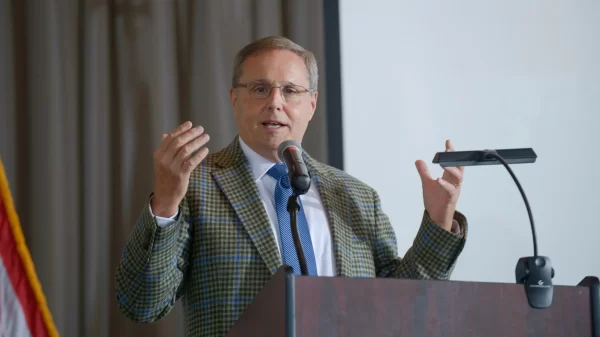


Alabama state agencies recognized National Rural Health Day on Thursday, highlighting a commendation given to physician and educator, Dr. William Curry.
National Rural Health Day has been coordinated annually on Nov. 20 by the National Organization of State Offices of Rural Health, NOSORH, since 2011.
NOSORH is a membership organization established in 1995 to assist state offices of rural healthcare, such as ADPH’s Office of Primary Care and Rural Health.
The observance of National Rural Health Day was recognized in Alabama by a proclamation released by Gov. Kay Ivey last month.
Ivey wrote that the day “highlights the unique healthcare needs and opportunities of rural communities.”
“The healthcare and wellbeing of our citizens are of utmost importance to our state,” the governor proclaimed. “Rural communities often experience barriers such as limited access to healthcare services, shortages of healthcare providers, transportation challenges, an aging population with higher rates of chronic conditions and a greater proportion of uninsured citizens.”
In honor of National Rural Health Day, NOSORH granted “Community Star” recognitions to individuals and organizations across 47 states for their contributions to rural healthcare.
This year, Curry, a physician and retired professor of medicine at the University of Alabama Birmingham, was recognized by NOSORH.
Curry, a native of Pickens County, served for 23 years as associate dean for Primary Care and Rural Health at the UAB School of Medicine.
Prior to his time at UAB, Curry practiced internal medicine in Pickens County, serving on the local hospital board.
During his tenure at the university, Pickens helped establish medical school pipeline programs with the University of Alabama and University of Alabama Huntsville, as well as Alabama’s first statewide Area Healthcare Education Center and the University of Alabama Institute for Rural Health Research.
The doctor has also served in leadership positions with the Medical Association of the State of Alabama, focusing on rural healthcare initiatives.
In a series of statements published by NOSORH, Curry explained his work to advance rural healthcare, including how he became invested in serving rural communities.
“I began to run out of money in medical school, so I took a U.S. Public Health Service scholarship to cover tuition and living expenses. After residency, I repaid the obligation by practicing in my hometown of Carrollton, Alabama, and realized I was called to the challenges and fulfillment of rural practice,” Curry said. “That on-the-ground experience convinced me of the need for students and trainees to have similar opportunities.”
When asked by NOSORH to describe an innovative approach or program he has helped implement to address challenges in his rural community, Curry highlighted a sales tax referendum that Pickens County Medical Center staff advocated for in order to keep the hospital financially solvent.
“In the state’s sixth poorest county, the tax passed by a wide margin and closed the financial gap,” Curry said. “From that campaign, citizens also made clear their desire for obstetrical care, which we restored. Once in double digits, the county’s infant mortality rate fell to zero and remained there for years.”
“The power of rural people and their communities flows from their values and commitments to one another. Because of scarce resources, distances, and cultural challenges, rural people must adapt, cooperate, and persevere. Despite inevitable challenges, that spirit endures, generation after generation,” Curry added.
The day of observance was also met with recognition from the Alabama Rural Health Association, a nonprofit organization which works to promote rural healthcare access, and the Alabama Department of Public Health, which highlighted Curry’s commendation from NOSORH.
“Rural communities are the backbone of our state, and their health is vital to our collective future,” said Alabama State Health Officer Dr. Scott Harris.
“ADPH is proud to celebrate National Rural Health Day and acknowledge the unwavering commitment and steadfast dedication of rural healthcare providers, organizations, and community leaders who work tirelessly every day to improve the lives of others,” he added.
ADPH hosted a reception Thursday in honor of Curry’s contributions to rural healthcare at the Jefferson County Department of Health.
U.S. Senator Katie Britt, R-Ala., in a statement recognizing National Rural Health Day, highlighted her support for the One Big Beautiful Bill Act’s Rural Health Transformation Fund clause and her introduction of the NIH IMPROVE Act.
“Strengthening healthcare in rural communities and expanding access to maternal care are among my highest priorities. I’m deeply committed to supporting the families who rely on these essential services,” Britt wrote. “This includes getting the Rural Health Transformation Fund signed into law and introducing bipartisan legislation to facilitate stronger obstetric readiness in rural hospitals, so communities have the care they need close to home.”