



















Three years ago, police arrested Pastor Michael Jennings of Childersburg while he watered his neighbor’s flowers because he refused to provide them with physical identification.
The courts thus far have sided with Jennings’ position that an Alabama statute empowering police to demand certain information including the name and address of a criminal suspect does not mean Jennings obstructed police by refusing to offer his ID.
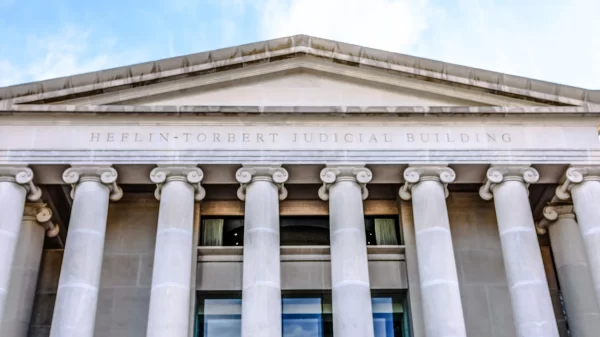
But the state took that question before the Alabama Supreme Court on Wednesday hoping that the state’s highest judicial body would have a different read on the law.
Henry Daniels, the attorney arguing on Jennings’ behalf Wednesday, told the justices that interpreting the law to allow police to demand physical identification would extend too much power to law enforcement.
“Freedom cannot thrive under the capricious demand of the state,” Daniels argued. “Entitlement to live one’s life free from unwarranted interference by law enforcement or other governmental entities is fundamental to liberty.”
The justices spent time trying to pin down whether the statute gives the police authority to ask for an ID, but Daniels argued that is not the question.
“They can ask for your drivers’ license immediately,” Daniels said. “That’s not the question; the question is whether they can demand it.”
Daniels said at times it felt like the two sides were rehashing the case in front of the justices, when the legal procedure that brought the case before the judges is more tricky.
Justices questioned Ed Haden, counsel for the city of Childersburg and the individual defendants, whether they should take into account the decision of the 11th Circuit, which found there to have been no probable cause for Jennings’ arrest.
Haden argued that the court had the final authority to interpret Alabama law.
If law enforcement does not have the power to verify that a criminal suspect has given a true name, Haden argued, it would impede officers’ ability to arrest guilty parties.
Haden used Luigi Mangione, the accused killer of a healthcare CEO, as an example, noting that Mangione gave a false name to police when confronted.
Daniels argued interpreting the statute to require presentation of an ID would burden Alabamians with having to carry their license at all times, not just when driving, or face potential arrest at the mere accusation of a crime.
The justices have taken the arguments under consideration and will provide an answer at a later date.