











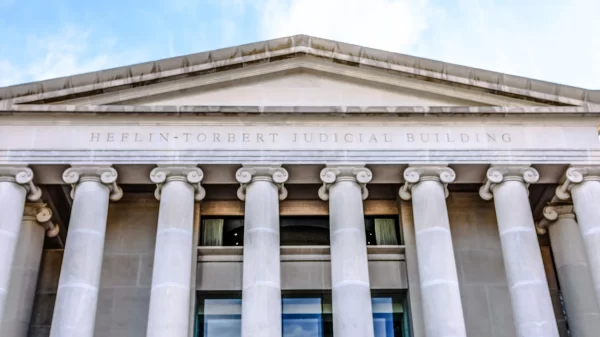







Montgomery County leaders, including commissioners and the sheriff, called a press conference on Thursday to emphasize the importance of the internet sales tax in the community.
The Association of County Commissions of Alabama is fighting to keep the tax distributed in its current form as some of the state’s biggest cities look for a bigger piece of the pie.
The state currently collects a flat 8 percent in sales tax on online purchases. Half of that is distributed out to cities and counties based on population sizes, which likely means sales tax revenue generated by online purchases made in the biggest cities are being spread around to smaller communities.
Montgomery County Sheriff Derrick Cunningham said Thursday that losing the internet sales tax funding would cut their department by 12 deputies.
“We wouldn’t be able to get nothing done,” Cunningham said. “We wouldn’t be able to catch those bad guys and girls when they go in and start breaking into homes. We wouldn’t be able to catch those that go in, use their telephones and social media to commit crimes…”
Sonny Brasfield, executive director of the ACCA, said all 67 counties in the state have intervened in a lawsuit filed by Tuscaloosa and Mountain Brook leaders challenging the tax structure.
“And I think sometimes, we look at things from only our perspective,” he said. “I think that’s a good bit of what we’re facing in this issue with SSUT. Looking at our silo and not looking at the entire state.”
The tax revenue has been a boon particularly to county general funds as the revenue comes unearmarked. Counties have little power to raise revenues, so the fast-growing tax stream has been a welcome boost.
The debate over the tax structure is further complicated by schools, which find themselves also fighting for a better deal out of the tax collection as there are currently no guarantees at a statewide level that the taxes fund school systems. Local sales taxes collected by counties often go largely to schools.