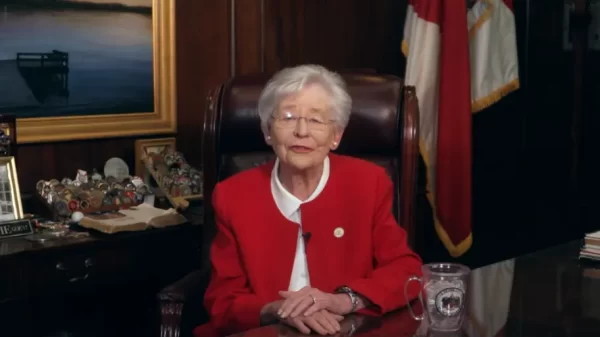




Governor Kay Ivey’s ninth and final state of the state address, the contrast between her governing style and U.S. Senator Tommy Tuberville’s political brand, and several developments shaping Alabama’s political landscape were the focus of this week’s episode of The Voice of Alabama Politics.
Hosts Bill Britt, Susan Britt and Josh Moon opened the program by discussing Ivey’s final address, framing it as a capstone to a tenure defined by stability and a calmer political environment than Alabama experienced in the years preceding her ascension to the governor’s office.
The panel noted that Ivey entered the job during a period of significant scandal and dysfunction in state politics and that her administration, despite ongoing debate over her policy choices, restored a measure of institutional credibility to the governor’s office. The discussion also revisited Ivey’s leadership during the COVID-19 pandemic, including her reliance on medical guidance at a time when public health measures were highly politicized.
Moon, an APR columnist and investigative reporter, said Ivey’s moment in history shaped how her governorship is perceived. He argued that her preference for low-profile leadership, combined with a national political climate dominated by spectacle, made her style appear steady to many Alabamians.
From there, the conversation shifted to what the panel described as a sharp contrast between Ivey and Tuberville, who is widely viewed as a leading contender in the 2026 Republican field. Britt said Ivey’s approach emphasized institutional restraint and measured public leadership, while Tuberville has built his political identity through confrontation and nationalized messaging. The panel discussed how that contrast could affect Alabama’s reputation and policy direction if the state transitions from Ivey’s reserved approach to a more combative model of leadership.
In the second segment, the panel examined protests taking place across the country and what it takes for protest movements to translate into lasting political change. The discussion referenced research often described as the “3.5 percent rule,” the idea that sustained, nonviolent resistance can pressure governments to respond once participation reaches a critical mass. The panel emphasized that successful movements typically combine moral urgency with clearly defined demands, organized leadership and strategic pressure on institutions with the authority to enact reform.
The episode then returned to Alabama politics with a discussion of the special election in House District 63, where Republican Norman Crow defeated Democrat Judith Taylor by a wide margin, but turnout was exceptionally low. Fewer than 2,000 voters participated in a district of roughly 40,000 residents. The panel described the result as a reflection of civic disengagement and structural political realities that can leave voters feeling outcomes are predetermined.
Moon said low-turnout elections often stem from both organizational failures and a political ecosystem shaped by district maps and party incentives that minimize competition, reducing accountability and weakening voter influence.
The third segment featured the return of former Alabama Agriculture Commissioner Ron Sparks, who has qualified to run again for the office he held from 2003 to 2011. The panel discussed Sparks’ name recognition, his ties to the agricultural community, and the potential impact of his candidacy in a race with significant economic implications for rural Alabama.
Finally, the show addressed legislation prefiled for the 2026 session that would loosen restrictions related to ivermectin and hydroxychloroquine. The panel discussed the continuing political debate surrounding the drugs, the role of state policy in regulating medication access and promotion, and tensions between political messaging and medical standards.
The Voice of Alabama Politics airs weekly and is available on digital platforms. The full episode can be viewed online.