



















The House State Government Committee has advanced legislation aimed at regulating the long-term environmental responsibilities of utility-scale solar developments, approving the measure after brief discussion and a public hearing that highlighted tensions between industry practices and state oversight.
House Bill 623, sponsored by Representative Chris Sells, R-Greenville, would establish a regulatory framework requiring large-scale solar projects to register with the Alabama Department of Environmental Management and meet specific standards for site restoration and financial accountability.
Sells described the bill as a “ground protection” measure designed to ensure that solar facilities are responsibly managed throughout their lifecycle, particularly when projects cease operation.
“What HB623 does is set up what I call the ground protection part of a solar farm,” Sells said. “It would require any and all utility-scale solar farm projects to register with [ADEM] and sets forth a process including bonding, decommissioning and restoring the site back to original condition.”
Under the proposal, solar developers would be required to provide financial assurances to cover the costs of dismantling infrastructure and restoring land once a project is no longer in use. The bill also authorizes ADEM to step in and decommission facilities that have not produced or sold power to the grid for at least three years.
If the agency undertakes cleanup efforts, it would be permitted to place a lien on the property to recover costs. Revenue from those liens would be deposited into a dedicated fund for future restoration projects, creating a self-sustaining mechanism for addressing abandoned or neglected sites.
The committee adopted a substitute version of the bill without objection before opening the floor to public comment.
The substitute bill shifts the focus from statewide environmental oversight to local control by authorizing county governments to regulate how and where solar farms are developed. Under the measure, counties may establish “standards, specifications, criteria, and conditions” governing the “permitting, construction, placement, or operation” of solar facilities, giving local officials authority to influence projects before they are built.
Unlike the original bill, which centers on state-issued permits and cleanup requirements after a project is underway, the substitute operates at the front end, empowering counties to decide whether large-scale solar development fits within their communities at all.
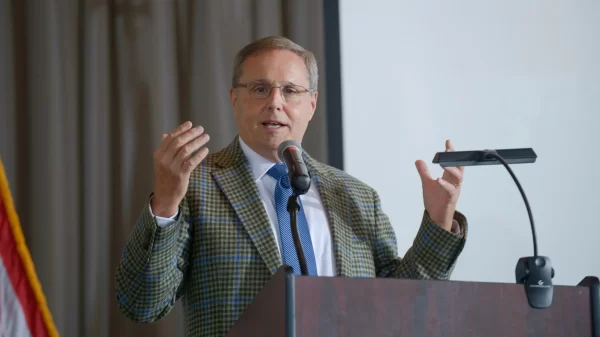
During the hearing, Sam O’Rourke, director of policy and government affairs for Silicon Ranch Corporation, voiced concern about how the legislation approaches decommissioning requirements. While acknowledging the importance of planning for worst-case scenarios, he argued that the bill could disrupt existing contractual relationships between landowners and developers.
“This presents a risk overwhelmingly borne by the landowner themselves, but in our view, that risk pales in comparison to any other parties,” O’Rourke said.
O’Rourke emphasized that in many cases, including his company’s model, the developer and landowner may be the same entity, reducing the likelihood of disputes or abandonment. He pointed to neighboring states such as Texas, Georgia, Tennessee and Mississippi, which have adopted policies requiring decommissioning terms to be embedded directly in lease agreements between private parties.
“Financial assurance should flow directly and exclusively to landowners,” O’Rourke said. “State law should provide certainty and guardrails, but also maintain a limited role that respects economic freedom and self-determination.”
He added that legislation in surrounding states has received broad bipartisan support by striking that balance, and urged Alabama lawmakers to consider similar frameworks.
Despite those concerns, committee members did not raise questions during the hearing, and the bill moved forward with a favorable report.
The bill goes back before the House, but if enacted, the bill would grant ADEM authority to implement and enforce the new requirements, including adopting rules to govern registration, financial assurances and restoration standards.