



On Wednesday, the Alabama Senate Judiciary Committee held a public hearing on Senate Bill 293 by State Senator April Weaver, R-Brierfield, legislation which would establish the crime of “interference with a first responder” as a Class A misdemeanor under Alabama law.
Weaver first introduced the bill in February following the killings of Renee Good and Alex Pretti by Immigration and Customs Enforcement, ICE, in Minnesota. In her press release announcing the legislation, Weaver attributed the unrest and violence which unfolded following Good and Pretti’s killings to those protesting ICE’s actions, with her legislation ostensibly seeking to limit protestors’ abilities to obstruct law enforcement.
Under Weaver’s bill, an individual could be charged with “interference with a first responder” if they remain within 25 feet of a first responder after being told to vacate the area and impede, threaten or touch the first responder in any manner. As a Class A misdemeanor, the crime would be punishable by up to one year in jail and a fine of up to $6,000.
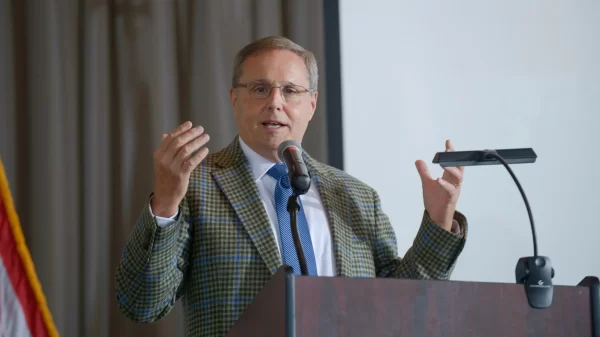
Wednesday’s public hearing featured two proponents and one opponent of the legislation. First to speak was Eric Pendley, president of the Alabama Ambulance Association.
Pendley explained that the Ambulance Association “fully supports” SB293, arguing that the legislation addresses a public safety issue facing both emergency medical service personnel and their patients.
“People start getting close and we ask them to step back and they don’t, then it can become a distraction,” Pendley told the committee. “We may push the wrong medication, may miss something that we need to do for patient care. So I think it’s a public safety issue.”
“Fire and EMS support this bill,” he added.
Following Pendley’s comments, Senator Rodger Smitherman, D-Birmingham, asked if the legislation could in any way criminalize a concerned parent who may not be calm while EMS treats their child. Pendley argued that EMS would not ask a parent to step away in such a scenario, and Senator Weaver told Smitherman that she would work with him to ensure that concerned parents would not face criminal penalties under the bill.
The other proponent to speak in favor of SB293 was Baldwin County Sheriff Huey “Hoss” Mack, who attended the hearing on behalf of the Alabama Sheriff’s Association.
“I think it’s a piece of good legislation…it is very timely in the world we live in today,” Mack said.
The sheriff went on to speak favorably of the bill’s 25-foot rule, stating that “25 feet is not an unreasonable distance for officer safety, and for all of our first responders.” He added that law enforcement is taught that an individual with a “sharp-edged weapon” can cause bodily harm to someone within 16 feet “within one to three seconds.”
Mack also argued that law enforcement and other first responders would use appropriate discretion when applying the bill’s provisions were it to become law.
“We’re talking about direct interference with a lawful action and trying to prevent things from getting out of hand,” Mack said.
Meanwhile, Camille Bennett, the founder and executive director of Project Say Something–a Florence-based nonprofit organization dedicated to confronting racial injustice–spoke against SB293, arguing that its provisions are vague, arbitrary and would violate citizens’ First Amendment rights.
“If protestors cannot hear the instruction to vacate the premises and people are still less than 25 feet away from the officer, how can the first responder accurately measure 25 feet in real-time?” Bennett asked the committee. “Will first responders carry sound amplification devices instructing protestors to stand back? What happens if not everyone hears the instructions? Will multiple people be charged with a misdemeanor that can carry up to one year of jail time?”
Bennett added that the bill’s provisions could also limit police accountability by discouraging the documentation of police brutality incidents.
“SB293 has the power to eliminate third-party recordings of crime scenes,” Bennett said. “The recordings of police incidents have been proven to contradict the reports of the officers involved. This bill would eliminate that window of accountability.”
“Citizens may feel intimidated when witnessing police brutality based on the 25-foot rule, which is an arbitrary number left up to the discretion of the officer,” she added.
Bennett also argued that SB293 does not account for the impact that mental health crises or physical disabilities could have on an individual’s ability to understand or comply with an officer’s order to vacate.
“If a person is experiencing a mental health crisis at a potential crime scene or governmental function, their impairment and inability to interpret the language may lead to an unwarranted punishment,” Bennett told the committee. “If someone has a disability that impairs or severely limits their ability to interpret a command to leave an area and create an arbitrary space between themselves and the public service, will they be punished?”
Bennett concluded by arguing that Weaver’s bill does not actually provide first responders with additional protections and instead limits citizens’ First Amendment rights.
“If the intent of SB293 is to protect first responders in the line of duty and the law already exists, why do we have more vague and restrictive language?” Bennett asked. “If SB293 is meant to expand the current code to protect public service, their protection cannot disregard the First Amendment rights of the citizen.”
While the committee did not vote on SB293 following the public hearing, they did approve an amendment that would exempt “news-gathering activities from bonafide news organizations” from incurring penalties under the legislation.
The Senate Judiciary Committee will vote on whether to advance SB293 at a later date.