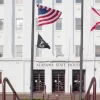




A bill requiring public schools to display a poster or framed copy of the Ten Commandments in historical settings in classrooms passed following a debate in the House Judiciary Committee, reviving a proposal that stalled during the previous legislative session.
House Bill 216, introduced by Representative Mark Gidley, R-Hokes Bluff, was considered by the legislature last session, but only passed the House. The primary difference between Gidley’s legislation last year and this year is the exclusion of the requirement for public universities to display the Ten Commandments.
The bill still requires the display to be posted in a common area like a cafeteria or library. The requirement would not apply to schools that serve only students in kindergarten through fourth grade.
Gidley said the display, which the bill specifies must be a minimum of 11 inches by 14 inches, includes the Ten Commandments alongside references to historical documents he said influenced the nation’s founding.
The poster includes the Ten Commandments alongside text referencing historical documents, including the Alabama Constitution, the Declaration of Independence, the U.S. Constitution, the Mayflower Compact and the Northwest Ordinance.
The legislation specifies that the displays must be funded through private donations, meaning schools would not be required to use public funds to comply with the mandate.
HB216 was considered by the House Education Policy Committee and received a favorable report.
Gidley stated the Ten Commandments should be displayed in schools as part of a broader understanding of the foundations of American law and government. They contend the bill is designed to present the text in an educational context rather than a religious one, particularly by placing it in history classrooms.
“This is strictly a historical reference to remind our students of one of the documents that was one of the foundational principles of the founding of this country,” Gidley said.
Representative Patrice McClammy, D-Montgomery, raised concerns, saying the proposal reflects a broader pattern of pushing Christianity into public school settings.
“I still have a problem because it feels like we’re continuously, especially over the last two years, trying to force the Ten Commandments and Christianity on students, no matter what their religion may be,” McClammy said.
“I wish we could pay more attention to the things we’re taking out of the classroom that are part of our history. I’ll just be frank — Black history. We tend to find out we shouldn’t discuss how the history of people who look like me came about, that it’s too much for students,” McClammy said.
In 2018, voters approved Amendment 942, allowing the display of the Ten Commandments on public property, though that measure did not require schools or other entities to post them.
If enacted, HB216 would require local school systems to work with state education officials to ensure compliance, including determining appropriate display formats and placement. Schools would need to coordinate how and where the displays are posted to meet the bill’s requirements.
The bill now awaits further consideration by the full House.