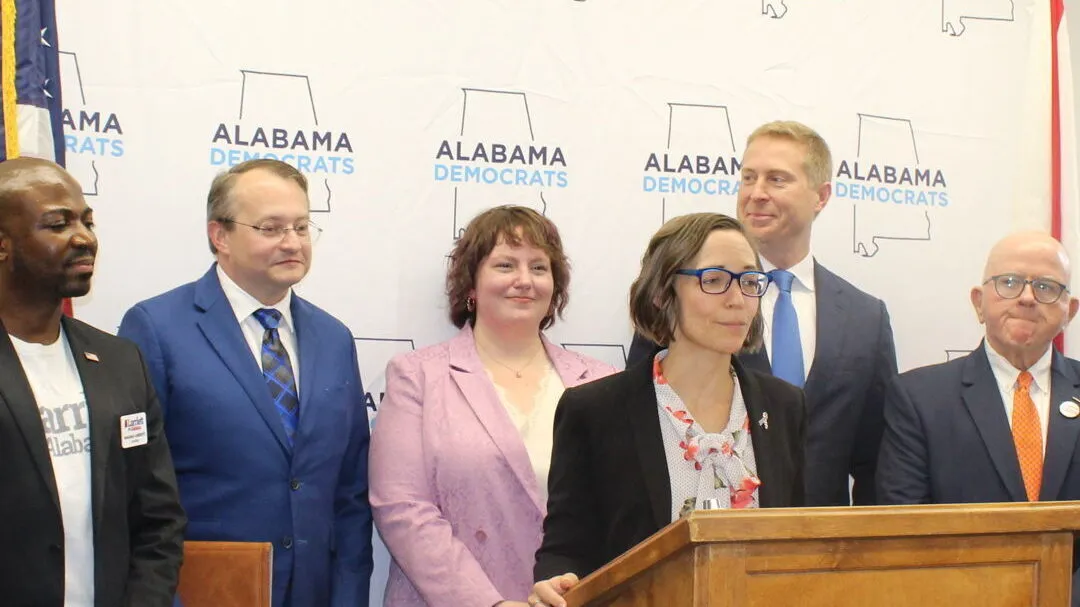





Democratic congressional challengers from across the nation gathered on the U.S. Capitol steps on Wednesday, pledging their support for an Alabama-led push for legislative and judicial reform.
Balance and Accountability Candidates is a coalition of 70 U.S. House and Senate candidates from 35 states who have pledged their support for a five-point policy outline aimed at promoting congressional ethics reforms and judicial accountability.
The initiative, founded by Andrew Sneed, a candidate for the Alabama 5th Congressional District, officially launched at a D.C. event, where 18 BAC signatories stood in support of the coalition.
BAC’s key commitments are 12-year congressional term limits, a ban on congressional stock trading, a five-year moratorium on members of Congress becoming lobbyists after leaving office, overturning the U.S. Supreme Court’s Citizens United v. FEC ruling and establishing an enforceable code of ethics for the Supreme Court.
“This movement is built on fixing what is deeply broken. No matter how well intentioned, career politicians combined with unchecked corporate money and lobbying has corroded our system,” Sneed said during the event. “We have to be able to trust justice. It is a sacred trust that has to be rebuilt. So, this coalition has come together from across the country.”
“We want the party to understand that we have to talk about this. We are all proud Democrats, and we have solutions, we have policy solutions for the affordability crisis, and the healthcare crisis and the crisis of the attack on women’s health,” the candidate added. “We have solutions, but we have to be able to resolve the issues of trust to re-earn the trust of the American people to bring those solutions to bear.”
Additional candidates who spoke at the Capitol included Ceretta Smith of Georgia, Julian Beaudion of South Dakota, Michael Masuda of California, Mary Allen of Indiana, Cyril Jefferson of North Carolina and Evan Hunt of Texas.
Following the event, Sneed, who is currently vying for the Democratic nomination for District 5, told APR that he expects the coalition to grow to 100 candidates before Alabama’s primaries and 200 by the general election.
The congressional hopeful explained that while BAC is currently attempting to rally support from Democrats, once members begin winning their respective elections, the coalition will begin exploring bipartisan proposals to address its policy priorities.
“Our goal is to get the national party to recognize that we have, I would go so far as to say, a responsibility to address these things as a party,” Sneed said.
The candidate emphasized that while signatories are currently focused on winning their primary and general elections, the ultimate goal of BAC is to explore avenues for promoting its policy priorities.
“We’re not trying to major on the minor right now,” he said. “I think that once we get through Congress, what we have is an unequivocal pledge to fight for these things, the way the specific avenues in which we make the find the legal theories and the ways to write this legislation can be worked out when we have congressional coalitions.”
“Let’s say ten of us won our elections. So those ten of us, or if it’s five of us, or if it’s 20 of us, will form a caucus,” Sneed continued. “You will have a balance and accountability caucus. As soon as we get in, we will open it up to be bipartisan.”
The initiative has also formed a PAC with the goal of raising money to support members’ campaigns.
“Some of these folks haven’t been able to raise money in a way that we can,” Sneed said. “Our goal is to grow this movement and invest in these candidates that are, again, I use the word unequivocally, pledged to getting this done. You want to see this change? Support these candidates because they mean it.”
BAC counts three additional Alabama congressional challengers among its ranks: 1st Congressional District candidate Clyde Jones, 3rd Congressional District candidate Lee McInnis and 4th Congressional District candidate Amanda Pusczek.
Jones, who has secured the Democratic nomination for District 1 and appeared on the Capitol steps for BAC’s launch, expressed satisfaction that candidates from across the country were able to connect with one another and share a unified message in support of congressional and judicial reform.
“It was good to be able to share policy ideas, to be able to share talking points, discuss fundraising opportunities,” said Jones. “We’re in it to win, right? We’re in, and there’s so many people who are ready for a change that I think we have a great opportunity.”
“We see far too often that people make a career out of being a politician, and then they kind of forget their constituents,” Jones said when asked to describe the importance of the coalition.
“We shouldn’t be obligated to any corporation; we should be obligated to the people of the district who you represent,” he remarked. “There’s no way that we should be making legislation or passing legislation that benefits companies that we’re investing in.”
Both Jones and Sneed described BAC’s stance in favor of a code of ethics for the Supreme Court as a commonsense measure to ensure judicial accountability and fairness.
“You would think that was something that didn’t have to be talked about, but obviously, we see that is something that’s needed now,” Jones said.
“If a municipal judge took a bribe, if we can call it that, they could be thrown off the bench, they could be prosecuted, there is legal recourse,” Sneed said, pointing to public scrutiny surrounding Supreme Court Justice Clarence Thomas’s acceptance of a more than $200,000 loan from health insurance executive Anthony Welters to purchase a luxury RV.
“It is insane that the arbiters of the Constitution, the ultimate arbiters of the Constitution here in the United States, don’t have an enforceable code of ethics,” he added.
Sneed argued the importance of exploring “different avenues” for enacting BAC’s policy priorities, highlighting a Montana ballot initiative aimed at prohibiting corporate entities from spending money to influence elections as “leading the way” in legislative attempts to counteract the Supreme Court’s ruling in Citizens United and curb corporate influence in politics.
The candidate went on to express hope that BAC members will eventually be able to pass constitutional amendments in line with the initiative’s policy objectives.
“I don’t shy away from saying that out loud,” Sneed said.
“If we can’t pass amendments in the wake of 2026 and what’s happened with this administration and where we’re at in American politics, this state of division, then maybe we don’t deserve to keep our democracy,” he continued. “I think that anything less than that is falling short.”
Alabama’s 2026 primary elections will take place on May 19. The general election is on November 3.