











There is a polite fiction that still lingers in Alabama politics—that because sports betting isn’t legal, it isn’t happening.
That fiction does not survive contact with reality.
After years of debate inside the State House, one thing is clear: Alabama does not lack gambling. It lacks control over it.
The gap between law and reality is no longer theoretical. It is operational.
That reality is playing out every day—quietly, digitally and largely outside the reach of state law.
A market that already exists
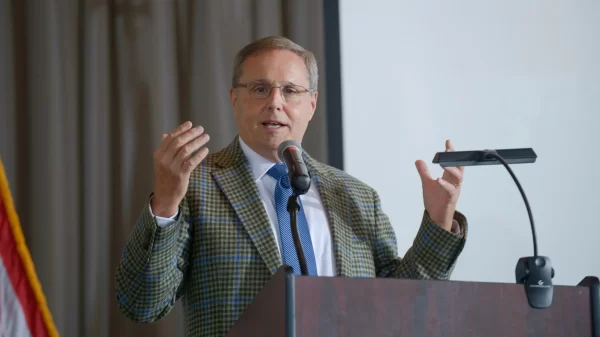
Joe Maloney, president and CEO of the Sports Betting Alliance, says the starting point for any honest discussion is acknowledging what is already happening.
“Gambling is taking place,” Maloney said. “The question is whether the state chooses to acknowledge it.”
According to Maloney, Alabama’s current sports betting environment is not defined by absence—but by fragmentation.
Some activity still runs through traditional bookmakers—individuals operating informally, often extending credit and collecting losses outside any legal framework.
But the larger share now exists online.
Offshore sportsbooks, many based in jurisdictions such as Curaçao or Costa Rica, operate polished, professional platforms designed to attract U.S. users. These sites often target states like Alabama, where there is no legal alternative.
“They heavily advertise in jurisdictions where it’s not legal,” Maloney said, noting those same operators rarely compete in states with regulated markets.
Some of the most widely used offshore platforms—such as Bovada and MyBookie—operate outside U.S. jurisdiction while presenting themselves as accessible alternatives for American bettors.
These sites often accept U.S. customers despite lacking authorization at the state level, creating a system where users have little visibility into how bets are handled, how outcomes are settled or how disputes are resolved.
Alongside them are unregulated “sweepstakes” platforms—systems that mirror traditional betting while operating under promotional or gaming loopholes. Platforms such as Fliff and Rebet allow users to accumulate virtual currency before converting activity into real financial transactions.
“These are products that often rely on minimal age verification,” Maloney said. “In some cases, it’s little more than clicking a box.”
Because many of these platforms operate at an 18+ threshold—or rely on self-reported age—they exist in a space that can be more accessible to younger users than traditional regulated sportsbooks.
A newer entrant has added another layer.
Federally regulated prediction market platforms, operating under the Commodity Futures Trading Commission, allow users to trade contracts tied to the outcome of events—including sports. While structured differently, the overwhelming majority of activity on those platforms is tied to sporting events.
Together, these systems form a functioning market—one that operates regardless of Alabama law, and entirely outside its control.
Little protection for consumers
The absence of regulation does not stop the activity. It removes the guardrails around it.
In Alabama’s current environment, there is no uniform system to verify age, protect user data or ensure that winnings are paid.
“If you don’t get paid, there’s no one to call,” Maloney said. “These operators answer to no one.”
In regulated markets, operators are required to meet strict compliance standards, including independent audits, identity verification, geolocation controls, and financial accountability measures designed to ensure wagers are honored and systems operate fairly.
Those requirements do not apply in offshore or unregulated environments, where oversight is limited or nonexistent.
In Alabama’s current system, those assurances simply don’t exist.
That lack of oversight extends beyond financial risk.
There are no mandated responsible gaming tools—no limits, no monitoring of problematic behavior, and no structured pathways to intervention for those developing gambling-related issues.
Legal markets, by contrast, require operators to implement identity verification, enforce age restrictions—typically 21 and older—and provide tools designed to detect and address harmful patterns of play.
“In unregulated settings, those safeguards simply aren’t there,” Maloney said.
Revenue flowing elsewhere
While consumers navigate that risk, the financial impact on the state is more straightforward.
Alabama collects no tax revenue from sports betting.
Maloney estimates that, if legalized and regulated, sports wagering could generate tens of millions of dollars annually for the state, depending on how a system is structured.
Since the U.S. Supreme Court struck down the federal prohibition on sports betting in 2018, more than 30 states have established legal markets.
Alabama has not.
“You’re not inventing the activity,” Maloney said. “You’re deciding whether to regulate it and tax it.”
As it stands, the revenue tied to Alabama-based betting flows to offshore operators, unregulated platforms and entities beyond the reach of state enforcement.
A decision that remains unresolved
Under Alabama law, legalizing sports betting would require a constitutional amendment—meaning lawmakers must first approve legislation to allow voters to decide the issue.
That step has repeatedly stalled.
For more than a decade, efforts to create a comprehensive gaming framework in Alabama have collapsed under competing interests, internal divisions and shifting political priorities.
The result is a status quo where the activity continues—but the state remains on the outside of it.
That gap has persisted even as neighboring states have moved forward with regulated systems.
For years, state leaders, including Governor Kay Ivey, have indicated support for allowing voters to weigh in. But no proposal has successfully cleared the Legislature.
Maloney declined to speculate on political dynamics or outside influence, focusing instead on what he described as a consistent principle across other states.
“It’s about giving voters a voice,” he said. “That’s where this starts.”
Concerns remain
Opposition to gambling expansion in Alabama has been consistent and organized.
Groups such as Alabama Farmers Federation and Alabama Citizens Action Program have long argued that expanding legalized gambling would bring increased addiction, financial harm and broader social consequences.
They have also raised concerns about the long-term reliability of gambling revenue as a funding source.
Those concerns have played a significant role in shaping the debate inside the Legislature—and in slowing efforts to establish a legal framework.
At the same time, the absence of that framework has not prevented gambling activity—it has simply shifted it outside the reach of the state.
Growth without oversight
The broader trend is not in dispute.
Sports betting in the United States has shifted almost entirely to digital platforms. More than 90 percent of legal wagers are placed online, reflecting both consumer behavior and the structure of modern markets.
“It’s about consumer trust,” Maloney said. “People engage when they know it’s regulated.”
In Alabama, that trust gap remains.
The market is active. The technology is accessible. The demand is established.
What is missing is the framework to govern it.
The question facing Alabama
The state is not deciding whether sports betting exists.
That decision has already been made—by consumers, by technology and by a marketplace operating beyond state control.
What remains unresolved is whether Alabama will continue to allow that system to function without oversight—or move to regulate it, tax it and place it within a structure designed to protect the public.
Until then, the system in place remains: Active. Unregulated. And beyond the reach of the state.