


















The Alabama Attorney General’s Office has issued a cease-and-desist letter for businesses selling certain products found to contain kratom.
Kratom, a plant originating in Southeast Asia that acts as a stimulant in low doses and a sedative in higher doses, was made a Schedule I narcotic by the Alabama legislature, alongside its derivatives, in 2016.
The product and its derivatives are commonly sold in legal states at gas stations, vape shops and convenience stores as capsules or extracts. The Attorney General’s Office, on Tuesday, urged retailers to immediately cease selling and carrying certain products found to contain mitragynine, kratom’s primary psychoactive alkaloid, alongside hydroxymitragynine, a concentrated byproduct alkaloid derived from the plant with a higher potency due to the stronger binds it forms with opioid receptors.
The products cited by the attorney general are all 15- or 30-milliliter liquid shots sold as wellness supplements under the names “Boujee Bliss,” “Better Weather” and “Happy Hour.”
None of the products lists kratom in their active ingredients; however, the Attorney General reported that all were found to contain kratom alkaloids by an independent lab test.
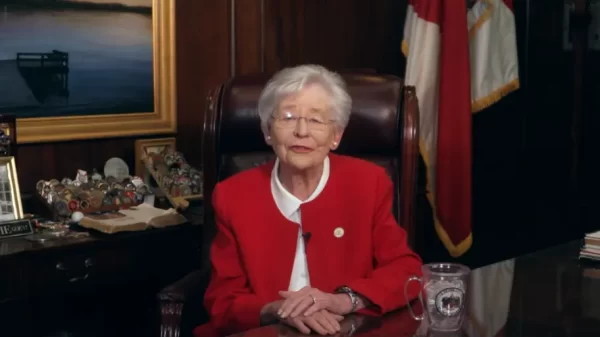
“These products prey on unsuspecting consumers, including children, who have no way of knowing what they are purchasing,” Alabama Attorney General Steve Marshall said on Wednesday.
“We are putting every retailer on notice that they need to remove these products immediately. Those who choose to ignore this order will face the full force of the law, including seizure of assets and felony prosecution,” the attorney general added.
In the AG office letter, Alabama Deputy Attorney General John L. Kachelman III threatened seizure and forfeiture of products containing kratom alkaloids, alongside prosecution for the sale and transportation of products and for violations of Alabama’s Deceptive Trade Practices Act.
“It is important to note, some of these products may not list these substances as ingredients, and the product labeling may not include all ingredients for consumers,” the cease-and-desist letter reads. “Nevertheless, if a product contains these controlled substances, they are illegal to possess or sell in the State of Alabama, regardless of whether you have knowledge of their illegality.”
“The laws of this state will be enforced, and we will not allow these dangerous products in our communities,” the letter continued.
Kachelman wrote that the Attorney General’s Office will work alongside local district attorneys and law enforcement agencies in order to “expel these illegal products” from the state.
As of January 2026, 30 U.S. states and the District of Columbia regulate kratom, and the plant has been fully banned in a total of seven states.
Alongside state legislation restricting kratom and its alkaloids, 7-hydroxymitragynine, commonly known as 7-OH, has drawn scrutiny from the U.S. Food and Drug Administration, which has warned consumers of the drug’s risk for addiction.
Last year, the administration issued warning letters to companies found to have illegally shipped the product, alongside notices to healthcare professionals and consumers warning of its risks.
The drug has not yet been scheduled by the U.S. Drug Enforcement Agency. The FDA has recommended scheduling “to control” access to the drug, which they wrote “is increasingly recognized as having potential for abuse because of its ability to bind to opioid receptors.”
The Attorney General’s Office urged businesses with questions regarding compliance with the cease-and-desist letter to contact the office via email at [email protected].