








During its inaugural press conference, representatives of the U.S. Campaign to End the Death Penalty highlighted the uptick of executions in the South and the growth of public sentiment against the death penalty.
The new initiative, which hosted a digital launch event on Wednesday, consists of more than 50 partner organizations, including Alabama Arise and the Alabama Post-Conviction Relief Project.
Campaign to End the Death Penalty Executive Director Laura Porter argued the campaign’s formation comes during a growing divide between public support and policy surrounding capital punishment.
“In this moment, we see a very clear disconnect between the handful of politicians pushing for more executions in the expansion of the death penalty, and current public sentiment on this issue,” Porter said.
“We want to make sure policymakers know the country is moving away from the death penalty,” she continued. “The surge in executions and efforts to expand the death penalty are out of touch with the views of Americans.”
Porter pointed to the 2025 results of Gallup’s yearly poll conducted on public support for the death penalty.
The poll found that U.S. public support for capital punishment has been steadily declining since it reached an all-time high of 80 percent in 1994.
Gallup reported that 52 percent of Americans polled were in favor of the death penalty for those convicted of murder, a 50-year low, while opposition to the death penalty for murderers reached a 50-year high of 44 percent.
New death sentences also reached a low in 2025, with juries sentencing fewer than 30 inmates to death nationwide.
“There’s no greater indicator of how Americans feel about the death penalty than in the jury room, and juries are sending very few people to death row,” Porter said. “We will build on the continuing trend away from the death penalty jurisdiction by jurisdiction, until our country lets go of the death penalty once and for all.”
“We are confident that the American public is growing more and more aware of the problems with the death penalty,” said Witness to Innocence Executive Director Herman Lindsey, who served three years on death row in Florida for a murder he did not commit.
“By working collectively with 50-plus organizations around the country, through the US Campaign to End the Death Penalty, we have an opportunity to expose the death penalty’s flaws and highlight the problems of wrongful convictions,” he added.
Additional coalition members who spoke during the Monday launch event consisted of: American Catholic religious sister, activist and author of “Dead Man Walking” Sister Helen Prejean, Co-founder and special counsel for the Innocence Project Barry Scheck, Brooklyn School of Law professor Dr. Alexis Hoag-Fordjour, Promise of Justice Initiative Executive Director and attorney Samantha Kennedy and founder of Conservatives Concerned Demetrius Minor.
Panelists raised concerns surrounding the growth of public opposition to the death penalty coinciding with an uptick in executions in Southern states and outspoken support for capital punishment from the Trump administration.
Florida has led the nation this year in the number of state-conducted executions, with 17 inmates being put to death in the state so far in 2025, compared to just one last year.
Out of the 10 additional states that have conducted executions in 2025, Alabama, Texas and South Carolina tie for the second most prisoners executed, with each putting five inmates to death.
Alabama also led the nation in executions last year, conducting six, a fact that was publicly celebrated by state Attorney General Steve Marshall.
Alabama’s execution rates in 2024 and 2025 mark a ten-year peak for the state, with annual executions reaching their highest point since 2011. On average, Alabama has conducted two executions per year since 2000.
Kennedy argued the increase in executions in states such as Florida and Alabama is the result, not resulting from increased public support for capital punishment, but as “a reckless political tool of violent and weak politicians.”
“The public isn’t clamoring for murder done by its government,” she said. “The public isn’t clamoring for political gamesmanship and pleasing our president with murder.”
Hoag-Fordjour added that the Trump administration’s outspoken support for capital punishment has helped spur a surge in executions concentrated in the South.
“Part of the uptick, recent uptick, is that the current administration has really normalized the use of the death penalty and carrying out executions in a way that we haven’t seen,” she said. “It’s created a climate that in states that have been long dormant, that it is now okay to move forward and steamroll through the post-conviction review process and secure an actual execution from a long-ago death sentence.”
In January, U.S. President Donald Trump signed the executive order, “Restoring the Death Penalty and Protecting Public Safety,” which tasked the U.S. attorney general with encouraging state attorneys general to pursue the death penalty “for all crimes of a severity demanding its use,” and seeking the overrule of Supreme Court precedents “that hinder capital punishment.”
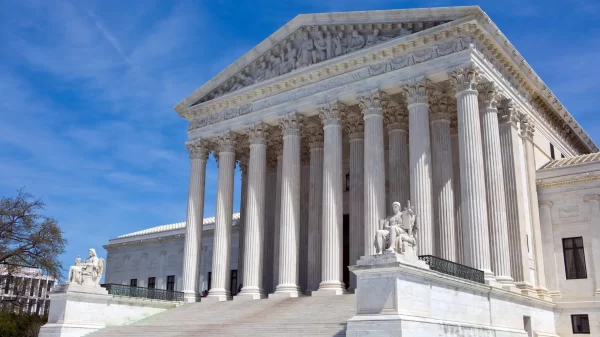
The order was cited in an October letter signed by a coalition of Republican attorneys general, including Marshall, which called for the use of capital punishment in child rape cases and the repeal of Kennedy v. Louisiana, a U.S. Supreme Court decision that struck down capital punishment for offenses that do not result in a death.
Panelists went on to discuss the emergence of nitrogen hypoxia as means of execution. Alabama became the first U.S. state to execute an inmate through nitrogen hypoxia in January of 2024 and has since put six inmates to death using the method.
Nitrogen hypoxia was adopted as an alternate method of capital punishment in Alabama in 2018. Inmates killed by the method were given the chance to do so during a one-month period in 2018. At that time, no U.S. state or foreign government had officially tested it as a means of killing a human.
“The last Alabama execution took 15 minutes, was clearly torturous from reading the witness accounts of the media who attended,” Porter said.
Prejean argued that the new execution method exposed issues inherent to “humanely” putting inmates to death.
She explained that nitrogen executions, which have been criticized as a lengthy and cruel means of putting someone to death, began seeing adoption after European manufacturers of chemicals used for lethal injections began backing out of contracts with U.S. states, following increased concern surrounding the humaneness of the method.
“We have been trying and trying to show that we can do the killing of a conscious, imaginative human being in a humane way, and it is impossible,” Prejean continued.
Prejean and Minor also spoke on their work pushing for public opposition to the death penalty from conservative and faith-based organizations and leaders.
“More and more conservatives across the country are questioning the death penalty and advocating for change,” Minor said. “Many of our allies come to the death penalty dialog from a pro-life perspective and awareness of big government programs and government overreach.”
Minor described state-level campaigns against planned executions, conducted by Conservatives Concerned, including against the planned death sentence of Alabama inmate David Lee Roberts, which was stayed in July.
He also emphasized the importance of bipartisan support when pursuing state legislation to repeal the death penalty.
“Every successful repeal of the death penalty in the last 20 years has included support from pro-life, Republican legislators,” he added. “We expect much more of that in the years to come.”
Prejean, meanwhile, highlighted that, although the Catholic Church has been historically in support of capital punishment for centuries, Catholic and Christian advocates’ work against the death penalty helped lead to the church publicly opposing the policy in 2018.
“There’s a great Psalm that says, ‘truth springs up from the ground, and it springs up from the experience of people.’ And that began to happen in the Catholic Church,” Prejean said. “The Catechism of the Catholic Church—those are words printed on a page. To bring those words and to set them on fire in the hearts of people is what it’s all about.”