
















Alabama’s a weird place, man.
If you ever doubt it, try putting together a top stories list from the previous year. You will find oddities and weirdness run rampant. Not just this year, but every year.
The names and faces change. Time moves on, even with so many in this state pulling against it. But the weirdness seems to always remain.
Here are APR’s Top 5 stories from 2025.
A Wild Governor’s Pre-Race
It’s weird to think about, but the Alabama governor’s race hasn’t actually started yet. At least, not officially. And yet, the lead up to it, with a whole bunch of moving and shaking—most of it rather surprising—has been a show that’s captured the attention of the state.
It started, as political stories often do, with quiet rumors about a sitting U.S. senator potentially looking for a way out of D.C. and possibly eyeing the governor’s mansion. APR first reported on that possibility in Sept. 2024. It was all rumor and speculation at that point, but still, the talk was out there.
Lieutenant Governor Will Ainsworth, however, was still the frontrunner, and many believed—and still believe—that he could give Tuberville a solid run. In fact, many consultants predicted that Ainsworth would best Tuberville in the GOP primary, thanks in large part to Tuberville’s extremely high unfavorables in polling. Either you like Tuberville or you don’t, and a whole bunch of people around this state really, really don’t like him.
Nevertheless, he had name recognition out the wazoo and that was enough to chase Ainsworth off for now. (And possibly to the U.S. Senate seat vacated by Tuberville, if current rumors are accurate.) With no other viable candidate in the race on the GOP side, that would seem to set up essentially a coronation for Tuberville. Except … we don’t do those around here.
Two things have thrown a monkey wrench into the whole thing: Tuberville’s residency and Doug Jones.
Reporting by APR and other outlets around the state have pretty well proven that Tuberville does not meet the state’s residency requirements for running for governor—living here the seven years prior to the general election. Travel records, property records and basic common sense have all shown that Tuberville resides in a multi-million dollar beach home in Florida. That has left many speculating, including many Republicans, that Tuberville could face a real problem in the courts should a residency challenge be filed. One will be.
Even if Tuberville survives the residency challenge—or runs out the clock until he becomes governor and then figures out a way to kill the challenge—he won’t be facing the cakewalk that was expected. Instead, Jones, possibly the only Democratic candidate who could challenge for governor, is now in the race. And all of a sudden, Tuberville has some work to do.
Can Jones overcome long odds and pull off another shocking upset? Clearly, he faces an uphill battle. But on the other hand, you’ve got the most unpopular candidate for governor in modern Alabama history, a whole bunch of questions about residency, veterans charities, stock trades and other actions, and a lot of business leaders who would prefer a serious, stable person in the governor’s mansion. We’ll see.
Attorney General For Sale
Someone is trying to buy the Alabama attorney general’s office. And they’re doing so by way of Katherine Robertson.
Just who is trying to buy the AG’s office isn’t crystal clear. While we have a suspect or two in mind, the true culprit(s) is hidden behind a veil of dark money—money masked by a 501(c)(4) nonprofit and a gigantic hole in Alabama’s campaign finance laws.
Through that hole, more than $1.3 million has flowed from shady nonprofits—one of which was registered just a few days prior to a $150,000 donation to Robertson—from mysterious sources and into the campaign accounts of Robertson. APR’s reporting on this issue landed at the feet of Leonard Leo, a billionaire conservative donor who was the architect of the current Supreme Court.
Leo has a goal of reshaping the American judiciary into a partisan, Christian nationalist group that will ignore the constitution and all precedent—as the high court did when overturning the Roe decision—to achieve its goals. Part of the plan involves buying states’ attorneys general.
Regardless of the intent of that plan, however, the reality—that an outside entity with deep pockets could essentially buy Alabama’s top law enforcement official—should be enough to force state lawmakers to revamp our campaign finance laws.
The Hemp Is Gone
It was supposed to be a piece of legislation that merely regulated and properly taxed hemp products being sold around Alabama. Lawmakers, led by state Representative Andy Whitt, said they wanted only to ensure the hemp products, which have been growing rapidly in popularity with people of all ages and all walks of life, were kept out of the hands of kids and were manufactured responsibly. But for those who were relying on the products to take the place of medical marijuana—which the state still hasn’t managed, after five years, to get to patients—and those adults who used the products responsibly, there would be no concerns, they said.
They lied.
Instead, what emerged from the Legislature, basically out of the dark, was a cobbled together bill that was a gift to the alcoholic beverage industry. It annihilated the hemp industry, making it all but impossible to sell vapes and other popular products and placing such stringent restrictions on sellers and producers that any profit margins vanished. And the stores went with them.
The legislation tanked hundreds of Alabama businesses overnight, bankrupting some people who had done everything right and followed every law up until that moment. And it did so without the slightest warning.
It is likely the single most devastating piece of legislation for small businesses in the state in modern history.
The Day Diversity Died
Somehow, just a few years after pretty much all of America admitted that we had engaged in terrible racism, bigotry and unfairness and needed to do better, we decided in 2025 that the real problem in this country was all the diversity, equity and inclusion. Alabama’s GOP-led Legislature jumped at the chance to make sure white people no longer felt urged to be decent to those who look or believe differently.
It came in the form of legislation that made DEI programs at state-funded institutions illegal. That included on college campuses, where such programs often committed the mortal sin of making minority students feel more welcome and ensuring that their concerns were addressed. At state universities, offices of diversity and inclusion were closed, and programs that assisted minority students were either disbanded or shifted to other offices.
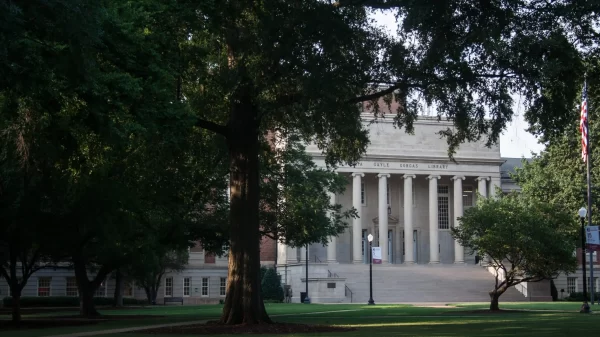
On the University of Alabama campus, officials used the cover of Trump’s anti-DEI push to close two magazines—one which gave voice to Black students and another that focused on women’s issues.
Those moves, along with others at campuses across the state, have prompted harsh pushback from students and supporters. And they’ve also brought lawsuits, which are still working their way through the court system.
A Space Odyssey
It was here. Then it was gone. Then it was maybe coming back. Then it wasn’t. Then there were studies. And now, it’s back … it seems like for good.
Space Command is located in Huntsville. Officially.
The move was made by the Trump administration, and to be quite fair, it should have been. The repeated studies of the issue consistently found that Huntsville was a far better option for the new program, saving taxpayers billions of dollars and allowing for more rapid expansion of the program.
But politics, and Trump’s usual brand of brash stupidity, intervened.
Former President Joe Biden had kept Space Command in Colorado in large part because he was concerned about Alabama’s abortion laws affecting the medical care female members of the Command would receive if stationed in Alabama. There was also the matter of Sen. Tommy Tuberville blocking military promotions and angering thousands of troops.
Trump didn’t help matters by the manner in which he moved Space Command originally to Huntsville, making it seem as if the move was purely political and based upon Alabama’s voters choosing him in the 2016 election. That made it very easy to keep injecting politics into the equation, and for Biden to seek to leave the Command in Colorado.
But to Biden’s credit, he also followed proper protocol and had independent reviews conducted to determine the best, most cost effective location for it. And each time, Huntsville came out on top.


