














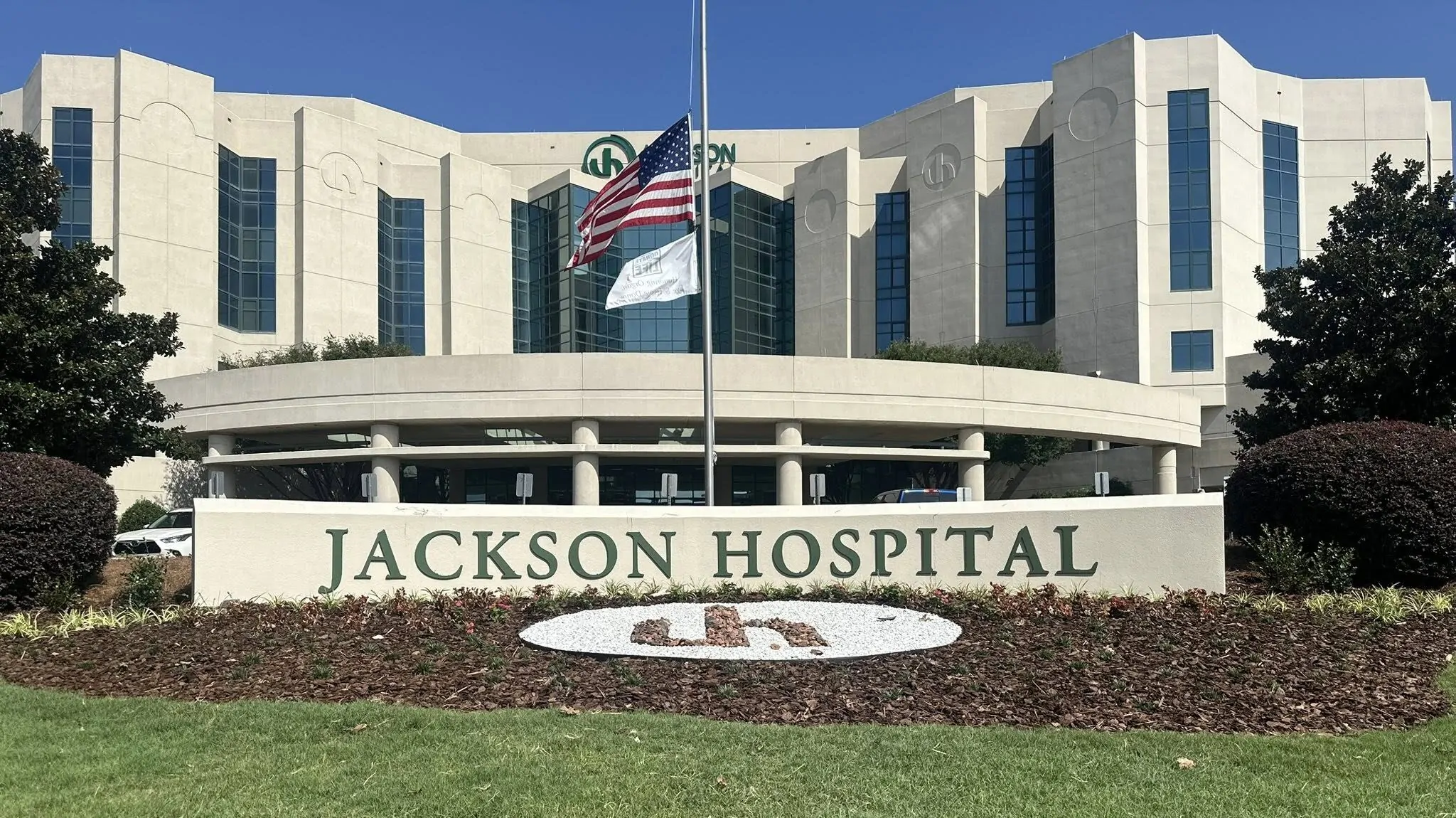
The political fight over Jackson Hospital’s bailout has now turned personal.
At Monday’s Montgomery County Commission meeting, Commissioner Dan Harris said critics angry over his position on additional county funding for the financially troubled hospital not only targeted him publicly—they also threatened his family at home.
Jackson Hospital is navigating deep financial trouble and debt restructuring, and hospital leaders have sought matched local and state bailout funding to stabilize operations. The city has already committed millions in funding, while the county debate has been contentious, with commissioners insisting on oversight and accountability.
Harris said he had “never experienced the level of misinformation and lies and threats and all craziness” surrounding his vote on the additional $7.5 million in county support for Jackson Hospital. Some opponents, he said, went so far as to “call my house and threaten me and my family.”
Even as billboards accused him of voting to “kill Jackson Hospital,” Harris said the pressure campaign “had absolutely no effect” on his decision-making. He insisted he has “always supported Jackson Hospital,” but only “under the terms of the first $10 million that we put forth,” emphasizing his concern for financial oversight and accountability.
The remarks came as the Commission wrestled with two high-stakes questions at once: how to structure additional funding for Jackson Hospital, which is working through bankruptcy restructuring, and whether to cap growth in the one-cent education sales tax that supports Montgomery Public Schools.
Several educators warned that limiting that revenue would harm students just as the system is gaining momentum.
Montgomery Public Schools Superintendent Dr. Zickeyous Byrd told commissioners that “education is not separate from economic development; education is economic development,” arguing that removing revenue from classrooms is not a neutral shift in policy. “Anytime funding is limited or withheld,” Byrd said, “that is not a bonus—that is a cut.”
School Board President Pamela Portis added that “opportunity is fragile, and the moment matters,” urging the Commission to protect school funding rather than freeze it while costs continue to rise. She said history should reflect that the Commission “chose children over short-term investments.”
Commission Chairman Doug Singleton floated a proposal to guarantee MPS the first $41 million annually in sales-tax revenue—matching 2025 levels—while allowing the county to capture any future growth. He described the setup as “stable funding,” though school leaders declined to accept a permanent freeze and asked for further talks.
Meanwhile, District 2 Commissioner Carmen Moore-Zeigler said the political climate surrounding Jackson Hospital and school funding has veered toward hostility that is out of step with Montgomery’s civil-rights legacy. She said the city has “forgotten brotherhood and love,” and questioned, “Why you coming for somebody’s house? Why you coming for somebody’s family?”
District 3 Commissioner Justin Castanza echoed concerns about the escalating rhetoric, while Commissioner Isaiah Sankey—who also faced public backlash—said his earlier opposition to prior bailout terms had been guided by fiscal oversight, not opposition to healthcare. He said he intends to remain “a good steward of the money that we get from the taxpayers,” and that many constituents told him to “stand my ground” once they heard the facts.
The Commission ultimately approved $7.5 million more for Jackson Hospital, structured over three years, while delaying action on the school sales-tax proposal.
But Harris’ comments made one reality clear: what began as a policy debate over hospital survival and public revenue has now moved beyond the walls of government—and into the private lives of elected officials.