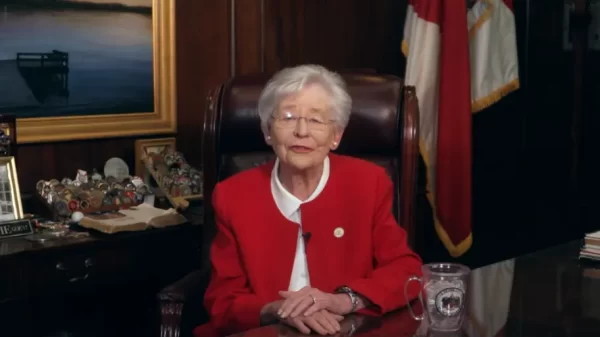











The Alabama House Agriculture and Forestry Committee held a public hearing on Senate Bill 71, introduced by Donnie Chesteen, R-Geneva, which would “prohibit agencies from adopting a new rule, or amending an existing rule, that establishes standards for certain environmental protection subjects that are more stringent than the federal requirements.”
In cases where no federal rule exists, the bill would require agencies to base any new limits on what it defines as the “best available science” and the “weight of scientific evidence.”
Proponents addressed the negative impacts of state-level environmental protections. Opponents spoke of undermining the state’s rights to protect its residents, of vague science standards and of the exclusion of risk-based science assessments.
Luke Kiszla, director of government affairs for Mobile Baykeeper, said that removing the Alabama Department of Environmental Management’s ability to create new regulations takes away the state’s power to regulate on behalf of its residents.
“When this bill links our ability to adopt environmental protections to the federal law, for good or for bad, saying that we cannot go above the federal law and federal law says we cannot go below that, I believe that we are surrendering our power to defend our citizens’ rights,” said Kiszla.
Kiszla also warned that the proposal could limit the state’s ability to consider public health risks and scientific evidence when evaluating environmental harm, saying the bill would narrow the tools available to protect Alabamians.
“When this bill takes away our ability to use, say, increased risk of cancer, as the basis for bodily harm coming from toxic substances, we are culling out valuable information that we need to make the best possible judgment decision on behalf of the citizens of Alabama,” said Kiszla.
“I am not against using sound science. I have said full well that I am not a scientist, and I am not the person to have that debate, but I believe in that debate. If we adopt this bill as it is, we are precluding ourselves from having that debate from now until we take further action,” said Kiszla.
Speaking in support of the bill, Tim Howe, chief advocacy officer at Business Council of Alabama, called SB71 a “common sense approach to Alabama’s regulatory environment.”
“We support it because it will contribute to a stable and predictable business climate for Alabama,” said Howe.
Mark Behrens, speaking on behalf of the U.S. Chamber of Commerce, federal scientific standards already represent the highest benchmark for policymaking.
“President Trump, in May, issued an executive order called ‘Restoring Gold Standard Science,’ where he said that when federal agencies are making decisions, they have to use the most credible, reliable and impartial scientific evidence available. That’s what this bill does,” said Behrens.
Cindy Lowry, executive director of the Alabama Rivers Alliance, told lawmakers her opposition to the bill was shaped by her own family’s experience with cancer.
Lowry said doctors were never able to point to a single direct cause of her father’s illness. Still, they could identify environmental exposures that increased risk—the same type of evidence she said SB71 would effectively exclude.
“This bill would require ADEM to find out what directly causes human diseases like cancer,” Lowry said. “That is not sound science. That is impossible science. All public health and environmental protections are based on risk assessments.”
Lowry warned that requiring proof of direct causation would delay protections until harm had already occurred, limiting the state’s ability to act proactively. She said the bill would place too much authority in federal hands, instead of allowing Alabama to respond to local conditions.
Some lawmakers questioned whether tying Alabama’s regulatory authority to federal standards could leave the state vulnerable to policy shifts in Washington. Thomas Jackson, D-Thomasville, asked what would happen “when administrations change from term to term,” noting that federal rules can be rolled back or rewritten, potentially affecting Alabama’s ability to respond.
“We don’t really like to just attach ourselves completely to the federal government,” said Jackson. “It seems a little different in this case, and I’m just trying to understand what it changes when the administration changes.”
Chesteen responded that while administrations change, federal law remains in place unless formally revised, and the bill would still allow Alabama to adjust its rules within those parameters. He also emphasized that SB71 preserves an agency’s ability to act during emergencies.
Questions were also raised about the bill limiting the ADEM’s discretion to act independently. Artis McCampbell, D-Linden, said he wished ADEM representatives had been present to explain how the department would implement the legislation.
Chesteen reiterated that SB71 would not restrict ADEM’s core responsibilities, arguing it simply sets clearer scientific standards for rulemaking while preserving emergency authority.
The committee ultimately passed the bill with members voting along party lines. It now moves to the House for a second reading.