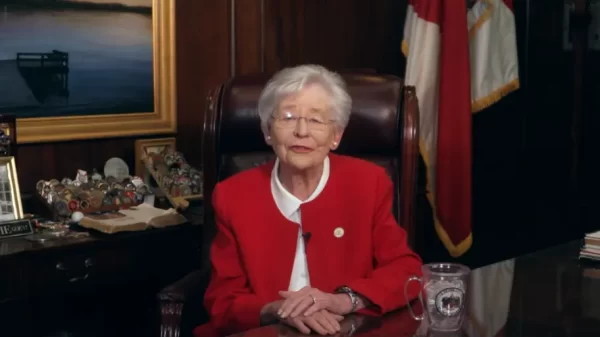











Alabama Governor Kay Ivey signed a bill into law on Thursday making individuals found guilty of sexual crimes against children eligible for execution.
House Bill 41, or the Child Predator Death Penalty Act, has marked a major priority of the 2026 Legislative Session for Ivey alongside conservative leaders and lawmakers.
The bill saw strong support from both houses of the legislature, with the House voting 73-6 in its favor in late January and the Senate sending the bill to Ivey’s desk last week with a vote of 33-1.
In a statement released on Thursday, the governor argued the statute’s importance for protecting Alabama’s children.
“For too long, the most vulnerable of our society have lacked the most stringent legal protection from child predators,” Ivey stated. “Through the Child Predator Death Penalty Act, Alabama now joins just a handful of states imposing the toughest penalty possible for child predators. Those who target the youngest among us for the vilest crimes will soon be met with the harshest punishment under the law.”
The law’s sponsor, Rep. Matt Simpson, R-Daphne, also celebrated the law’s enactment and expressed appreciation for the governor’s support for the measure.
“With the signing of the Child Predator Death Penalty Act into law, Alabama has taken decisive action to ensure that the most horrific offenses committed against minors face the maximum punishment our legal system permits,” said Simpson.
“This law sends a clear message that we will not stand by while young lives are shattered. Those who commit such unspeakable crimes will be prosecuted to the fullest extent of the law,” the representative said. “I am grateful to Governor Ivey for her steadfast leadership and unwavering commitment to keeping our communities—and especially our children—safe.”
Simpson introduced a previous version of the Child Predator Death Penalty Act last session, which failed to advance to a Senate vote.
The 2026 legislation, however, drew early attention and support last year from Ivey alongside Sen. April Weaver, R-Brierfield.
Weaver joined Simpson as the bill’s Senate sponsor last year, well before it was prefiled for 2026, in response to a child sexual abuse ring discovered in Bibb County last summer. Eight individuals have been arrested and charged with rape, trafficking and sexual torture of at least 10 children held captive by the group.
Weaver expressed hope that the legislation would help prevent instances of sexual abuse and violence against children, such as the case exposed in her district last year.
“With the signing of the Child Predator Death Penalty Act, we are putting these sick individuals on notice that a cell on death row awaits them if they abuse the most innocent and defenseless among us,” Weaver said. “Alabama now has zero tolerance for those who prey on our children. I want to thank Governor Ivey for her support, as well as my colleagues in the Legislature for protecting our most vulnerable citizens.”
With the enactment of the Child Predator Death Penalty Act, Alabama is the sixth state to enact legislation to make the sexual abuse of children punishable by death.
However, the Supreme Court ruled in a 5-4 decision on the 2008 case Kennedy v. Louisiana that capital punishment in cases that do not result in death is unconstitutional.
The majority opinion held that executing an individual for a non-fatal crime violated their constitutional protections against cruel and unusual punishment, due to the then-rarity of state laws allowing executions for crimes not involving death.
The opinion also cited an amicus brief filed by the National Alliance to End Sexual Violence, which argued the expansion of the death penalty for abusers could unintentionally harm child victims.
“The threat of capital punishment for child sexual abusers greatly amplifies the concerns that already prevent many victims and relatives from reporting abuse,” the brief read. “Victims who love their abusers may be all the more reluctant to report abuse to police when the possible consequences include lethal injection.”
Despite laws similar to the Child Predator Death Penalty Act having been enacted over the last three years in Florida, Tennessee, Idaho, Oklahoma and Arkansas, no state has undertaken the execution of an individual convicted of child sexual abuse post-Kennedy, which would challenge the Supreme Court’s ruling.
However, Simpson and Alabama Attorney General Steve Marshall have both publicly expressed hopes that Alabama joining the list of states with laws on the books allowing the death penalty for child sexual abuse will prompt the Supreme Court reconsider its Kennedy verdict, should an attempt be made by a state government to execute an individual for sexual crimes against children.
Weaver, during a press conference following HB41’s Senate passage, pointed to Alabama’s legislation, which banned abortions in the state in most cases, and was passed before the Supreme Court overturned Roe v. Wade, saying she felt confident that, despite conversations about the bill being unconstitutional, it will eventually be able to be enforced.
“That’s the same kind of conversation we heard when we brought the Human Life Protection Act to the state of Alabama. It’s now the law of the land, and I am confident that we will prevail,” Weaver said.
“I’ve stated before I believe there’s a special place in hell for people who do this to our children, and today we’re one step closer to having a special place for them in Alabama, and that’s on death row in the death chamber at Holman Prison,” the senator added.
The Child Predator Death Penalty Act will become effective on October 1.