













Every year when I was a kid, come March, it was time to go crappie fishing.
My family has a place off Wheeler Lake in Lauderdale County, and it was a prime location for crappie. We’d grab a bucket of minnows and some casting reels and hit the stick-ups in a green, flat-bottom boat.
Over the course of a few weeks, we would catch enough crappie to freeze and have a fish fry every couple of weeks for most of the summer. There’s nothing that comes close to that today.
And I mean that very literally.
Because eating that much crappie from those waters at this time would make you sick. Give you cancer. Mess with your immune system. Spike your mercury levels. Maybe even lead to your death. Our very own Alabama Department of Environmental Management tells us that every year.
That’s because Alabama and the federal government did such a poor, poor job of monitoring and ensuring that major corporations—mostly chemical companies and a paper plant located along the Tennessee River—didn’t dump massive amounts of poison waste into our waterways that the entire north Alabama river system was compromised to the point of being deadly.
What they didn’t kill, they poisoned beyond usefulness.
There used to be millions of freshwater mussel shells living on the bottom of those same rivers. When the water was pulled down by TVA during the winter months, you could find hundreds by just walking along the bank. I was up there the other day—I didn’t find one.
This is what rolled-back, business-first regulating looks like at the ground level. And it’s what makes a bill like the one Republican Senator Donnie Chesteen has sponsored so utterly infuriating.
We are killing our natural resources. And our conservative lawmakers—the very ones most likely to put a fishing pole or a shotgun in their campaign ads in an effort to make themselves seem relatable to regular folks—are actively participating in the criminal acts against them. All in the name of campaign donations and “investments” from big-dollar businesses.
Chesteen’s bill would prohibit ADEM—a fairly toothless agency to begin with—from imposing regulations that exceeded federal regulations. Chesteen called it a “balance” between regulation and economic development, in that there would be no regulation so economic development could proceed without those pesky protections for our state’s environment. Unless the feds stepped in.
So much for “states’ rights,” I reckon.
Well, actually, that’s not 100-percent accurate. Chesteen’s bill would lean on the federal EPA for everything … unless we’re talking about the EPA’s Integrated Risk Information System (IRIS) that’s used to develop numeric water quality standards. Then, that is specifically forbidden by Chesteen’s bill.
That’s because IRIS has set particularly troublesome water standards for a number of companies in Alabama, thanks to those companies’ use and improper disposal of “forever chemicals” into Alabama’s water systems and waterways. The discovery of numerous dump sites and improper disposals around the state cost these companies billions of dollars over the last few years, and the continued regulatory enforcement of strict standards would cost even more.
I know all about those, as well. The school building where I attended middle school in Decatur is no longer standing. Turns out, it was built on top of a toxic chemical dump site (thanks, 3M) and some of those PFAS and PFOS forever chemicals were in the water system. (So, if you’ve ever wondered what’s wrong with me, there ya go.).
That’s also the same place where we played little league, learned to swim at the nearby Aquadome public pool and roamed in and out of the stormwater drains as kids of the 80s. It’s honestly a wonder that we don’t glow in the dark.
But hey, who cares about the health of a few snot-nosed kids when the profit margins for major corporations are at stake, amirite?
What is wrong with y’all?
Every time this state produces any tourism ads, sitting front and center is Alabama’s natural resources. We talk about our hunting lands. We talk about our lakes and rivers. We talk about our walking trails. Wildlife tourism in this state hauls in roughly $2 billion annually and it props up literally thousands of small businesses. More than 25,000 jobs are held up by our fishing and hunting tourism alone.
And that’s if you need a reason to care about the environment beyond, you know, the environment—all of those animals and trees and nature and junk.
When pressed on his legislation by Democratic Senator Vivian Figures, Chesteen suddenly had few answers. He could barely tell her anything about the legislation, except for the fact that some “group” of people came to him and asked him to carry it.
Which group, Figures asked. Who was behind this?
Chesteen’s literal answer: “I’d rather not say.”
Yeah, I bet not.
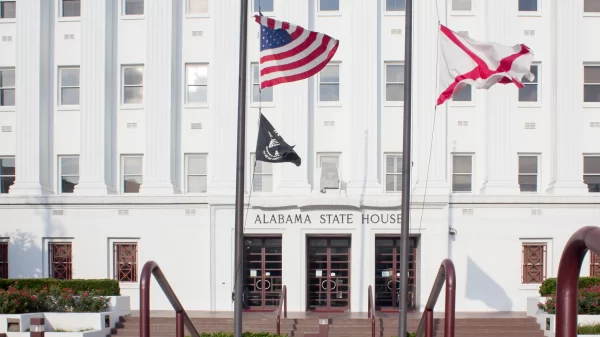
How shameful and pathetic. These are the people y’all have put in charge of every branch of Alabama’s government. These are the people who you’ve entrusted with our health care system, our education system, our corrections system and our natural resources.
What do all of those things have in common?
They’re failing miserably. Most of them due to purposeful, harmful actions that undermine the systems at the expense of the people and for the benefit of big business and highly profitable corporations.
Is this what y’all voted for?


