














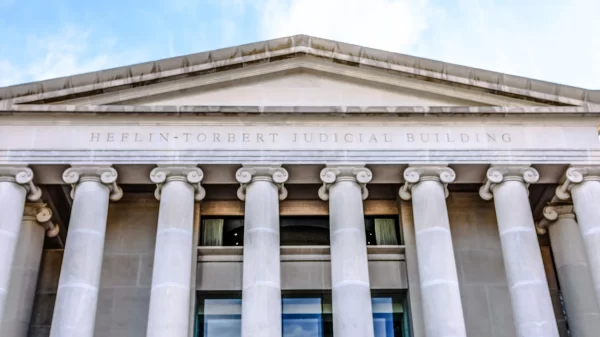






An Alabama House committee on Wednesday advanced legislation to require the display of the Ten Commandments in history classes.
House Bill 216, sponsored by Representative Mark Gidley, R-Gadsden, would require local boards of education to display the Ten Commandments and a related context statement in each history class serving students from fifth through 12th grade. The bill would also mandate the installation of the displays in school common areas such as libraries, except for “any school that serves students in kindergarten through fourth grade.”
HB216 would condition the installation of displays on the availability of donated funds to provide for the exhibit’s materials.
The House Education Policy Committee unanimously voted to give the legislation a favorable review, following a brief discussion of the bill.
A previous version of the legislation, sponsored by Gidley, was passed in the House 81-11 last legislative session, but did not advance out of the Senate Education Policy Committee.
Gidley explained to the committee that the only change made to last year’s version of the legislation was the clarification of which grade levels are required to install displays.
“I worked with our governor’s office, with many others, to try to get a good, solid bill that would beat any kind of legal muster,” the sponsor said.
HB216 would require that a poster or framed document, at least 11 by 14 inches in size, which includes a context statement recognizing that Alabama’s Establishment Clause “respects the rights of its public school students to be free from state-established religion.”
“Recognizing that personal choice about matters of faith are left to students and their families, the purpose of this poster is simply to acknowledge the historical role of the Ten Commandments, and the broader Judeo-Christian tradition, in shaping American civil society,” the display’s context statement would read.
The display goes on to highlight language in the personal writings of U.S. President John Quincy Adams, the Mayflower Compact, the Declaration of Independence, the U.S. Constitution and the Northwest Ordinance of 1787; documents that the bill and proposed display argue are inspired by the moral and legal principles of the Ten Commandments.
“In 1813, future U.S. President John Quincy Adams wrote in a letter to his son that, ‘The Law given from Sinai’–in other words, the Ten Commandments–‘was a civil and municipal as well as a moral and religious Code,’” the display would read. “He noted that many of its provisions ‘were of universal applications – Laws essential to the existence of men in Society, and most of which have been enacted by every Nation which ever possessed any Code of Law.’”
The installation of Ten Commandments displays would not be funded by school boards themselves; rather, the bill would authorize Local boards of education to accept donated funds to purchase the displays or may, alternatively, accept donated displays.
“It’s all paid for with private funds—no requirement to put the posters up until the funds are there,” Gidley explained to the committee.
A Senate version of the legislation, sponsored by Senator Keith Kelley, R-Anniston, was passed out of its respective committee last month and is awaiting a vote on the Senate floor.
“It’s not a religious document. It’s a historical founding document that builds on how our culture, how our law, and how our nation was formed through a historical standpoint,” Kelley said of the Ten Commandments during the Senate committee hearing on the bill.
The legislation similarly argues that due to fear of violating the Establishment Clause, teachers are unlikely to emphasize the influence of the Commandments on U.S. legal theory.
“Due to reliance on misinterpretations about the meaning of the Establishment Clause or due to their own personal policy preferences, a significant number of Alabama teachers are unlikely to expose public school students to these historical truths if left with any discretion about how or whether to present these truths,” the bill reads, arguing that the context disclaimer included in the display will disavow educators of their concerns that installing the displays constitutes religious indoctrination.
“Such disclaimers will also serve the state’s educational objectives because they will make it more likely that classroom teachers will become comfortable discussing the historical truths that are included in the poster,” the bill adds.
While Gidley has assured lawmakers that the bill is written in a way that avoids concerns it may violate the Establishment Clause, previous versions of the legislation have received opposition from the ACLU of Alabama and have received a divided response from Alabama faith leaders.
“The First Amendment guarantees that students and their families—not politicians or the government—get to decide which religious beliefs, if any, they adopt and what role those beliefs will play in their lives,” ACLU Alabama wrote in its statement of opposition to last year’s Ten Commandments bills.
“Displaying the Ten Commandments in public-school classrooms blatantly violates this promise. Students can’t focus on learning if they don’t feel safe and welcome in their schools. These bills are unconstitutional–plain and simple,” the organization added.
During a public hearing held for the Senate version of the legislation last year, more than three dozen faith leaders presented a letter to the Senate Education Policy Committee.
Meanwhile, former Alabama GOP Chairman John Wahl and other faith leaders spoke in favor of the bill at the hearing.
Alabama voters in 2018 approved an amendment to the state’s constitution that allowed the public display of the Ten Commandments.
If enacted into law, Gidley and Kelley’s legislation would take effect on Oct. 1, 2026.