





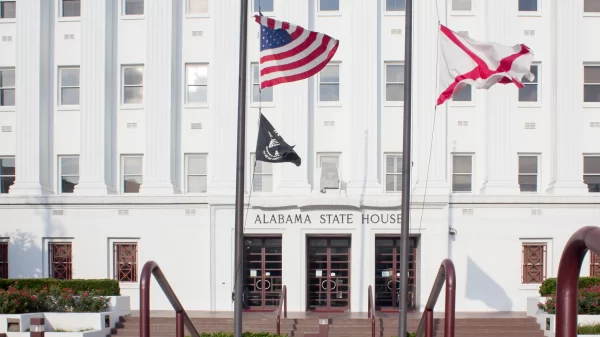








On Monday, the University of Alabama’s student newspaper The Crimson White reported staff of the student-run magazines Alice and Nineteen Fifty-Six had been informed that the two publications would be suspended by the administration, effective immediately. Alice’s editorial team had already begun working on assigning stories to writers in preparation for their spring issue before the suspension was announced, members told APR.
Launched in 2015, Alice was a “fashion and wellness magazine” primarily targeted at young women. Nineteen Fifty-Six was founded in 2020 and took its name from the year that Autherine Lucy Foster, the first Black student to attend the University of Alabama, enrolled.
During an interview on Tuesday, Gabrielle Gunter, the editor-in-chief of Alice, told APR that representatives of the administration informed staff of both magazines that the decision had been made because the publications used “unlawful proxies.”
“I was devastated but also I was kind of surprised,” Gunter said. “I thought that we had freedom of press under the First Amendment, and I thought that was why we were able to keep going after SB129.”
Gunter explained the potential impacts of SB129, the anti-DEI law passed during the 2024 Legislative Session, on Alice’s ability to continue publishing had greatly concerned her, but she eventually relaxed because of her understanding that the First Amendment protected student media.
“That’s what I thought; it turns out I was kind of wrong. I guess there’s some sort of work around because of the memo from the attorney general interpreting the laws a certain way,” she continued.
In a July 29 memo from U.S. Attorney General Pam Bondi, an unlawful proxy is defined as the use of “ostensibly neutral criteria that function as substitutes for explicit consideration of race, sex, or other protected characteristics” in order to “advantage or disadvantage individuals based on protected characteristics.” The memo’s contents are described on its first page as “non-binding suggestions to help entities comply with federal antidiscrimination laws and avoid legal pitfalls.”
Gunter told APR that Alice has “never excluded anyone” and actually had several men and nonbinary individuals on staff this fall. “We’re not just women,” she said. “We really want to be here for everyone.”
Calling the decision to shut down Alice and Nineteen Fifty-Six “just a little ridiculous,” Leslie Klein, the managing editor of Alice, told APR the magazines played a valuable role at the University of Alabama by highlighting marginalized communities.
“[Alice] is simply just a magazine and I feel like, they’re just not afraid to shut down voices,” Klein stated. “All I could think of whenever we first heard was: At the click of a button, the people in charge can just dismantle us.”
The editor-in-chief of Nineteen Fifty-Six, Kendal Wright, also stressed that that magazine was meant to help inform a wide audience at the University of Alabama.
“Regardless of our suspension, there will continue to be a need on campus for the stories of the university’s Black community to be told,” Wright wrote in an official statement posted to the magazine’s social media and shared with APR. “The mission of the magazine was to educate students from all backgrounds on culturally important issues and topics in an effort to produce socially conscious, ethical and well-rounded citizens.”
Both suspended magazines had received several awards over the years since they began publication, including at this year’s Southeast Journalism Conference. Alice won the 3rd place award for Best Magazine, and Nineteen Fifty-Six contributor Kay Maxwell received the 3rd place award for Best Magazine Writer.
“It’s scary knowing that our publications can go away at any point in time,” editor-in-chief of The Crimson White Maven Navarro told APR during a phone call on Tuesday. “I felt really deeply for them. I can’t imagine if the CW was immediately just taken away from me and all the students that work on it overnight. So I can’t imagine how they felt.”
“It’s scary from a free speech perspective that their outlets were just able to get chopped with—I don’t wanna say no reasoning—but with little reasoning and no negotiation,” she added.
“The University remains committed to supporting every member of our community and advancing our goals to welcome, serve and help all succeed,” a University of Alabama spokesperson wrote in a statement emailed to APR. “In doing so, we must also comply with our legal obligations. This requires us to ensure all members of our community feel welcome to participate in all provided programs, including student publications.”
The statement also directly confirmed The Crimson White’s reporting that staff at both Alice and Nineteen Fifty-Six had been told their publications would be immediately suspended, making the most recent issues the final ones. It added that the administration would be working to help create “a new publication that features a variety of voices and perspectives to debut in the next academic year.”
“The University routinely reviews programming as the compliance landscape changes,” the UA spokesperson’s statement continued. “If compliance with legal obligations impacts a program on UA’s campus, we will work to find new opportunities to take its place.”
The administration spokesperson did not respond to a follow-up question from APR about whether Alice and Nineteen Fifty-Six failed to make members of the UA community “feel welcome to participate.” The Crimson White reported that despite both publications having a specific target audience, they have each hired students from outside of those respective audiences as members of their staff.
While the administration highlighted its plans to launch a new publication during the next academic year, Gunter and Klein expressed significant skepticism of the idea during their conversations with APR.
“It saddens me a little to have people be like, ‘Oh, will you help us create a new magazine after we shut yours down,’” Gunter reflected.
“Personally, to switch it off to a very generalized magazine, just overall, I really don’t like the idea of that at all,” Klein told APR. “Because obviously as journalists, as writers of magazines and editors, we clearly have a target audience. Because what kind of magazine doesn’t have a target audience, you know?”
“So it feels like there will absolutely still be voices trampled no matter what,” she continued. “Now, if they’re adding such a generalized form of media—in the form of a magazine—it just feels like a way to just not hear everybody’s voices.”
Klein also expressed concern that a single magazine may not be able to provide as many opportunities for burgeoning student writers and journalists as the two publications it would be intended to replace. Now in her fourth year working with Alice, Klein said she doubts she “would have found my passion for journalism and for writing if it wasn’t for Alice Magazine.”
A public petition calling for the reinstatement of Alice and Nineteen Fifty-Six on the site MoveOn has garnered over 1,900 signatures so far. Navarro also told APR that her “phone has been blowing up with alumni asking how they can help and ways that they can give back to a publication that gave back so much to them.”
The Department of Justice did not respond to a request for comment before time of publication.


