


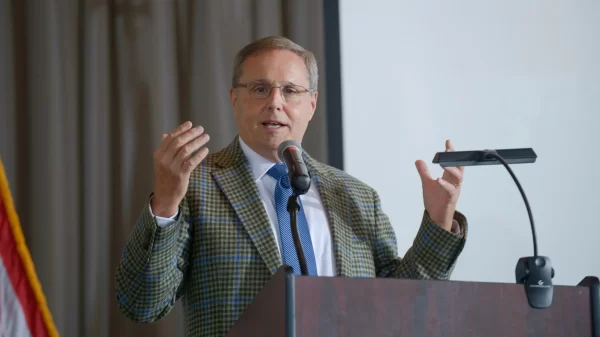





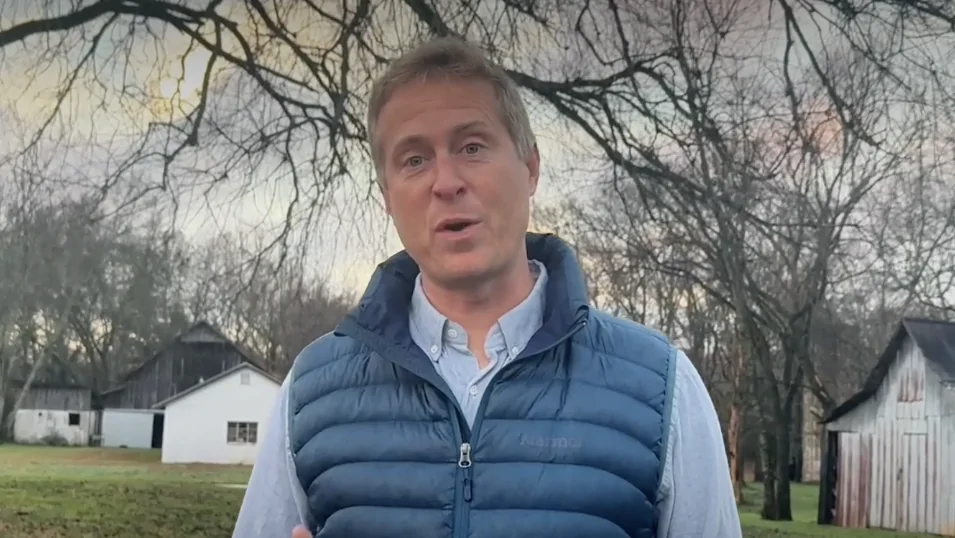
Democratic hopeful for Alabama’s 5th Congressional District, Andrew Sneed, is seeking to ignite support from working people and moderate voters in his run for the U.S. House of Representatives.
Sneed is running for the seat held by U.S. Representative Dale Strong, R-Alabama, who has served as the 5th District’s representative since he was elected in 2022. Sneed currently works as the head of Whole Home Solutions, a mechanical contracting business he founded in Huntsville.
During an interview with APR earlier this month, Sneed highlighted the importance of experiences gathered throughout his diverse career background, which he said have shaped his campaign and the approach he would take as a U.S. representative.
“My uniquely human path has prepared me to be a uniquely human candidate,” Sneed said.
Sneed is a native of Madison County and a 1998 graduate of Lee High School, where he took part in the school’s music magnet program. He then attended Boston University on a theater scholarship and moved to New York following graduation to pursue a career in acting.
“I’ve always believed that, you know, being an actor is a service business,” he said. “I didn’t feel like I was meeting my calling. I, you know, just thought, shoot, I’ll be 40 and doing this exact same thing, and what am I accomplishing? So, I left New York and came back south.”
After leaving New York, Sneed worked at the urban farm and nonprofit Growing Power in Milwaukee before opening and running five restaurants in Tuscaloosa and later serving as general manager of another in Birmingham.
The candidate then worked as an apprentice and journeyman plumber for seven years with HC Blake Plumbing in Huntsville before leaving to start his own plumbing and home repair business.
“Now, six and a half years later, we’ve got seven employees and six work trucks and three little girls,” Sneed said.
Sneed emphasized the importance of his background in blue-collar work to the outlook he would bring to his position, describing supporting working-class and agricultural workers in his district as top priorities for his campaign.
“I’ve worked with my hands for 25 years. You know, having a degree in theater and an acting degree, you know, that means you work in restaurants,” he said.
“I’m not a hand wringer. I’m a plumber,” he added. “I don’t get too kind of unflappable in a lot of ways. But the things are just continuing to get more and more divided and acrimonious.”
The candidate described his work background as preparing him to advocate for the interests of all constituents in District 5. Alongside working in kitchens during and after his high school and college education, Sneed highlighted his time in college, selling Christmas trees over the holiday seasons, which he said allowed him to become comfortable meeting and working with people of different backgrounds.
“Being around all different types of folks, especially when the goal is to serve them, requires, one, a disposition of service,” he said. “I do think it’s a contrast between Dale Strong and myself—to know that I’m not above anybody and my opinions aren’t more valid than anybody else’s, and that my job is to meet that person where they are, even if I don’t agree with them.”
When asked to explain how his approach to representing District 5 would differ from Strong’s, Sneed emphasized the need for strong representation for all citizens of the district as well as greater transparency and accessibility through frequent public town halls.
“I think [Strong’s] a poor representative, in terms of listening to people,” Sneed said. “I think he intentionally divides people. I think he makes disastrous decisions for—and really votes—not just decisions but votes against the interest of this district time and again. And I think we can do better.”
Throughout his campaign, Sneed has similarly criticized congressional Democrats as having lost touch with the issues impacting the day-to-day lives of working people.
“We’ve always been the party of solutions,” he said.
“FDR got us out of the Great Depression. Kennedy and Johnson, you know, brought forth and passed civil rights, albeit with a Republican Congress, which is important to notice,” the candidate continued. “Clinton was the last president to balance the budget, and Obama, you know, you know, delivered the ACA.”
Sneed, however, argued that Democrats have lost much of their working-class support by increasingly focusing their policy priorities on making progress on social issues while speaking down to portions of their working base and failing to deliver quality of life improvements.
“We want to put ourselves out as the party of empathy, but we tend to want our empathy; but empathy should be a two-way street,” he said.
“We can try to convince people or show them how they don’t have to be afraid, but that becomes incumbent on our party to show a better way and lead by example and not finger wag,” he added. “There’s been a lot of shaming. And when you shame people that dig their heels in, and that’s the exact wrong way to communicate.”
Sneed cited U.S. Senator Tommy Tuberville’s claim that New York City will be “completely Muslim in three or four years,” which he described as divisive rhetoric that is able to flourish when working people’s day-to-day economic interests are not addressed.
“I think that they feel that they’re losing something, and their reality informs them because of disastrous economic policies,” Sneed said.
Sneed argued for the importance of balancing technological innovations with policies that protect working-class interests, priorities he has described as particularly important in protecting the interests of all citizens in District 5.
The candidate has highlighted the need for regulation of artificial intelligence technology aimed at preventing job loss to automation as one of his campaign priorities.
Describing his stance on AI, Sneed emphasized that while he’s not opposed to the technology, he is concerned that it is being advanced for the benefit of America’s wealthiest, not the country as a whole.
“A trillion-dollar pay package for Elon Musk is beyond perverse,” he said. “When you combine that with the ability to replace people’s jobs—It’s not replace—eliminate people’s jobs, where the people at the top of these companies are able to control and receive all of this wealth and then not let it flow, that is a true problem.”
Sneed cited projections that 10 to 20 percent of jobs will be rendered obsolete within the next 10 years due to the continued development of AI technology.
“Separately, there’s a totally different concern, which we’re seeing right here in the 5th District, which is the energy consumption and the water pollution or impact that these data centers are having,” he added.
“We’re not here on the behalf of the technology. We’re here on behalf of people. We’re just on this world for a little while,” Sneed said. “My father’s on hospice care. He’s not gonna be here too much longer. You know, life passes in an instant. I think that while we’re here, we need to do the best we can to help the other people that were around and make things better for those that came after.”
“Maybe AI is going to solve the prostate cancer that’s killing my father in five years from now, and I’m going to be a cheerleader like everybody else, but if it eliminates 10 percent of the workforce, I think that that’s something we need to get out ahead of,” he continued.
The candidate went on to say he believes that if Congress develops AI regulations with the interests of the populace “writ-large” in mind, the technology may have societal advantages, but expressed doubt that congressional leadership has done enough to address AI’s impacts on the job market.
“We just need to design for success, and I don’t feel like these conversations are being had candidly enough,” he said.
Alongside regulating emerging AI technologies, Sneed has called for policies such as congressional term limits, overturning the U.S. Supreme Court ruling in Citizens United v. FEC, which gave corporations the power to donate to political campaigns, a moratorium restricting representatives from taking a lobbying job immediately after leaving office and a ban on congressional stock trading.
“Being a career politician is not in the interest of the people,” Sneed said. “To me, it’s about changing the incentive structure.”
Sneed explained that he believes reforms aimed at limiting the influence of wealthy corporations, PACs and lobbying groups will help improve representatives’ accountability and encourage them to work to better serve all their constituents.
“I don’t think Dale Strong’s a bad person for being wealthy, but Dale Strong is worth $25 million,” he said. “I’m afraid that there’s a disconnect.”
“He’s not trying to solve the problem or solve the impasses on behalf of the people of the district, while people in the district aren’t getting paychecks. So, it’s that sort of politics of division that does not serve the working-class and it doesn’t serve our farmers,” Sneed added.
The candidate pointed to Strong’s support for the Department of Government Efficiency at the expense of federal jobs in his district, Strong not meeting with Reps. Shomari Figures and Terri Sewell, D-Ala., during the government shutdown and supporting Trump’s tariff policies which prompted the need for a $12 billion bailout for farmers in early December.
“I’m a job creator, you know, I have a small business, but I’m very proud of it. We, I, pay for all of my guys’ health insurance in full,” he said.
“I don’t think Dale Strong’s ever had to be afraid to be hurt or to be sick, but I went without insurance for 10 years. I know what that’s like, personally. That’s no way to be,” he continued. “The dignity of work is just critical. You know, paid vacation, paid paternity leave, these are important things, but if someone’s never walked in those shoes, it’s awfully hard to understand, especially if they’re not going to go and listen to the folks that are experiencing that kind of hardship.”
Alongside congressional finance reform, Sneed pointed to extending Affordable Care Act subsidies and rolling back Trump administration tariffs on foreign imports as policies that would directly benefit working-class Alabamians.
When asked what sets him apart from other candidates vying for the District 5 Democratic nomination, Sneed pointed to his roots in the district and argued that his campaign has placed a strong emphasis on building bridges between citizens regardless of their background or political allegiance.
“This is a moderate place. The only path to victory for a Democrat, if there is a path to victory for a Democrat in this district, it’s through the middle,” Sneed said.
“I grew up here. I know what the 5th District is about. I’m the only one that creates jobs in this district,” he said. “Having a disposition of service, first and foremost, is something that I believe will set me apart, not only from Dale Strong, but from these other candidates, that my number one commitment is to listen to people and advocate and vote for this district regardless of party.”
Sneed pointed to past District 5 elected officials, such as Bud Cramer and Richard Shelby, as models for moderate leadership aimed at serving the needs of everyday constituents—qualities he described as being lost through Strong’s tenure as a representative.
“The status quo needs to be adjusted. It doesn’t need to be scrapped. I believe in the system that got us 250 years down the road, but it is time for some critical adjustments, and I’m the only candidate in this field on either side of the aisle that recognizes that that is the foundational issue,” he said.
Sneed also highlighted that his campaign has outraised Democrat contenders Jeremy Devito and Candice Duvieilh.
As of the end of September, the Sneed campaign had raised more than $230,000, with roughly $175,000 on hand. Reports from the same month show that Devito and Duvieilh had both raised roughly $9,700, with the candidates holding around $6,000 and $4,000 on hand, respectively.
“There are two other great candidates in this field. I respect both of them,” he said. “We’ve managed to build resources to actually run a campaign that can compete. We’re not there yet, but we’ve, you know, we’ve outraised them 12 to one combined as of the last FEC.”
“I don’t say that disparagingly. It’s just what the numbers are,” he continued. “Dale Strong will have unlimited resources, you know, between his net worth and the money that he takes in every year. So, it will take resources for any candidate to compete in this race.”
In September, Strong had raised more than $730,000 for his campaign, with more than $1 million in cash on hand.
Sneed added that he will “unequivocally support” the Democratic candidate for District 5 if another candidate secures the nomination.
“If they’ll have my voice, they’ve got it,” he said.
The Democratic primary for District 5 will take place on May 19, 2026. The general election is scheduled for November 3, 2026.