











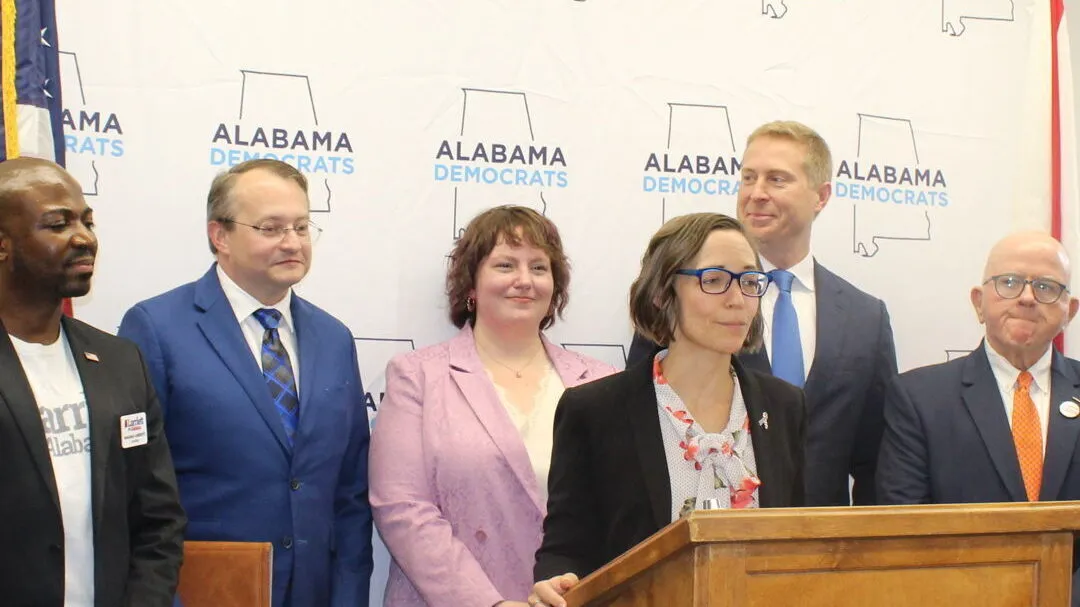
Democratic congressional hopefuls gathered in Montgomery on Wednesday to file election paperwork and call for changes in Alabama’s federal leadership.
During a public appearance held at 1 p.m. at the Montgomery headquarters of the Alabama Democratic Party, candidates filed qualifying paperwork and fees, as well as Alabama Ethics Commission documents needed to run for office. Qualifying for Alabama’s 2026 election season began Monday and runs until January 23.
Candidates present were: Clyde Jones running for Alabama’s 1st Congressional District, Lee McInnis running for District 3, Amanda Puszcek running for District 4, Andrew Sneed running for District 5, Keith Pilkington running for District 6 alongside Dakarai Larriett and Mark Wheeler, both running for the U.S. Senate.
In a series of statements released ahead of the joint-filing, candidates said the event highlighted their intention to embody feasible alternatives to incumbent congressmen in their districts.
During the appearance, candidates fielded questions regarding their respective campaign priorities and why they feel Alabamians deserve a change in congressional leadership.
McInnis, whose campaign has called for the reversal of federal health spending cutbacks, criticized Governor Kay Ivey for championing rural healthcare funding provided by the One Big Beautiful Bill Act.
A report from healthcare nonprofit, the Kaiser Family Foundation, found that the total rural health fund amounts to 37 percent of the estimated loss of federal Medicaid mandated by the OBBBA in rural areas over the next 10 years.
“If you do the math, we hardly get out of a year with the money they’ve given, and there’s no promise that there’s gonna be any additional funding after that, when they’ve cut $1 trillion out of the federal healthcare budget,” McInnis said. “That [$203 million] is not even a bandaid, it’s a short-term bailout, not a long-term solution to what our, especially our rural counties, our healthcare problem is like.”
Jones added that the healthcare issues discussed by McInnis impact “the entire state,” arguing new voices in federal positions would help correct Alabama’s rural healthcare crisis.
“That’s why we need people at the federal level who want to make change, alright, who want to make sure that people have healthcare, who want to make sure that people have workers’ rights,” he said.
Puszcek, pointing to the 28 years District 4 incumbent, U.S. Representative Robert Aderholt, R-Alabama, has served in office, similarly argued a change in congressional representation for the district is needed to better protect citizens’ interests.
“That’s generational change that you should have been able to make in that amount of time,” she added. “I think this is an amazing year of change, and I can’t wait for all of us to get to work.”
Sneed told APR that the appearance, originally conceived by McInnis, was intended to act as a display of unity among Alabama’s Democratic congressional candidates.
“Even if we don’t agree on all policies, we’re all fighting for better for the state of Alabama,” Sneed said.
Sneed expressed excitement that “for the first time in a long time,” Alabama has Democrat candidates running for each of its congressional districts and the U.S. Senate.
“I think that it shows, not only a revitalized, energized party—what I think it reflects is a feeling that things are broken and a felt pain that’s being felt across the state,” he added.
The candidate went on to express his hope that the event would give more Alabamians confidence that Democratic congressional hopefuls stand a genuine chance at flipping their respective seats and would improve representation for their constituents.
“I’ll always say that I’m a proud Democrat. But people have a choice. You almost could take away the fact that we are Democrats,” Sneed said.
“You know what they say, the definition of insanity is—is continuing to choose the thing that is not helping,” he continued. “We’re giving choices up and down the state for people to choose representatives that genuinely want to serve them, not politics, and they want to make things better for them in their lives.”
When asked to describe his feelings towards his campaign’s progress and goals for the remainder of the season, Sneed said he hopes to continue connecting with citizens of his district and expand his campaign’s reach.
“The goal is to build a big campaign, and I don’t just mean by capability, I mean a big campaign that reaches people in every corner of our district,” he said.
“It’s humbling, it’s gratifying to work hard and feel that we’ve been able to go to every county in the district, to gatherings, small and large, and listen to people and tell them, ‘I hear you. I hear you,’ and to see that that is turning into a campaign that genuinely has a shot to flip this seat, Sneed continued.
Since launching his campaign, Sneed has led District 5 Democratic candidates in fundraising with more than $236,000 raised and roughly $175,000 on hand as of his latest Federal Election Commission report. Meanwhile, incumbent U.S. Representative Dale Strong, R-Alabama, who also qualified to run for reelection this week, has raised more than $730,000 for his campaign with roughly $1 million on hand.
“I’m hoping that the people of the 5th Congressional District will realize that that is the only reason that we the only reason these dollars matter, the only reason this campaign matters is that we are determined to do better for the 5th Congressional District,” Sneed said. “And, I believe that once people have a choice and they realize that I understand the job is to serve, we think they’re going to choose differently in November.”
“This race doesn’t run through Huntsville. It runs through every corner district, and we know that, and I’m determined. I’m determined to outwork my opponent,” he added.
Alabama’s Democratic and Republican primaries are set for May 19, 2026, and the general election is scheduled for November 3.


