
















A new statewide survey of likely Republican primary voters suggests that President Donald Trump’s endorsements, while still influential, are not determinative in Alabama’s 2026 primaries—and that a potential endorsement from U.S. Senator Katie Britt could carry greater weight with the voters most likely to decide the outcome.
The February 1–4 poll of 500 likely GOP primary voters, conducted by The Alabama Poll, finds that candidates endorsed by Trump are trailing in both the U.S. Senate and lieutenant governor races, despite heavy national attention surrounding the former president’s involvement. The survey carries a margin of error of plus or minus 4.4 percent.
In the Republican primary for U.S. Senate, Attorney General Steve Marshall leads U.S. Representative Barry Moore by nine points, 26 percent to 17 percent. The race remains highly fluid, however, with 43 percent of voters still undecided—a figure that underscores how early the contest remains.
Moore received Trump’s endorsement earlier this year, but the poll shows that endorsement has not fundamentally reshaped the race. Moore’s support remains largely consistent with previous surveys and within the margin of error, while Marshall retains a durable advantage built on statewide familiarity rather than late-breaking momentum.
Marshall leads in five of Alabama’s seven congressional districts and performs best in the Birmingham, Huntsville and Montgomery media markets—regions that collectively account for roughly 74 percent of likely Republican primary voters. In those population centers, Marshall holds a net favorability rating of plus 28, compared to Moore’s plus 8, with more than one-third of voters saying they have never heard of Moore.
Moore’s strongest support is concentrated in the Dothan and Mobile media markets, which together represent about 21 percent of the GOP primary electorate. Even strong margins in those areas, the poll indicates, would be insufficient to overcome Marshall’s advantage in the state’s major population centers without a rapid expansion of Moore’s name recognition and favorability.
The survey also highlights limits to Trump’s endorsement power when applied to specific candidates. While 59 percent of voters say a generic Trump endorsement makes them more likely to support a candidate, that number drops to 43 percent when Trump’s endorsement of Moore is tested by name, with 39 percent saying it makes no difference.
A similar pattern appears in the Republican primary for lieutenant governor. Secretary of State Wes Allen leads former ALGOP Chairman John Wahl by 17 points, 23 percent to 6 percent, with 59 percent of voters undecided.
Wahl has been in the race for just two weeks, a factor that helps explain both his low level of name recognition and the limited immediate impact of Trump’s endorsement. Nearly half of likely GOP primary voters report they have never heard of Wahl, sharply constraining the endorsement’s ability to move support at this early stage.
Even accounting for Wahl’s late entry, the poll shows that Trump’s endorsement has yet to significantly alter the race. Only 38 percent of voters say Trump’s endorsement of Wahl makes them more likely to support him—the weakest endorsement effect measured in the survey.
Allen’s advantage appears rooted in his established statewide profile as secretary of state rather than transient political alignment. His 17-point lead is the largest margin recorded in any contested statewide primary tested in the poll, despite the unusually high number of undecided voters.
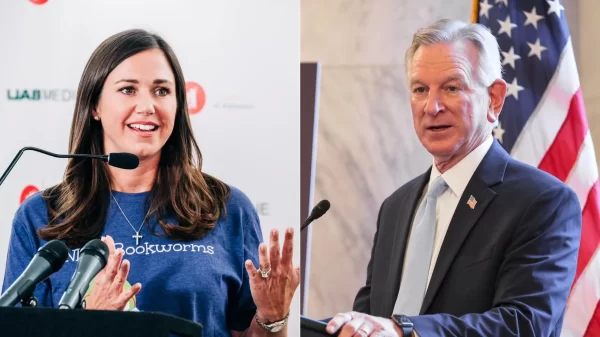
Perhaps the most notable finding involves a hypothetical endorsement from U.S. Senator Katie Britt. When tested generically, a Britt endorsement produces a net positive effect of plus 35 points, outperforming Trump’s endorsements of both Moore and Wahl. Britt’s endorsement also generates fewer negative reactions, with only 11 percent saying it would make them less likely to support a candidate, compared to 15–16 percent for Trump’s endorsements.
That advantage is especially pronounced among women and moderate Republican voters—constituencies where Trump’s endorsements underperform or actively repel support. Among the roughly 39 percent of voters who say Trump’s endorsement makes no difference to their vote, a Britt endorsement still moves 25 percent toward supporting a candidate.
With more than four in ten voters undecided in the Senate race and nearly six in ten undecided in the lieutenant governor contest, the poll suggests that both primaries remain wide open. The data indicate these races are more likely to be decided by candidate performance, voter contact and resource deployment than by endorsements alone.
Taken together, the findings challenge the assumption that Trump’s backing has settled Alabama’s Republican primaries. Instead, they point to contests shaped by familiarity, favorability, geography and coalition-building—and raise the possibility that Alabama’s junior senator may hold one of the most consequential endorsements in the 2026 election cycle.