












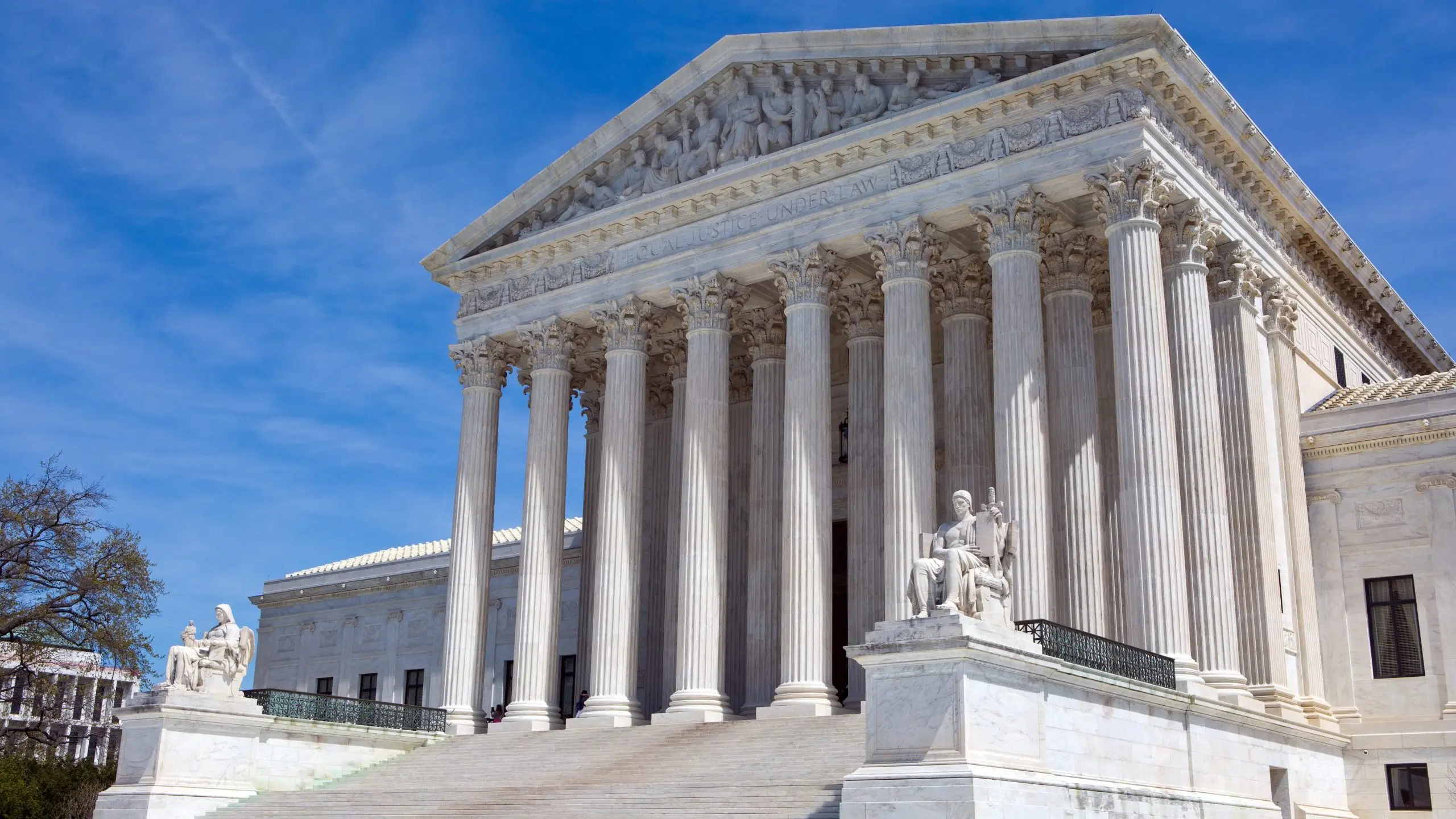
A push by Alabama and additional Republican states for the U.S. Supreme Court to rule that public begging is not protected under the First Amendment was denied on Monday.
The high court turned down a request to hear the case, Taylor v. Singleton, a class-action lawsuit launched in 2017 by original plaintiff, Jonathan Singleton, a homeless Montgomery resident, who challenged Alabama’s laws criminalizing public begging as a violation of his First Amendment rights.
Prior to his challenge to the city of Montgomery, the Alabama Law Enforcement Agency and the Montgomery County Sheriff, Singleton had been arrested or fined six times for violating Alabama statutes that criminalize public begging and soliciting.
Singleton reached a separate settlement agreement with the City of Montgomery in 2020, in which the city agreed to stop enforcing state laws subject to the suit.
A class for the case was solidified in 2022, and a U.S. Middle District of Alabama judge ruled in favor of Singleton’s suit against Alabama Law Enforcement Agency Secretary Hal Taylor in March 2023, declaring the two state statutes in question violated the First Amendment and barring enforcement of the laws.
The appeal, filed last fall, followed a September ruling from the Eleventh Circuit Court of Appeals, which also sided with Singleton, ruling that Alabama’s laws criminalizing public soliciting violated the First Amendment.
The office of Alabama Attorney General Steve Marshall asked the court to rule on whether public begging is protected free speech.
Marshall argued in a brief filed with the Supreme Court that begging and vagrancy were commonly criminalized early in American history, and begging is therefore not protected under free speech rights.
“Like every other State of its vintage, Alabama first regulated vagrancy over 200 years ago,” the brief reads. “At the founding, States commonly prohibited idleness, wandering about with no course of business or fixed residence, begging in the streets, and the like. The basic theory, inherited from the English, was to distinguish those who could work (but refused) from those [who] could not.”
The brief goes on to argue that the statutes are necessary to maintain public order and combat the homelessness crisis.
“Grappling with a ‘health and safety crisis’ on streets across the country, cities need ‘the full panoply of tools in the policy toolbox,’” the document argues.
“Those tools must comply with ‘a number of limits,’” the brief continues. “But at least as to begging, the Free Speech Clause is not one of them.”
Marshall was joined in urging the Supreme Court to hear the case and overturn the lower court rulings in briefs filed by a 19-state coalition led by South Carolina alongside the Alabama League of Municipalities and the cities of Orange Beach and Saraland.
In their response to Alabama’s request that the SCOTUS take up the case, Singleton’s legal team argued that the state’s argument in the case has exhibited “shaky originalism right out the gate.”
The legal team led by the Southern Poverty Law Center and National Homelessness Law Center highlighted the importance of early U.S. vagrancy in pinning up forced labor and maintaining white supremacy following the Civil War.
“The Thirteenth Amendment forecloses the theory of involuntary servitude that undergirded many of the founding-era vagrancy laws, and the Fourteenth Amendment forecloses the use of vagrancy laws to ‘maintain … racial hierarchy,’ as attempted by southern states in the wake of the Civil War,” Singleton’s lawyers wrote in their response to Alabama’s certiorari request.
The respondent’s representation also listed instances in which law enforcement officers have charged individuals, including homeless Alabamians seeking assistance, as well as others attempting public fundraising.
“Alabama law enforcement officers have issued citations under these statutes to [Singleton] and others for holding signs with messages such as ‘HOMELESS. Today it is me, tomorrow it could be you,’ ‘homeless please help,’ and ‘husband in hospital;’ another class member was arrested for holding a ‘plastic jar’ for ‘Birmingham Restoration Ministries,’ Singleton’s lawyers wrote.
According to SPLC, more than 400 citations were issued by the City of Montgomery alone within an 18-month period to enforce Alabama’s anti-panhandling laws.
Representatives of SPLC and NHLC celebrated the Supreme Court’s decision to deny the appeal in a series of statements released on Monday.
“Everybody needs a little help from their neighbors sometimes—that’s not a crime,” said NHLC Decriminalization Director Will Knight.
“Today, the Supreme Court upheld a basic and consensus understanding that asking for help is constitutionally protected speech,” Knight added. “This decision sends a clear message: Stop punishing people who are trying to make ends meet. Instead of making survival a crime, lawmakers must use their power to ensure that everybody has a safe place to live, access to the care they need and food they can afford.”
“The Supreme Court’s decision to not hear Alabama’s appeal leaves in place a ruling from the Eleventh Circuit that states cannot criminalize people simply for holding signs expressing that they are hungry and homeless,” said SPLC supervising attorney for the case, Micah West.
“The decision ends a six-year legal battle about whether the First Amendment protects the rights of people experiencing homelessness to ask for help to meet their basic needs,” he continued. “Although we are pleased with the Court’s decision, we cannot move toward a truly inclusive nation if the right to freely express oneself—and in this case, advocate for basic needs—is a crime.”
In an interview with APR on Monday, West described the state’s argument in the case as a “dangerous” attempt to reshape widespread legal precedent and limit protections for public speech.
“The state argued that people experiencing homelessness did not have a right to ask for help on public streets because they had no civil or political rights at the founding of this country,” he said. “It’s a very dangerous argument and would undermine really clear precedent from all circuits saying that people have a right on public streets to ask for help and to ask and to communicate messages of need, about their hunger, their homelessness, their illness.”
West went on to express hope that the case may serve to guide shifts in Alabama public policies aimed at curbing homelessness.
“I hope that going forward. The state of Alabama will focus on providing housing and support to people who are experiencing homelessness and not criminalize them,” he added. “Housing, not handcuffs, is the solution to homelessness.”
Messages left requesting comments from the Attorney General’s office on the SCOTUS decision have yet to receive a response.