




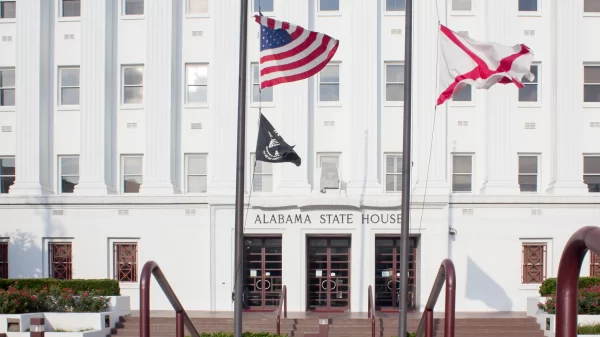










On Wednesday, the House Financial Services Committee held a public hearing on House Bill 585, a bill sponsored by Representative Jennifer Fidler, R-Silverhill. If passed as introduced, HB585 would place a 1.5 percent tax on outgoing international wire transfers, create a compensatory income tax credit, and direct excess tax revenue to sheriffs earmarked for the enforcement of immigration laws.
A similar bill was also supported by Fidler and considered by the legislature last session. It passed the House but failed to clear either the state Senate or the Senate Banking and Insurance Committee before the legislative session drew to a close.
“This is similar but a little bit different than last year,” Fidler told the committee on Wednesday. “As a reminder, there was a group of five or six folks in the legislature that informally met and went over some key bills that we thought could help us in the state of Alabama and this was one, a wire transfer fee put on any international transfers that go out of the state to help with some of the burdens that communities were having throughout the state of Alabama.”
“We’ve reduced the initial fee that we talked about last year from four percent to one-and-a-half percent,” she noted. “As a reminder, two months after we got out of the legislature last year, the Big, Beautiful Bill was passed with a one percent remittance fee on any international wire transfers. So this would be similar except the one-and-a-half percent that was collected would be going back to the area in which the wire transfer occurred to help with the sheriffs’ responsibilities.”
All four of the members of the public who spoke before the committee after Fidler introduced the bill were critical of the proposal. Two, lawyers Jim Barton and Allison Kinney, were speaking on behalf of remittance company Remitly. Barton was a Republican member of the state House between 2000 and 2013.
“This legislation is unnecessary,” Barton told the assembled representatives. “It duplicates existing oversight without improving it.”
He also stated that HB585 “stacks regressive taxes on law-abiding Alabamians” and “runs the risk of creating a triple taxation on lawful Alabamians,” by subjecting the same money to an income tax, a federal tax, and an Alabama specific one-and-a-half percent tax.
Kinney argued that the tax would most affect “Alabama’s military families and our faith-based communities,” pointing out that “wire transfers are very often used by our service men and women overseas.”
Carlos Javier Torres, the policy director for the Hispanic and Immigrant Center of Alabama, also spoke against the bill.
“We understand that this bill, number one, is another tax that is going to be imposed on all Americans, all citizens of the state of Alabama,” he said. “We are concerned that the burden will be on those of us who have families who do not live in the mainland, who have to do wire transfers and have to pay a fee. It could be taken as a tax credit but it’s not refundable, so if someone has a tax responsibility that is less than what would allow for them to get a tax credit, they would not be benefiting from these tax credits.”
After the public comments, Fidler stressed that the bill was designed to not affect “any sort of bank-to-bank transfer or CashApp,” or similar services.
Several representatives, however, still pressed her about whether, as Kinney argued, the bill might make it harder for military families to send funds to their family members in the armed forces serving abroad.
Representative Andy Whitt, R-Harvest, also questioned why the bill was needed at all and what its effects on his suit-buying practices would end up being.
“What is the purpose of the bill, please. Let’s just drill down. What’s the purpose of this piece of legislation?” Whitt asked Fidler.
Fidler responded by saying that “initially it’s been to reduce the community burdens because our communities have burdens that hit it.”
“Our taxpayers have burdens,” Whitt retorted. “You agree with that?” “Sure,” Fidler said.
“And we’re putting additional burdens on our taxpayers,” Whitt continued. “Let me give you an example. You know, I like a good suit. … Just walk down memory lane with me here real quick. I buy some suits from Taiwan. I’ve got a friend over there that makes suits. Anyways, I’ll order suits periodically from Taiwan. And I send my money Western Union. How will that affect me personally?”
“It’d be 1.5 percent,” Fidler responded.
When Fidler said that Whitt would have to file for a tax credit to get compensated for the 1.5 percent tax on the payments for his suits, Whitt complained about the paperwork burden and said that he hadn’t seen any meaningful support for the bill.
“So I would have to fill out additional forms, and I’m a tax-paying citizen, much like our friends from Birmingham that drove down here today for this meeting,” Representative Whitt said. “And I have not seen anyone stand up and support this legislation other than bill sponsor.” After another brief back-and-forth with Fidler, he said that it may be, “as my grandmother would say, we’re patching a roof that doesn’t need fixing.”
Near the end of the committee meeting, Fidler recognized that, even if the bill passes the committee and the House again this session, it is unlikely to pass the Senate as well. “The Senate, even if you guys love it, still doesn’t have time really to take it up,” she noted.