











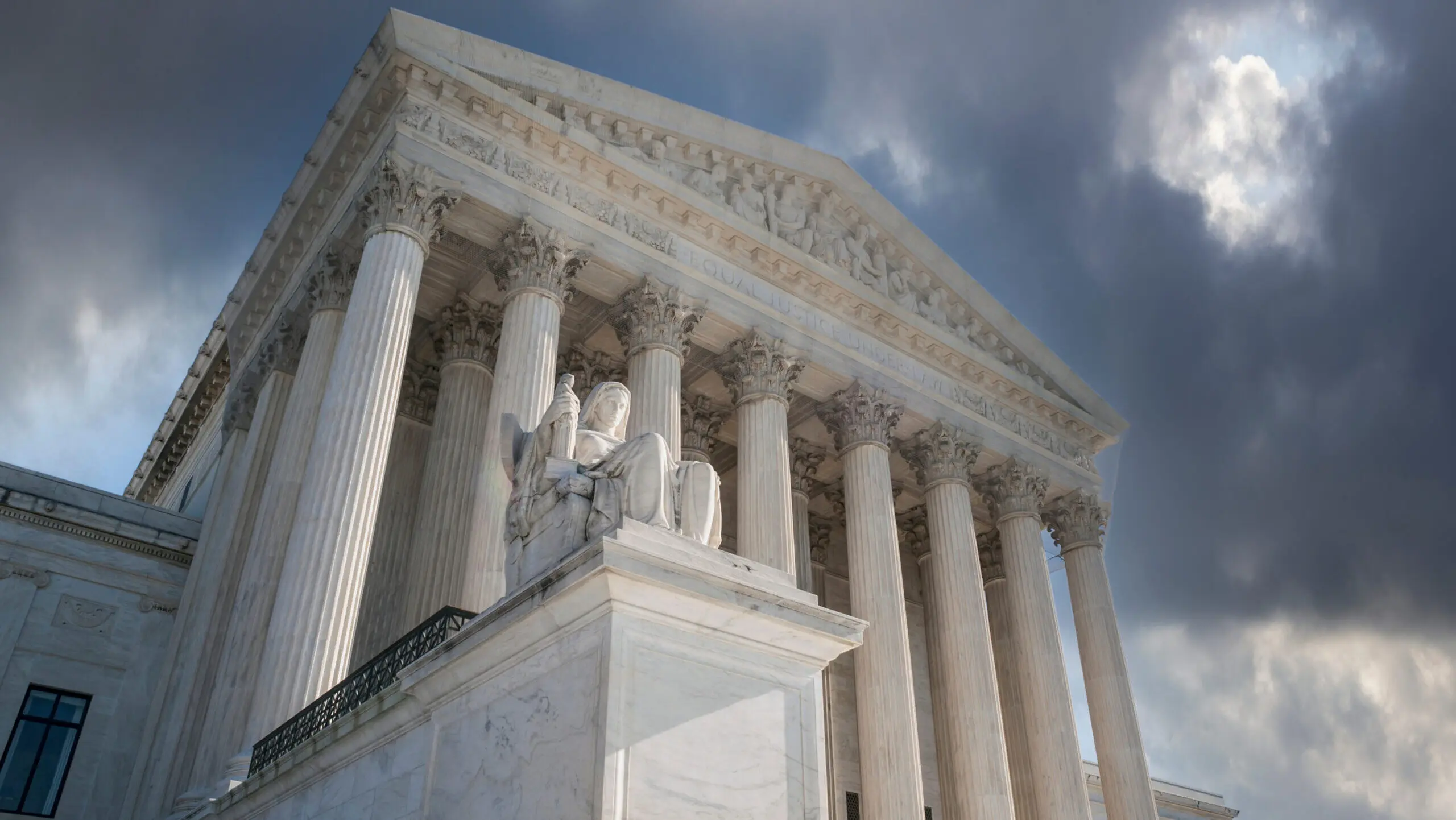
On Wednesday, the Supreme Court heard oral arguments in Trump v. Barbara, the court case over the Trump administration’s attempt to dramatically limit the constitutional right of birthright citizenship established by the Fourteenth Amendment. Alabama Attorney General Steve Marshall and representatives of over twenty other states filed an amicus brief in support of the administration’s position last year.
Both the liberal justices and several of the conservative justices expressed a marked skepticism of the arguments presented by U.S. Solicitor General D. John Sauer. President Trump was in the audience, the first time a sitting president has attended oral arguments before the Supreme Court. He left mere minutes into ACLU National Legal Director Cecillia Wang’s argument.
Trump, on the first day of his second administration, issued an executive order directing the federal government to no longer issue documents recognizing the citizenship of children born on American soil but whose parents who were not either citizens or permanent lawful residents. The order directly contradicted over one hundred years of both practice and judicial precedent.
One of three Reconstruction Amendments passed and ratified after the Civil War, the Fourteenth Amendment has been recognized as guaranteeing citizenship for all children born on American soil since the Supreme Court decided the case United States v. Wong Kim Ark in 1898.
The pertinent sentence, the first one of the amendment, reads:
“All persons born or naturalized in the United States, and subject to the jurisdiction thereof, are citizens of the United States and of the State wherein they reside.”
During oral arguments, Sauer stressed the phrase “subject to the jurisdiction thereof,” claiming that “unlike the newly freed slaves, [temporary visa holders and illegal aliens] lack direct and immediate allegiance to the United States.”
“You obviously put a lot of weight on ‘subject to the jurisdiction thereof,’” Chief Justice John Roberts told the solicitor general. “But the examples you give to support that strike me as very quirky, you know, children of ambassadors, children of enemies during a hostile invasion, children on warships, and then you expand it to a whole class of illegal aliens [which] are here in the country.”
Justices Amy Coney Barrett and Neil Gorsuch, both Republican appointees, also asked why Sauer’s logic wouldn’t lead to conclusions like suggesting the children of freed slaves shouldn’t have been granted citizenship, or recognizing that whether someone enters the United States illegally would be immaterial by the standards of 1868.
Justice Sonia Sotomayor pressed Sauer about whether the government was seeking for the Supreme Court to overturn Wong Kim Ark or the 1957 decision on Hintopolous v. Shaughnessy, which similarly involved asserting that the child of unlawful residents of the U.S. was a citizen. Sauer claimed he was not seeking the overturn of either case, but Sotomayor seemed unconvinced.
Arguing on behalf of the respondents, Cecillia Wang sought to defend the Supreme Court’s 1898 decision in Wong Kim Ark and argue that the understanding of the Fourteenth Amendment even shortly after its ratification included citizenship for the children of “temporary sojourners.”
“Ask any American what our citizenship rule is and they’ll tell you, everyone born here is a citizen alike,” Wang said. “That rule was enshrined in the Fourteenth Amendment to put it out of the reach of any government official to destroy.”
“When the government tried to strip Mr. Wong Kim Ark’s citizenship on largely the same grounds they raise today, this Court said no,” she continued. “Thirty years after ratification, this Court held that the Fourteenth Amendment embodies the English common law rule. Virtually everyone born on U.S. soil is subject to its jurisdiction and is a citizen.”
While justices still pressed Wang on her position, especially the role of “domiciles” in Wong Kim Ark, they seemed generally less skeptical of Wang’s arguments than of the ones Sauer presented.
Legal experts and commentators have suggested that the Supreme Court is likely to rule against the administration, albeit possibly on legal rather than constitutional grounds. The case will likely be decided by early July.


