




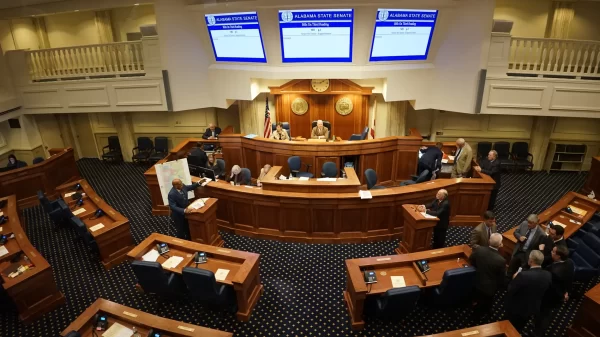








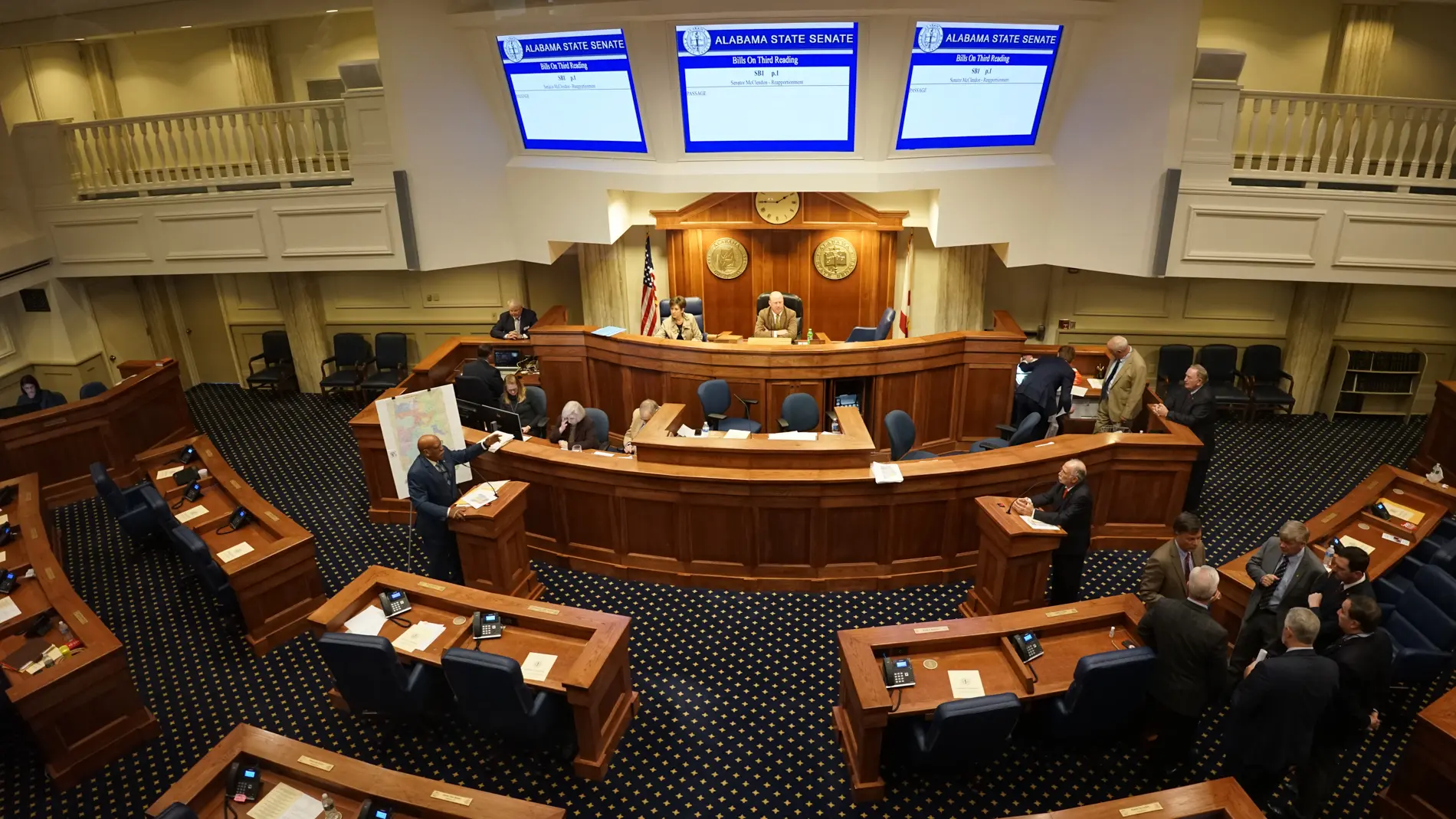
The state Senate unanimously passed a change to its rules on Thursday, significantly limiting the lieutenant governor’s role in presiding over the Senate.
Under the Alabama state constitution, the lieutenant governor presides over the state Senate. However, the Senate also elects a president pro tempore who supplants the lieutenant governor in their absence. Thursday’s rule change allows the president pro tempore to serve as the presiding officer if the lieutenant governor hasn’t taken their seat five minutes after the appointed start time.
This session, the president pro tempore of the state Senate is Senator Garlan Gudger, R-Cullman.
In addition to allowing the president pro tempore to serve as the presiding officer, the lieutenant governor will also no longer be guaranteed a seat on the Senate Committee on Assignments. Following the rules change, there will be four members appointed by the president pro tempore instead of three, and the president pro tempore will be able to dismiss all four at their will.
Senate conference committees are similarly affected. Instead of having two members appointed by the Committee on Assignments and one by the presiding officer, two members will be directly appointed by the president pro tempore, and one member of the minority party will be appointed by the Committee on Assignments.
The rules change also grants the president pro tempore, rather than the presiding officer, the ability to choose whether to recommit a bill to a different standing committee for additional consideration.
In interviews with the Alabama Reflector, Senator Arthur Orr, R-Decatur, and Senate Minority Leader Bobby Singleton, D-Greensboro, described the change as a “separations of power” decision.
Singleton said that senators have “given a lot of power to the lieutenant governor in the legislative branch when they are part of the executive branch,” and argued the Senate needed to reclaim some of that power.
In addition to limiting the role of the lieutenant governor in the state Senate, the rules change will also require any member who requests that a bill be read at length “remain at the microphone for the duration of the reading.”
Another change, unrelated to the redefinition of the lieutenant governor’s role in the state Senate, is the creation of a new standing committee with up to 11 members: the Committee on Economic Expansion and Trade.
The new committee will be tasked with considering “bills and matters pertaining to Alabama’s industries, businesses, and trades affecting Alabama and its goods and services and any other item requiring action deemed appropriate by the assigning authority.”