



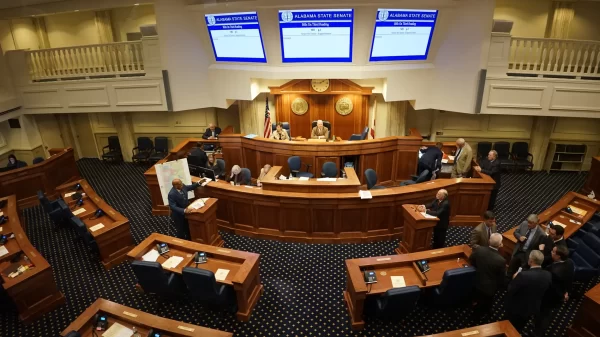







The Senate Transportation and Energy Committee on Wednesday advanced legislation that would open eligibility for utility relocation reimbursements on state road projects and establish new spending caps and reporting requirements.
Representative Chris Blackshear, R-Smiths Station, told committee members the proposal grew out of a study commission formed last year after similar legislation was introduced in the middle of the session. The group met monthly from June through early this year before drafting the current version, which has passed the House.
Under current law, utility companies with gross annual income under $250 million are eligible for reimbursement when they are required to relocate lines for state road projects. Companies above that threshold are not eligible for reimbursement, even though they still must move facilities.
House Bill 542 would remove the $250 million income cap, making all utilities eligible to seek reimbursement. However, the bill would limit how much the Alabama Department of Transportation could reimburse larger companies. It would cap utility reimbursement for companies with gross annual income above $250 million at $10 million annually, with a $500,000 maximum per project.
The legislation also would require ALDOT to spend at least $20 million annually on reimbursements to companies under the $250 million threshold. Blackshear said ALDOT has averaged about $21.86 million a year in relocation reimbursements over the past five years.
Blackshear said the maximum potential “net new” exposure under the bill would be about $8.14 million annually. ALDOT’s overall budget is about $2.5 billion.
The bill would not take effect until October 1, 2027, meaning it would not affect the current or upcoming budget cycle. Beginning October 1 of this year, however, ALDOT would have to implement a reporting mechanism detailing which relocation projects are reimbursed and which are not, while submitting annual reports. Blackshear said those reports would provide a clearer picture of reimbursements within the department so lawmakers could revise the legislation later if needed.
An amendment adopted in committee clarifies that projects using state funds through county or municipal matching programs would remain eligible for reimbursement. It also specifies that the bill applies only to utilities located in public rights of way, not private rights of way.
During the public hearing, supporters said the measure would promote fairness and predictability.
Taylor Vice, senior director of government affairs for Charter Spectrum in Alabama and president of the Alabama Cable and Broadband Association, told the committee that Alabama’s current policy is a national outlier and unfairly penalizes certain utilities based only on revenue.
“This $250 million income threshold is not present in any other state. We are the only state in the country that bases eligibility on how much a company makes. This bill ensures that when a government project causes the relocation, the project bears the cost,” Vice said.
Tony Harris, government relations manager at ALDOT, said the current relocation framework has been in place since the Federal Aid Highway Act of 1956, with periodic adjustments to the income threshold, which originally began at $10 million before rising to $250 million.
“What we’re gathered for here today is a weighty public policy issue, and by setting a $10 million amount to reimburse the handful of large utilities currently not eligible, we likely will see efforts to ratchet up that $10 million fund that would be created in the same way we’ve seen the threshold that is currently in the law,” Harris said.
Harris also raised concerns about the bill’s requirement that ALDOT reimburse at least $20 million annually for smaller utilities, noting that in some years the department did not undertake enough qualifying projects to reach that level.
Harris suggested lawmakers carry the bill over for further study, possibly through the Joint Transportation Committee, and floated alternatives such as tying reimbursement percentages to how long a utility has been in place.
Senator Greg Albritton, R-Atmore, voiced opposition, arguing the bill would divert transportation dollars to large private utilities. He said roughly $60 million in recent years had been redirected back to ALDOT after it was briefly used to subsidize the court system and the Alabama Law Enforcement Agency.
“$20 million now of that money that we sent back for DOT, it’s not gonna go into roads and bridges. It’s gonna be going into the pockets of large utility that’s given a monopoly that’s using the state right of way, that has state authority to get right of way,” Albritton said.
Blackshear said ALDOT would retain discretion over which projects are reimbursed and in what amounts, subject only to the annual minimum and maximum caps in the bill.
The committee adopted the amendment and then approved House Bill 542 on a roll call vote, sending HB542 to the full Senate for consideration.