



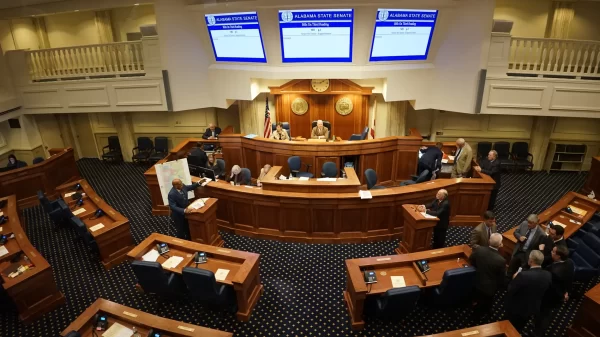







The Alabama House of Representatives passed Senate Bill 233 on Thursday, advancing legislation that would increase criminal penalties for attempting to elude a law enforcement officer.
Senator Lance Bell, R-District 11, sponsored the bill, and Representative Reed Ingram, R-District 75, carried it in the House.
Senate Bill 233 would raise the penalty for attempting to elude law enforcement in a motor vehicle from a Class A misdemeanor to a Class D felony, punishable by up to five years in prison and a $7,500 fine. Eluding by foot would remain a Class A misdemeanor punishable by up to one year in jail and a $6,000 fine.
SB233 also would add circumstances that could elevate attempting to elude a law enforcement officer to a Class C or Class B felony.
Under current Alabama law, the charge can rise to a Class C felony if a person collides with another vehicle or a pedestrian while fleeing law enforcement, causes physical injury to another person while attempting to elude, or crosses state lines during a police chase. SB233 would add Class C felony charges when a child younger than 14 is in the vehicle, when the person is on bail, probation or parole, or serving a sentence in a community corrections or work release program, or when the person has a previous conviction for attempting to elude.
Current law allows a Class B felony charge if an attempt to elude causes serious injury or death or if the person exceeds the speed limit by more than 20 mph while fleeing law enforcement. SB233 would add Class B felony charges if a person strikes or attempts to strike a law enforcement officer with a vehicle or has two or more previous convictions for attempting to elude.
The bill aligns with Governor Kay Ivey’s call for tougher penalties during her state of the state address.
“Unfortunately, some criminals attempt to elude their authority,” Ivey said. “There are repeat offenders and in the worst cases, there has even been loss of life. It is time we crack down on that reckless, criminal behavior and pass a bill led by Representative Reed Ingram and Senator Lance Bell.”
Still, SB233 drew strong opposition from Democratic lawmakers before Thursday’s vote.
Several members of the minority caucus said the bill ignores longstanding distrust between communities of color and law enforcement in Alabama. They argued that Black Alabamians sometimes flee police out of fear for their own safety.
“Sometimes people run and they’re not guilty of something,” Representative Napoleon Bracy, D-Prichard, said. “And we’ve seen that a lot, especially in my community. People would rather run to avoid a situation than to actually sit and have some level of confrontation or explanation with the police. They would rather avoid the police.”
“I know people that will run from the police that have not done anything just to avoid any level of confrontation with the police, because sometimes police confrontations can be escalated and not de-escalated,” Bracy added.
Representative TaShina Morris, D-Montgomery, echoed those concerns and asked Ingram how the bill would account for officers who “overstep their boundaries” and may cause people to flee for their own safety.
“Let’s hope we got rid of all them that overstepped their boundaries,” Ingram said. “I think we’ve got some good officers out there.”
Representative Thomas Jackson, D-Thomasville, said police brutality against Black Alabamians remains a serious concern. He pointed to the ongoing investigation into the death of 35-year-old Ammarin Tunstall, who died last week in Monroeville police custody. Video shows officers dragging Tunstall on the ground after they allegedly used a Taser and pepper spray on him multiple times.
“This is why we run,” Jackson said. “Because we want to live.”
Representative Juandalynn Givan, D-Birmingham, called SB233 a “band-aid” that ignores broader systemic distrust between Black Alabamians and law enforcement. Representative Mary Moore, D-District 59, urged Republican lawmakers to consider not only law enforcement concerns but those of other communities as well.
“I don’t think you all are listening,” Moore said.
Ingram said SB233 is not tied to police brutality or racial profiling and said the measure is intended to improve public safety.
“This bill is not about profiling,” Ingram said. “This bill is about the facts.”
The House passed SB233 by an 80-15 vote. The bill now goes to Ivey’s desk and is likely to be among several measures signed into law in the final days of the 2026 Legislative Session.