


























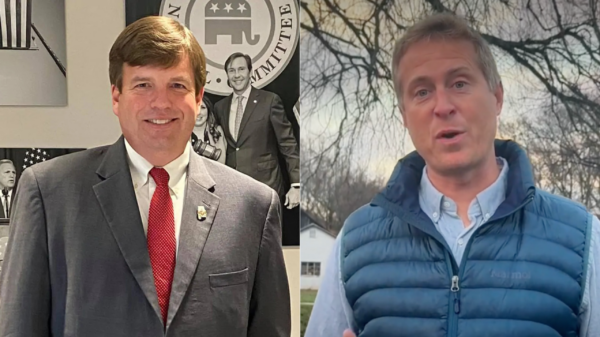


Welcome to the fight, Senator Tuberville.
On Monday evening, for the first time in what has been a year-long debate over Tommy Tuberville’s residency status, particularly where it concerns the requirements that a candidate for governor in Alabama live in the state for the seven years prior to the general election, Tuberville and his team offered up its first substantive defense. It came in the form of seven years (2018-2024) of tax returns, property tax records and an answer to numerous questions that had been posed by his Republican primary challenger Ken McFeeters.
I joked on social media awhile back that it was possible Tuberville was going to go into court at some point and produce a 1964 Pontiac Tempest, like Mona Lisa Vito in “My Cousin Vinny,” and blow up the widely accepted notion that he can’t prove that he really lives in Alabama. Monday’s filing wasn’t the whole Tempest, but it was definitely a couple of tires and an engine block.
But so many questions remain.
Like, why now? What was the hold up? Why didn’t Tuberville and his team produce this stuff months ago and squash what has been a growing controversy among voters and media—a controversy that has now been settled in most public circles, with people either believing one way or the other. It makes no sense.
Then again, lots of things make no sense. And like those things, there is no quick answer. I’m certain we will discover many answers down the road, but for now, the best we can do is analyze what we’ve got.
What do the tax returns mean?
Make no mistake about it, the tax returns are vitally important to this case. While they do not prove absolutely that Tuberville has been a resident citizen of Alabama for the past seven years, those returns presented Monday—if they can be verified and we don’t discover later that a couple of years were paid retroactively—would be a very big hurdle to overcome. Not impossible. But very daunting.
That’s because, if those returns are legit, anyone challenging Tuberville’s residency could not rely on cold, black-and-white documents. They would be left attempting to prove in court that the Auburn home is not Tuberville’s primary residence by showing that the former Auburn coach has not spent a majority of his time there, hasn’t slept there, doesn’t keep his possessions there, doesn’t conduct life’s primary business in the general area.
That’s certainly not impossible, as was proven during the David Cole residency case a couple of years ago. Cole was a state representative who attempted to claim a friend’s residence as his primary residence in order to meet requirements that he live in House District 10. In a deposition, Cole admitted that he never slept at the home, kept no possessions there and never ate dinner there. That was a wrap. He ended up going to jail for voter fraud because he used that address on his voter registration and voted outside of his precinct.
Tuberville will certainly face similar questions, as will his wife, Suzanne. McFeeters has already proclaimed that he wants to ask the Tubervilles about living in a three-bedroom, one-bathroom home for the last seven years and drill down on the specifics of their lives. Under the rules established by the Alabama Republican Party for a hearing, McFeeters will get that chance. He, or his attorneys, can subpoena up to five people and question them for up to two hours each in an under-oath deposition.
That’s a lot of time. A lot of ground can be covered.
Since you mentioned voter fraud…
One big mystery contained within the tax returns released by Tuberville’s attorneys is why the 2018 tax year’s return was included. It wasn’t necessary to meet the seven-year residency requirement (Tuberville needs to have lived in Alabama continuously from November 3, 2019) and, more importantly, it appears to show Tuberville committed felony voter fraud.
According to that tax filing, Tuberville became a resident of Alabama on August 1, 2018. The return has the box for “part year” checked and the dates “8-1” and “12-31” entered for the time period for his “Residency.”
The problem is Tuberville voted in Florida in November 2018.
According to records from the Walton County, Florida, registrar’s office, Tuberville registered to vote in Florida on May 24, 2017, and voted by mail in the 2018 general election. The earliest he could have received a mail-in ballot was October 2, 2018, according to the Division of Elections at the Florida Department of State.
This issue also ensnares Suzanne Tuberville, who also voted in Florida in 2018. She and the Tubervilles’ son, Tucker, claimed a homestead exemption on the Auburn house in October 2018. To gain such a homestead exemption a person must claim the property as their primary residence.
This has been a central component of Tuberville’s argument that he is a legal Alabama resident—the fact that the family held a homestead exemption on the Auburn home (even though he was not on the home’s deed until 2024). That means there is now both a homestead exemption and a tax filing that shows the Tubervilles were Alabama residents when they voted in Florida, after swearing a year earlier that they were Florida residents.
That seems … not good.
Another curious admission …
The voter fraud was not the only potential legal issues exposed by Tuberville and his attorneys in their response to McFeeters’ challenge. As reported by the Lagniappe Daily late Tuesday, in answering McFeeters’ questions about Tuberville’s reimbursements from his Senate office account and his various political action committees for food, transportation and flights to the Florida coast, Tuberville’s attorneys refute that these are evidence of Tuberville residing primarily in Florida but are instead nothing more than the expenses associated with Tuberville’s “vacation escapes.”
That would appear to be another legal issue, because it is generally illegal for a senator to accept reimbursements from his senate office account for travel expenses to a vacation home. Additionally, while rules are a bit looser for PAC expenditures, those expenses typically have to be tied to campaign purposes and travel to a vacation home would not be acceptable.
McFeeters has already filed an ethics complaint with the Alabama Ethics Commission over Tuberville’s campaign expenditures. This is likely more fuel for that fire.
What does it all mean?
The Tuberville camp’s filing, despite some obvious issues that will have to be dealt with, was stronger than many expected. I think it was naturally assumed after more than a year of news stories and public chatter over his residency that Tuberville simply didn’t have evidence to back up his claims and he was going to rely on the Republican-dominated courts in Alabama to get his back.
These documents make clear that’s not the case. Tuberville is going to put up a fight—a good one.
That should be more than a bit worrisome for those on the other side. Because as the Republican nominee, in a legal matter in which judges are already inclined to get out of the way and let voters decide, all he needs is a crack of doubt. A little crevice for a judge or some justices to wriggle through.
On the other hand, if it’s discovered somewhere down the line that there’s a problem with one or more of the tax returns offered up, well, that’s a whole other issue.
But we do know one thing for sure: It looks like the fight just got started.