

















John Wahl did something Alabama conservatives often say they want candidates to do: He proposed cutting taxes in a way that would matter.
Not trimming around the edges. Not offering a temporary rebate. Not promising another study. Wahl made phasing out Alabama’s state income tax a central part of his campaign for lieutenant governor, arguing that Alabama should reduce the burden on work, help families keep more of what they earn and make the state more competitive with its neighbors.
Wahl did not present the phaseout as an overnight act of fiscal magic. He described it as a six- to eight-year effort that would have to be done through a responsible model. His first step would be to raise the income threshold before Alabamians are required to pay state income tax. That matters because the proposal begins where Alabama’s tax code is most plainly unfair—with low-income workers and families pulled into the system too soon.
That is not some exotic theory of government. It is basic conservative tax policy.
And the Alabama Policy Institute tried to knock it down.
API did not respond as though Wahl had opened a serious debate about one of the most unfair features of Alabama’s tax code. It did not say the idea was ambitious but worth studying or offer a competing path to phasing down the income tax burden on working families, low-income citizens, small businesses and job creators.
Instead, API publicly dismissed the idea. In a Facebook post titled “The truth about tax cuts,” the Alabama Policy Institute called it “utter nonsense to advocate for a freeze or the immediate and/or full elimination of the corporate and individual income tax in Alabama.” API also wrote that anyone proposing immediate elimination of the income tax “cannot do basic math” and “likely overestimates their role in the process.”
API’s concern would be understandable if it had been limited to overnight elimination. No serious person should pretend Alabama can erase a major revenue source by wishing it away. But API’s public language went further. It treated the broader goal of freezing or eliminating Alabama’s income tax as unserious. That is where caution became opposition.
That was not merely a policy disagreement. It was an institutional rebuke from the organization many expected to welcome a serious debate over lower taxes, limited government and competitiveness.
Stephanie Holden Smith’s comments matter because she is not a random observer. Smith is president and CEO of the Alabama Policy Institute, the state’s best-known conservative policy organization. When she argued publicly that eliminating the income tax would not numerically work without raising other taxes, her words carried institutional weight and helped define API’s posture toward one of the most ambitious conservative tax goals now before Alabama.
Smith and API have every right to ask how the numbers work. Budgets matter. Education funding matters. Revenue matters. The math matters.
But API was right to ask for math. It was wrong to mock the mission.
There is a difference between asking hard questions about how to phase out an income tax and declaring the goal itself to be nonsense. A conservative think tank should be where conservative tax reform is made workable, not where it is declared impossible before the work begins.
Wahl’s proposal deserves scrutiny. Any serious tax plan does. But it also deserves to be taken seriously because it confronts a real problem: Alabama’s income tax reaches working people too quickly and takes too much too soon from people still trying to gain financial footing.
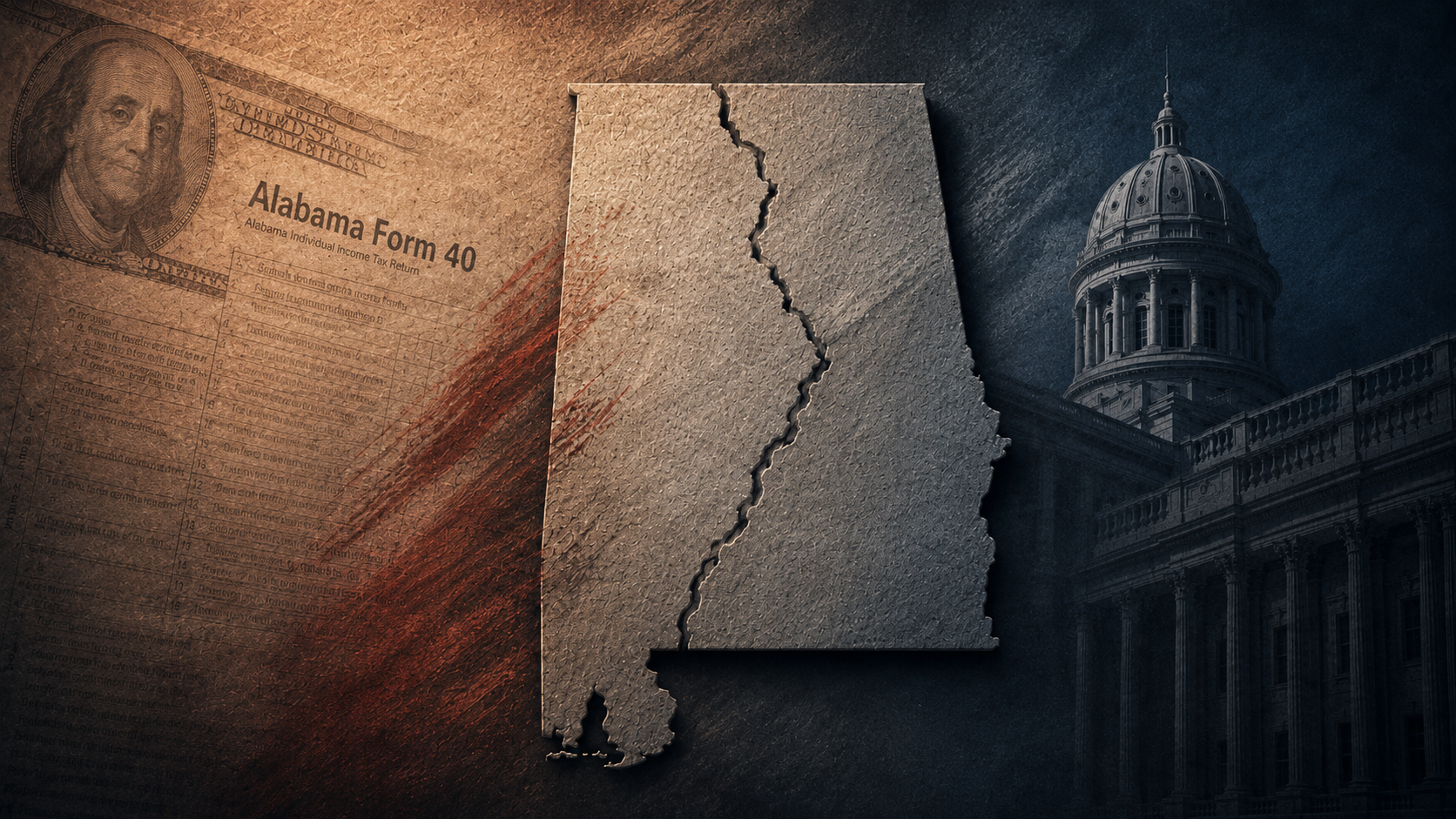
According to the Alabama Department of Revenue, single people with adjusted gross income of $4,000 or more are subject to Alabama’s individual income tax rate schedule. For single filers, the state taxes the first $500 of taxable income at 2 percent, the next $2,500 at 4 percent and taxable income over $3,000 at 5 percent. For married couples filing jointly, the top 5 percent rate begins on taxable income over $6,000.
Think about what that means. A person can be poor by any common-sense measure and still be pulled into Alabama’s income tax system: a single mother working a low-wage job, a young worker just starting out, a family already paying sales taxes, grocery taxes, gas taxes, car tags, fees and other costs attached to ordinary life.
These are not abstractions. These are Alabamians.
The moral force of Wahl’s argument begins there. Higher earners would benefit from lowering or eliminating the income tax. So would small-business owners, professionals, employers trying to attract workers and families across the income scale who would keep more of what they earn.
But the deepest unfairness is found at the bottom, where Alabama’s tax code reaches people long before they have much room to absorb the burden. There is nothing conservative about taxing people before they have reached stability. There is nothing pro-family about taking too much, too soon, from those trying to build one. And there is nothing pro-growth about admiring Tennessee and Florida while explaining year after year why Alabama cannot move in the same direction.
For years, Alabama conservatives have praised states with stronger growth and lighter income tax burdens. They have looked to Florida and Tennessee as examples. But when Wahl, the former chairman of the Alabama Republican Party and now the Republican nominee for lieutenant governor, put a serious income tax phaseout before voters, API did not lead the conversation. It tried to stop the conversation before it began.
Mississippi, Alabama’s neighbor and frequent competitor, has already moved in the direction Wahl is suggesting. In 2025, Mississippi enacted House Bill 1, cutting the state’s individual income tax rate to 3 percent by calendar year 2030, with future trigger-based reductions that could eventually take the rate to zero if revenue conditions are met.
That does not mean Alabama can copy Mississippi line for line or ignore its own obligations. But it does mean this idea is not fantasy. It is within the mainstream of conservative tax policy in the Deep South. That makes API’s dismissal harder to understand.
API itself has argued that Alabama needs tax relief. In its own policy work, API has proposed moving to a flat individual income tax rate of 3.95 percent, eliminating the state’s 2 percent income tax bracket and reducing the corporate income tax rate from 6.5 percent to 4.75 percent.
So API is not against every tax cut. That is not the point. The point is that API drew a line when the reform became more ambitious. It was willing to trim the system. Wahl proposed challenging the system.
Those are not the same thing. One approach accepts Alabama’s tax structure and seeks to make it somewhat less burdensome. The other asks whether the structure itself is wrong. One works within familiar boundaries. The other asks why those boundaries exist at all.
That is why API’s criticism matters. It was not coming from the left, Democrats or advocates of bigger government. It was coming from Alabama’s conservative policy establishment, aimed at a Republican nominee advancing a recognizably conservative idea.
There is a pattern in Alabama politics. Bold reform is often praised in theory and resisted in practice. Leaders talk about change until change threatens familiar arrangements. Then the warnings come dressed as prudence, process and arithmetic. Sometimes those warnings are necessary. Sometimes they are right. But sometimes they are simply the voice of an establishment more comfortable managing the old system than building a better one.
Alabama’s old system is not good enough for working families squeezed from every direction, low-income citizens taxed before they have a foothold, small businesses and job creators competing in a region where other states are moving faster, or a state that talks about growth but too often settles for excuses.
Wahl’s victory does not settle the tax question. It does not write the legislation. It does not balance the budget. It does not guarantee that Alabama can phase out its income tax exactly as proposed or on any particular timeline.
But it does prove something politically important. Republican voters were willing to hear the argument. They were not frightened by the idea of major tax reform. They did not reject a candidate for saying Alabama should think bigger.
That should matter to every conservative organization in this state, especially the Alabama Policy Institute and Smith.
John Wahl has put forward a bold idea, but more importantly, a serious one. It is rooted in fairness, work, family, competitiveness and the belief that conservative principles should do more than decorate campaign speeches. They should shape policy.
Now the question is whether Alabama conservatives will do the hard work of making those principles real.
Alabama does not need another generation of leaders explaining why bold reform cannot happen here. It needs leaders willing to ask why it has not happened already.