








It was two days after Thanksgiving in 1964. After learning that her partner’s brother, Frank Andrews, had been shot, Mabel Estes rushed to Choctaw County General Hospital in Butler.
Estes arrived too late.
Andrews was dead. He left behind four young children—three daughters and a son.
Choctaw County Sheriff Leon Clark and the FBI briefly investigated the killing. Neither investigation resulted in an arrest or prosecution.
The case remained closed for decades until the FBI reopened it and interviewed former Deputy Sheriff Quinnie Donald, the original subject of the investigation.
Donald initially admitted to shooting Andrews during an FBI interview in 1964. In a 2008 interview, however, Donald changed his account and told agents the gun discharged accidentally.
The FBI declined to prosecute Donald for the shooting or for making a false statement to investigators.
In 2013, the FBI closed the case again.
Donald told the Associated Press in 2015 that he regretted killing Andrews. Andrews’ family said he never directly apologized.
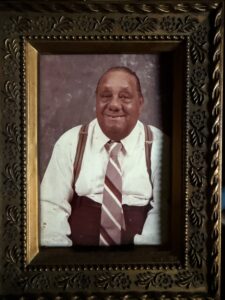
Frank Andrews’ father, Sylvester “Boise” Andrews. (Photo courtesy Mabel Estes)
“He was a nice person.”
Frank Andrews, 27, was one of 16 children born to Sylvester “Boise” and Lelia Andrews. He lived with his family on a farm on Ararat Road, a predominantly Black community several miles southeast of Butler. The family grew cotton and raised cattle and hogs.
Andrews attended a small segregated school on Ararat Road with his siblings.
“It was a two-teacher school,” Lisman Councilwoman Linda Turner-Gaines said in a May 2025 telephone interview. “My mother used to teach at the school.”
When Andrews was 5 years old, his mother died during childbirth. His father never remarried. Andrews’ older sister, Lucille “Cille” Edwards, helped raise the younger children.
As an adult, Andrews cut timber and hauled logs to a nearby sawmill that produced wood pulp.
“He was a nice person,” Estes said during a March 2026 interview at her home in Mobile. “He liked to hunt and fish.”
Two different stories about the shooting at Smith’s Cafe
On November 28, 1964, sheriff’s deputies “Bo” Clark and Quinnie Donald went to Smith’s Cafe, a Black-owned establishment on Route 10 in Lisman, to investigate reports of illegal whiskey sales, according to a U.S. Department of Justice report.
“It was a little gathering spot where people would go,” Turner-Gaines said. “People would sit around talking and she [Mrs. Smith] would fix food.”
Andrews and his friend, Charlie Lee Jackson, were sitting in Jackson’s truck outside the cafe.
According to a statement Clark later gave the FBI, he asked Andrews to open the glove compartment.
Andrews refused.
Clark ordered Andrews out of the truck.
Donald later told the FBI that he believed Andrews had a knife and was leaning toward Clark as if preparing to attack him.
Donald said he warned Andrews to move away from Clark.
Andrews did not move.
Seconds later, Donald shot Andrews in the back with a .38-caliber pistol.
Black witnesses gave investigators a very different account.
Jackson told the FBI that Andrews turned to him and asked whether it was all right to open the glove compartment. Jackson said yes.
According to Jackson, Clark then ordered Andrews to ignore Jackson and listen only to him. Andrews exited the truck, and Jackson heard Clark place him under arrest.
Jackson said Donald then approached Andrews with his gun drawn, patted him down for weapons and walked behind him. Without saying anything, Donald shot Andrews in the back.
Jackson told investigators Andrews neither attacked Clark nor possessed a knife.
Two other witnesses, 18-year-old Tommie Lee Roberts and Rose Mae Spear, a beauty shop owner whose business sat next to Smith’s Cafe, told the FBI they saw Donald point his gun at Andrews’ chest.
Roberts also said he saw Donald move behind Andrews and press the gun into his back.
Both witnesses heard the shot.
Although investigators documented conflicting accounts, the Choctaw Advocate reported only the version provided by the deputies.
After the shooting, Donald and Clark drove Andrews about eight miles to Choctaw General Hospital in Butler. The segregated facility assigned Black patients to the hospital’s 300 ward.
Andrews died less than two hours later.
Dr. James H. Clark, who signed the death certificate, listed the cause of death as hemorrhaging caused by a gunshot wound to the chest and a ruptured liver. He ruled the death a homicide.

Telegram from John LeFlore to the U.S. Department of Justice. (Photo courtesy Non-Partisan Voters League Records, The Doy Leale McCall Rare Book and Manuscript Library, University of South Alabama.)
Calls for a federal investigation
Andrews’ brothers Sammie, Arlester and Melvin Andrews sought help from Mobile civil rights leader John LeFlore, according to LeFlore’s papers.
LeFlore spent decades leading civil rights efforts in Mobile.
“He worked on everything—voting rights, education, housing,” his grandson, Burton LeFlore, said during a March 2026 interview in Mobile.
LeFlore helped found the Mobile branch of the NAACP in 1925 and later created the Non-Partisan Voters League. He pursued civil rights work during evenings and weekends while maintaining his job as a U.S. Postal Service letter carrier.
Witnesses told LeFlore that Andrews was unarmed and did not resist arrest, according to contemporary news reports.
On December 2, 1964, LeFlore sent an urgent telegram to Nicholas Katzenbach, acting attorney general at the U.S. Department of Justice during President Lyndon B. Johnson’s administration.
“Our investigation shows that Andrews … was shot in the back and not in the chest and that he did not resist arrest, nor did he advance on the deputy with a knife,” LeFlore wrote.
LeFlore urged federal officials to investigate, arrest Donald and conduct an autopsy.
The following day, FBI Special Agent in Charge Earl M. Dalness announced that the Justice Department’s Civil Rights Division had ordered an investigation.
Several days later, Andrews’ family held funeral services at Slater CME Church. He was buried in an unmarked grave at Slater Cemetery near Ararat Road on December 6, 1964.

Choctaw County Courthouse in Butler. (Photo courtesy Alabama Department of Archives and History.)
Local investigation
At about the same time federal authorities announced their investigation, Sheriff Clark launched a local inquiry.
Clark was the older brother of Deputy “Bo” Clark, who was involved in the incident.
Despite calls for Donald’s arrest, Clark never arrested him, and Choctaw County Solicitor Wyman O. Gilmore never filed charges.
Officials handled Andrews’ death differently than another fatal encounter involving the sheriff’s office months later, when 28-year-old Alton Hendley, a white Choctaw County resident, died during a high-speed chase involving deputies.
Unlike Hendley’s case, officials did not convene a coroner’s jury or perform an autopsy, despite requests from Andrews’ family.
Clark later presented the case to a grand jury.
After hearing testimony from Jackson and other witnesses over two days, the grand jury declined to indict Donald.
Within weeks, the FBI also concluded that federal prosecution was unwarranted and closed the case.
Family members said they expected that outcome.
“Nobody thought that anyone would be prosecuted,” Estes said.

FBI memo on 1965 demonstration.
Memorial service and demonstration
Several days before Christmas 1965, Andrews’ family and supporters organized a memorial service at St. Mark’s CME Church in Lisman.
More than 100 people attended.
After the service, participants marched peacefully along Route 10 to Smith’s Cafe, where Donald had shot Andrews one year earlier.
The Choctaw Advocate regularly published coverage of Ku Klux Klan rallies and membership drives led by Alabama Grand Dragon Robert Creel. The newspaper did not report on the demonstration.
The FBI did.
According to records from the FBI’s Mobile office, agents informed headquarters about the event.
“About 100 persons marched to Smith’s Cafe without incident,” an FBI report stated.
The bureau took no further action.
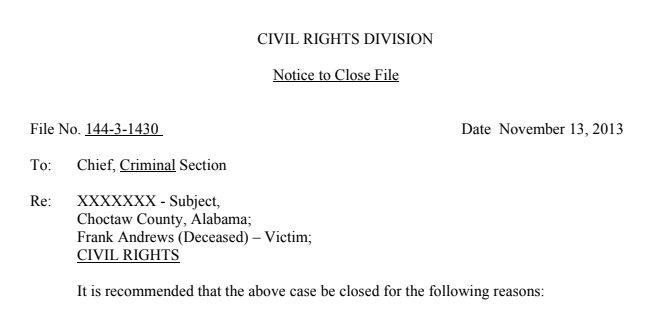
2013 DOJ notice closing case.
FBI reopens case 40 years later
More than four decades after the killing, President George W. Bush signed the Emmett Till Unsolved Civil Rights Crime Act into law. The measure authorized investigations into civil rights-era killings that occurred before December 31, 1969.
Based on recommendations from FBI field offices and civil rights organizations, Andrews’ name appeared on a list of unsolved cases.
The FBI reopened the case in 2008.
Agents interviewed Donald, who had left the sheriff’s office, entered the trucking business and later served as mayor of Needham.
During the interview, Donald substantially changed the account he had given investigators in 1964.
Donald said he was carrying an unfamiliar weapon and that the trigger was more sensitive than expected. He said the shooting was accidental.
Although Donald admitted shooting Andrews and altered key details of his original statement, the investigation produced the same result.
The Justice Department closed the case in 2013, concluding that federal prosecution was not warranted.
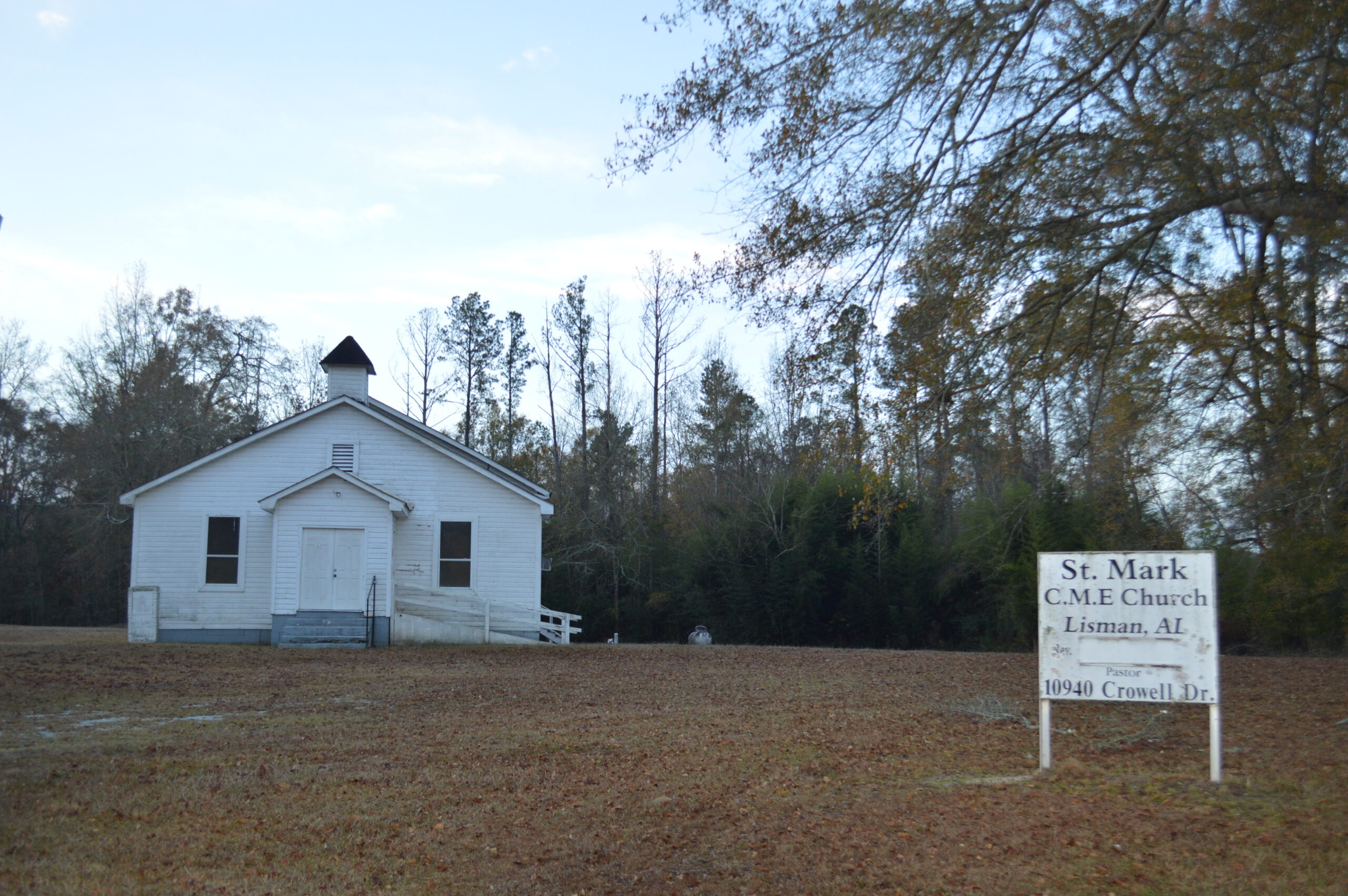
St. Mark’s CME Church in Lisman. (Photo by Liz Ryan)
No justice and no apology
More than 60 years later, Andrews’ relatives continue to remember him and question why no one was held accountable.
Faye Andrews, who was married to Andrews’ brother Charles “CA” Andrews, said her husband frequently spoke about Frank Andrews and the shooting.
“Frank was a good man,” she recalled him saying.
Asked whether the family received justice, she answered: “No.”
Estes gave the same response.
“No, I do not.”
The family has never received an apology from Donald or the Choctaw County Sheriff’s Office, Estes said.
Few traces of Andrews’ life remain beyond the memories of those who knew him.
“After Frank was killed, everybody was sad,” Estes said. “Frank didn’t bother anybody; he was just riding in Charlie Jackson’s truck.”