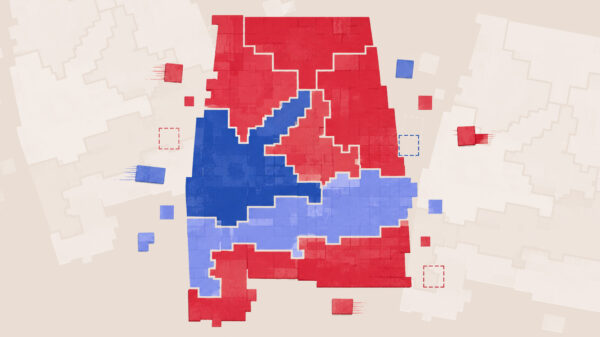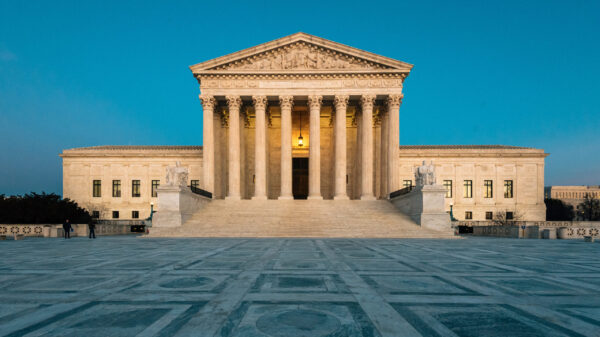





















The U.S. Supreme Court’s latest order in Alabama’s congressional redistricting litigation raises a legal and practical question: What does it mean for a precedent to remain good law if the remedy it once appeared to require is no longer available in the same way?
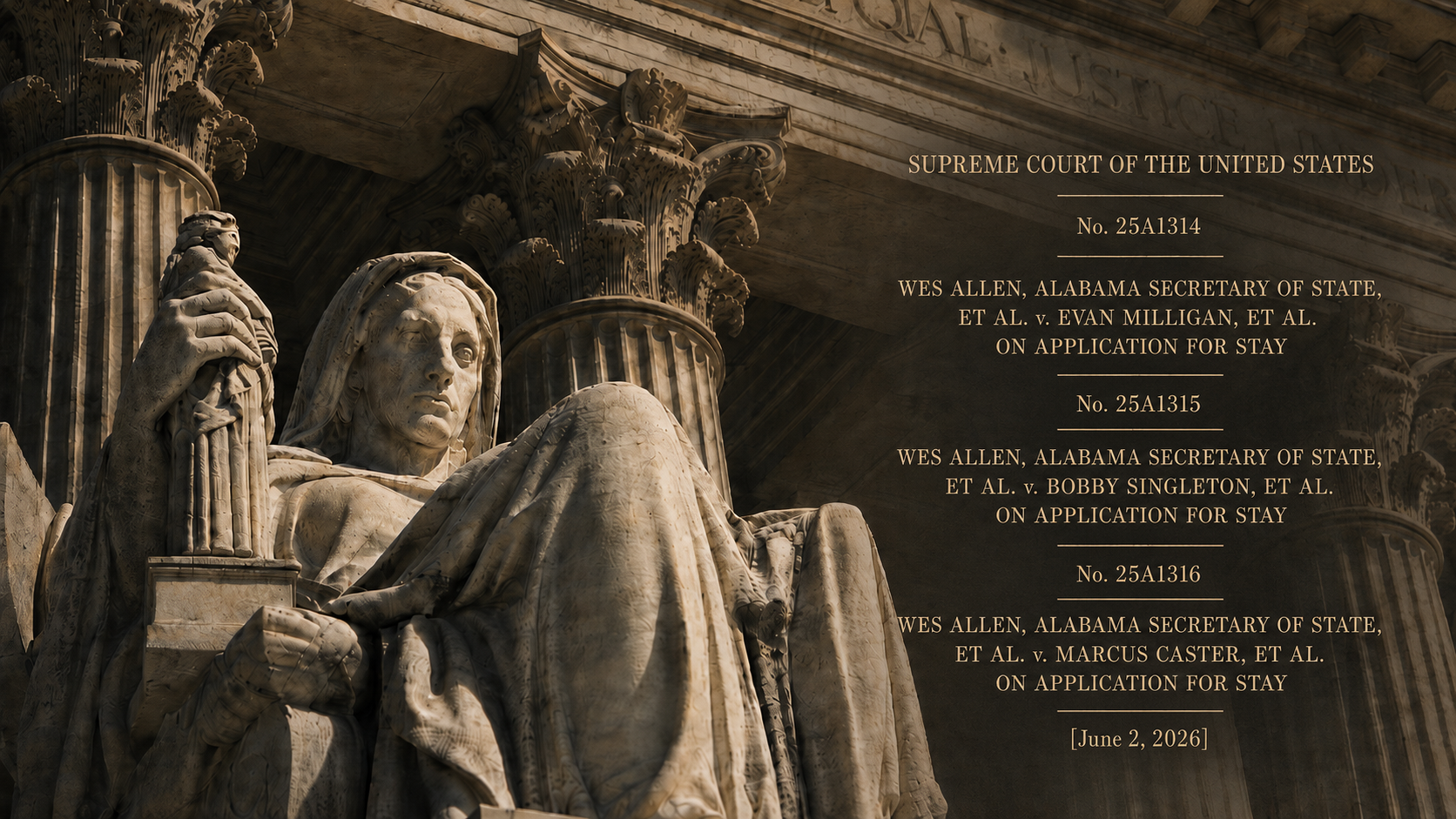
That question sits at the center of the Court’s June 2 order allowing Alabama to move forward, at least for now, under its 2023 congressional map. The order follows the Court’s recent decision in Louisiana v. Callais, which changed the standards for proving vote dilution under Section 2 of the Voting Rights Act. In the Alabama order, the Court said the lower court failed to follow those new standards and concluded that the state was likely to succeed on the merits.
The difficulty is that the Court had previously affirmed the lower court’s ruling in Allen v. Milligan, the 2023 case holding that Alabama’s earlier congressional map likely violated Section 2 because it diluted Black voting strength. That decision was widely viewed as a significant voting rights ruling. It required Alabama to adopt a map with either a second majority-Black district or a second district in which Black voters otherwise had an opportunity to elect a candidate of their choice.
Now, the Court says Allen remains good law while allowing Alabama to proceed under a map that lower courts found did not adequately remedy the violation recognized in Allen.
The Court’s position may be defensible in a technical sense. Allen has not been formally overruled. It remains on the books. Lower courts and lawyers may still cite it. The majority in Callais said it did not overrule Allen, and the Alabama order treats Callais as an update to the standards governing Section 2 rather than an abandonment of Allen itself.
The practical effect is harder to reconcile.
A parent might tell a child, “I am not taking away what I promised you. I am only changing the rules so you can no longer use it.” No 5-year-old would accept that distinction. The child would understand the practical truth: The promise may remain in words, but it has been taken away in effect.
That is the difficulty with the Court’s treatment of Allen. The decision remains formally intact, but the remedy it once appeared to require has been narrowed by a new legal standard. For voters, the practical effect matters more than the doctrinal label.
The Court did not erase Allen. It changed the terrain beneath it.
Under Callais, plaintiffs bringing Section 2 vote-dilution claims now face a more demanding test. The Court said an alternative map must satisfy all of the state’s legitimate districting objectives “just as well” as the state’s own map. It also said plaintiffs cannot use race as a districting criterion in preparing that alternative map and must provide analysis showing that racial bloc voting cannot be explained by partisan affiliation.
Each of those requirements matters in a state like Alabama.
Race and party often overlap in modern Southern politics. Communities of interest can be defined in ways that either recognize or obscure the political history of Black voters. State districting goals, such as protecting incumbents, preserving certain regions or emphasizing selected communities, can be presented as race-neutral even when their effect is to limit Black political power.
That does not make every state map unlawful. It does require courts to decide whether race-neutral explanations are genuine districting principles or convenient justifications for maintaining an unequal political structure.
The Roberts Court’s voting rights decisions have increasingly emphasized three principles: skepticism toward race-conscious remedies, deference to state control over elections and concern about federal courts managing election rules too closely. Each principle has legal force. Together, they place pressure on the Voting Rights Act, a statute designed precisely because state control and race-neutral language had so often failed Black voters in the Deep South.
That is the collision at the center of the Alabama case. The Court is treating race-conscious voting remedies as a constitutional danger. The Voting Rights Act treated them as a constitutional necessity.
That is why the Alabama litigation has carried such weight.
After the 2020 census, Alabama adopted a congressional map with one majority-Black district out of seven. Black voters and civil rights plaintiffs challenged the map, arguing that it diluted Black voting strength in violation of Section 2. A three-judge federal court agreed. In 2023, the Supreme Court affirmed that decision in Allen.
Alabama then enacted another map. The lower court later found that the new map still failed to remedy the violation and concluded that the state had intentionally entrenched the vote dilution previously identified by the courts. The Supreme Court’s latest order stayed that lower court ruling, saying the district court had not properly applied the new standards announced in Callais.
That sequence is important.
The underlying history did not disappear. Alabama did not suddenly become a different state with a different political geography. Black voters continued making the same basic claim about dilution and representation.
The legal framework changed.
That is why the Court’s insistence that Allen remains good law may offer limited comfort. A precedent can survive formally while being weakened in practice. Courts do not have to overrule a decision to reduce its reach. They can change the test, increase the burden, narrow the remedy or give more deference to state officials.
In voting rights law, those changes can be decisive.
The Reconstruction Amendments are a reminder that formal guarantees have never been enough. The 13th Amendment abolished slavery. The 14th Amendment promised citizenship and equal protection. The 15th Amendment prohibited racial discrimination in voting. After Reconstruction, Southern states found ways to evade those guarantees while leaving the constitutional text untouched.
The right remained on paper. The power was stripped away in practice.
That was the central lesson behind the Voting Rights Act of 1965. Congress acted because constitutional promises had not enforced themselves. States had used poll taxes, literacy tests, intimidation, racial violence and districting systems to suppress or dilute Black political participation. The Voting Rights Act was designed to give practical force to the Reconstruction Amendments.
Alabama’s place in that history is unavoidable. The state was central to the movement that produced the Voting Rights Act. Selma forced the nation to confront the violent denial of Black voting rights. Decades later, Alabama was central again in Shelby County v. Holder, the case that weakened the act’s preclearance system. Now Alabama is again at the center of a legal fight over how much force the Voting Rights Act still has.
The current dispute centers on whether Black voters’ ballots carry meaningful political weight. A voting system can allow access to the ballot while still weakening a community’s ability to elect representatives of its choice.
That is the difference between formal participation and effective representation.
Justice Sonia Sotomayor’s dissent, joined by Justices Elena Kagan and Ketanji Brown Jackson, focused heavily on that practical reality. She argued that Alabama had adopted a map in defiance of a prior court order and that the Court was allowing the state to proceed under a map she described as intentionally discriminatory against Black Alabamians. She also warned that the decision could create election confusion by requiring changes affecting hundreds of thousands of voters close to an election.
The majority saw the case differently. It emphasized the lower court’s obligation to follow Callais, the state’s districting interests, the presumption of legislative good faith and the Court’s concern about changing election rules close to an election.
Those competing views reveal the larger conflict in modern voting rights law.
The majority is focused on preventing race from becoming too dominant in redistricting. The dissent is focused on ensuring that race-based vote dilution can still be recognized and remedied. The majority worries that Section 2 remedies may push states toward unconstitutional racial gerrymandering. The dissent worries that the Court is making it nearly impossible to remedy racial discrimination in voting.
Both concerns cannot carry equal practical force in this case. If Alabama can move forward under a map that lower courts found failed to remedy the violation recognized in Allen, then Allen has been weakened, even if it has not been formally abandoned.
That distinction matters because ordinary citizens experience legal decisions through consequences, not citations. Black voters in Alabama will experience this order through congressional district lines, political representation and the practical reach of the Voting Rights Act.
That is where history presses hardest.
The long struggle over Black voting rights in the Deep South has often turned on the gap between legal promise and political reality. The Reconstruction Amendments promised equal citizenship and voting rights. Jim Crow hollowed out those promises. The Voting Rights Act restored enforcement power. Subsequent court decisions narrowed that power. The Alabama redistricting case now asks whether Section 2 remains strong enough to address vote dilution in a political environment where race, party, geography and power are deeply intertwined.
The Supreme Court’s answer is not simple. It says Allen remains. It says Callais controls. It says lower courts must apply the new standard. It says Alabama is likely to succeed, at least for now.
The practical result is clear enough: Alabama may move forward under the disputed map, while Black voters face a more difficult path to prove and remedy vote dilution.
That is the meaning of this moment.
The Court has left Allen standing. It has also made the ground beneath it narrower. In voting rights law, narrower ground can mean less room for Black voters to protect political power the Constitution and the Voting Rights Act were designed to secure.