





























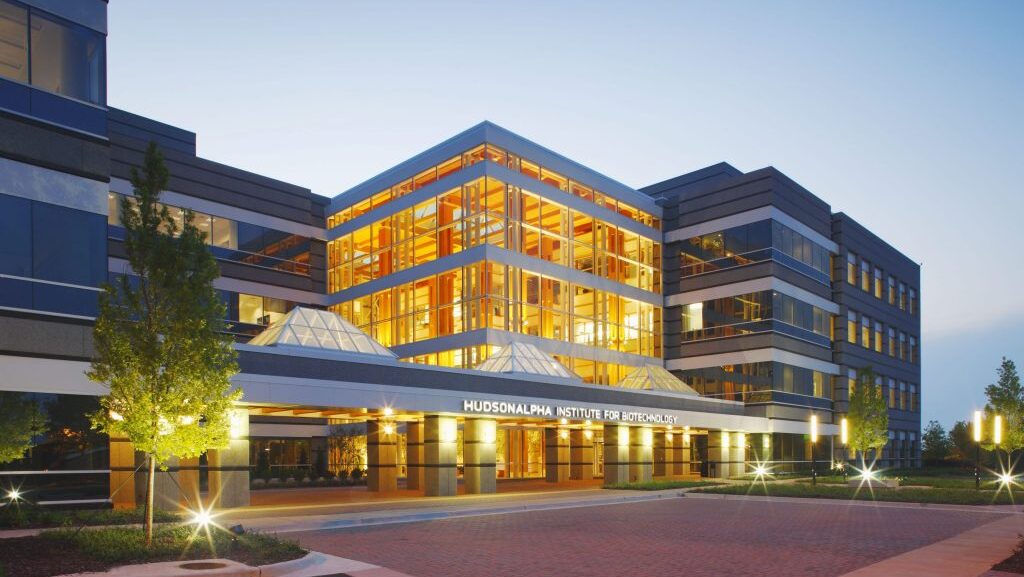
A new independent economic impact study conducted by the Public Affairs Research Council of Alabama, or PARCA, reports that the HudsonAlpha Institute for Biotechnology and its resident tenant companies generated $1.27 billion in total economic output between fiscal years 2023 and 2025, bringing the institute’s total economic impact on Alabama to $5.5 billion since opening in 2006.
A nonprofit focused on biomedical research, education outreach, and innovation and economic development, HudsonAlpha currently hosts over 50 resident companies at its 150-acre Huntsville campus. Through those resident companies, alongside its own research activities and commercialization efforts, HudsonAlpha has been a key player in Alabama’s biotechnology economy.
According to the PARCA study, over the past three years, HudsonAlpha and its resident companies generated $1.2 billion in operations and $77.7 million in capital expenditures and supported an average of 2,088 jobs statewide each year through direct and indirect employment.
Dillon Fritz, Ph.D., vice president for innovation and economic development at HudsonAlpha, told APR that he expects the organization’s economic impact to continue to grow as more major private and public partners flock to North Alabama.
“The most exciting part is what’s to come,” Fritz told APR in a recent phone interview. “What’s not part of this economic impact report is Eli Lilly landing in Huntsville, the momentum and the gravity being created by that, but also growth at DOW and Redstone Arsenal, Space Command coming to Huntsville, SBI, NASA—these are all areas that are leveraging HudsonAlpha as well, because there’s a lot of life science solutions that we’re providing to those challenges, both in government and industry. So there’s a huge kind of wave coming for not only HudsonAlpha, but also for North Alabama because of these big economic movers.”
Fritz also noted HudsonAlpha’s recent expansion to a second location at Dothan’s Wiregrass Innovation Center, where the organization is focused on building up the ag tech industry—a potential opportunity for generating even more economic activity in the state.
“In March of this year, we had the ribbon cutting for the new Wiregrass Innovation Center, which HudsonAlpha Wiregrass is an anchor tenant in this beautiful facility. And so it’s taking our three mission areas—research, education, and innovation and economic development—and then kind of ‘Wiregrassing’ it and putting it down in Dothan, Alabama,” Fritz said. “So it’s not the same cookie cutter focus that we have up here down in Dothan.”
“[Dothan] is the peanut capital of the world, so how do we align with those unique industries around the Wiregrass? We have a strong focus on ag tech, animal health and rural health with our initiatives down in the Wiregrass,” he continued. “[We are] being very intentional in the types of companies that we recruit down there to then align them with the peanut growers, with the poultry farms, with the cattle, with the soybean—really building this intentional ecosystem that’s going to provide additional impact and growth. And again, HudsonAlpha Wiregrass wasn’t included in this previous report, so we’re super excited about the next three years and what that’s going to bring.”
Fritz said the PARCA report is evidence that HudsonAlpha’s model is working, both as a driver of innovation and of economic development.
“I think the recipe is working,” Fritz said. “I think that that’s what HudsonAlpha was really built around: to bring in fantastic basic scientists, be a home for cutting-edge innovations and companies, and to have education also to create these ‘collisions of brilliance,’ as our founders like to say. I don’t think they had economic impact in the billions as part of their KPIs, but that’s kind of been the result of all this.”