





















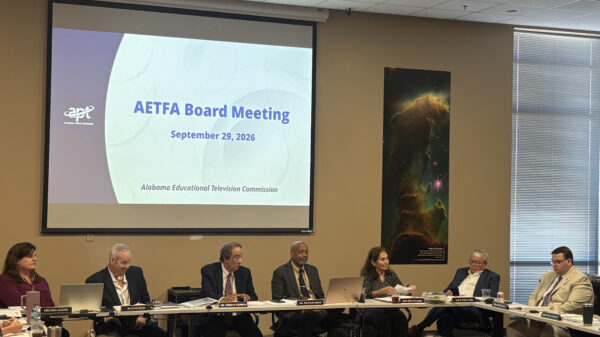












The Joint Contract Review Committee held contracts from the Alabama Department of Corrections on Wednesday, with lawmakers arguing the state has spent tens of millions of taxpayer dollars defending federal prison lawsuits instead of fixing the problems that led to them.
During the meeting, lawmakers considered several contract amendments tied to ongoing prison litigation, including the landmark Braggs case over mental health care in state prisons and a separate U.S. Department of Justice lawsuit challenging conditions throughout Alabama’s men’s prison system.
Before the committee reached the contracts, Representative Chris England, D-Tuscaloosa, said they represented only the beginning of the state’s response after losing the Braggs litigation, in which a federal judge ruled Alabama’s treatment of prisoners with serious mental illness violated the Constitution.
“The amount you pay your lawyer sometimes correlates directly with how bad of a client you are. If that’s the case … ADOC must be a really, really bad client,” England said.
England said the contracts reflected the remedial phase of the lawsuit, during which the state will remain under federal court supervision while implementing reforms ordered by U.S. District Judge Myron Thompson.
The department presented an extension for Dr. Elizabeth Falcon and a new contract for Rick Ramesh, both members of the external monitoring team appointed by the court to oversee Alabama’s compliance with the Braggs ruling. ADOC also requested additional funding for Butler Snow to continue representing the state in the litigation, citing court-ordered weekly meetings and the start of external monitoring later this year or early next year.
Before discussion shifted to the legal contracts, England and other committee members discussed the broader mental health system that funnels many people into Alabama’s prisons.
Representative Chris Pringle said prisons were never intended to serve as mental health institutions, noting that many people with serious mental illness cycle through the criminal justice system after state psychiatric facilities closed.
England agreed that the state’s mental health infrastructure has deteriorated but argued many of those problems stemmed from policy decisions made more than a decade ago.
“Our infrastructure was destroyed because Dr. Robert Bentley pursued federal money that would allegedly take the money that was supposed to be used for institutional care and follow the patient to community-based care,” England said. “The money never materialized for the community-based care, but we closed our facilities. Probably one of the worst decisions we’ve ever made.”
England said the lack of mental health facilities contributes to incarceration. Still, he emphasized that the Braggs litigation centered on how the Department of Corrections treats prisoners once they are already in state custody.
“This is not about negligence. This is deliberate indifference, which means that we are doing things within our Department of Corrections that is akin to torture,” England said.
England noted that the federal court concluded the department’s treatment of severely mentally ill prisoners was systemic and unconstitutional after documenting repeated inmate suicides and other failures in care.
“Once we even identify someone with a severe mental illness, we do the opposite of treatment,” England said. “We punish them for being mentally ill by putting them in solitary confinement.”
The committee later reviewed an amendment increasing Butler Snow’s Braggs litigation contract by $3 million, bringing the contract’s total value to approximately $4.65 million.
“If I told you that we had already spent about $17 million on Braggs litigation … this will be another three to four million, so the Braggs litigation would have put us at about $21 million for lawyers,” England said.
England argued lawmakers should evaluate whether the state could have settled instead of continuing to spend millions defending litigation it ultimately lost.
“I want to know what the settlement discussions looked like because going forward, writing blank checks to lawyers, I think a bigger discussion needs to be had about the strategy. Are we discussing settlement? Are we just defend and deny until the judge makes us do the right thing?” England asked.
He also questioned whether attorney Bill Lunsford, who represents the state in the litigation, had any conflicts because of previous work involving prison health care providers. England asked the department to provide information about any conflict reviews and previous settlement negotiations before allowing the contract amendment to proceed.
The committee then considered another amendment adding $30 million to Lunsford’s contract for the Department of Justice lawsuit over Alabama’s men’s prisons. Department officials said the funding would cover legal work through the end of the year as the case moves toward a trial expected to begin in November and last six to eight weeks.
“We appropriated to the Department of Senior Services $52 million for a year’s worth of care for older individuals, and we’re spending almost $40 million on lawyers in just one day. It’s getting outrageous,” England said.
He questioned why the state continues spending heavily on litigation instead of directing those resources toward prison reforms.
“It’s beginning to look like our whole theory in the Department of Corrections is no longer to reform and fix the problems,” England said. “It looks like our new theory is just defend and pay lawyers.”
“I can guarantee you that $40 million would go a lot further in the Department of Corrections addressing the reform than it would just paying lawyers; we’re probably going to stand there and watch us get beat to death,” England said. “We’ve got to do something different.”
England asked the committee to temporarily hold both legal contract amendments until lawmakers receive additional information about settlement discussions, potential conflicts of interest and the state’s litigation strategy.
Before the committee moved on, members requested that the Department of Corrections provide a summary of the Braggs case, and department officials agreed to do so.