








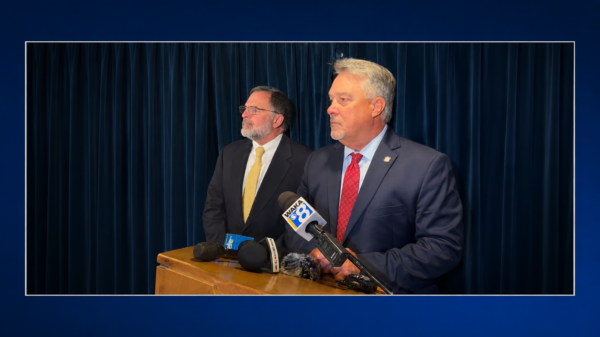



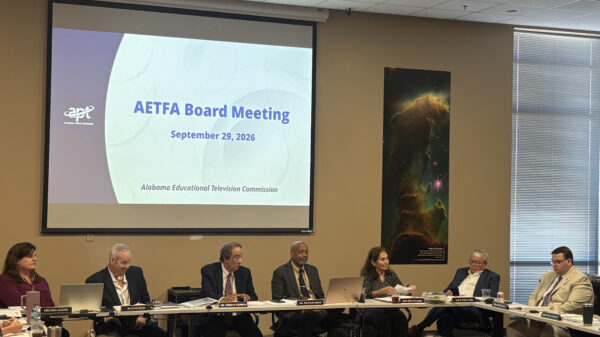










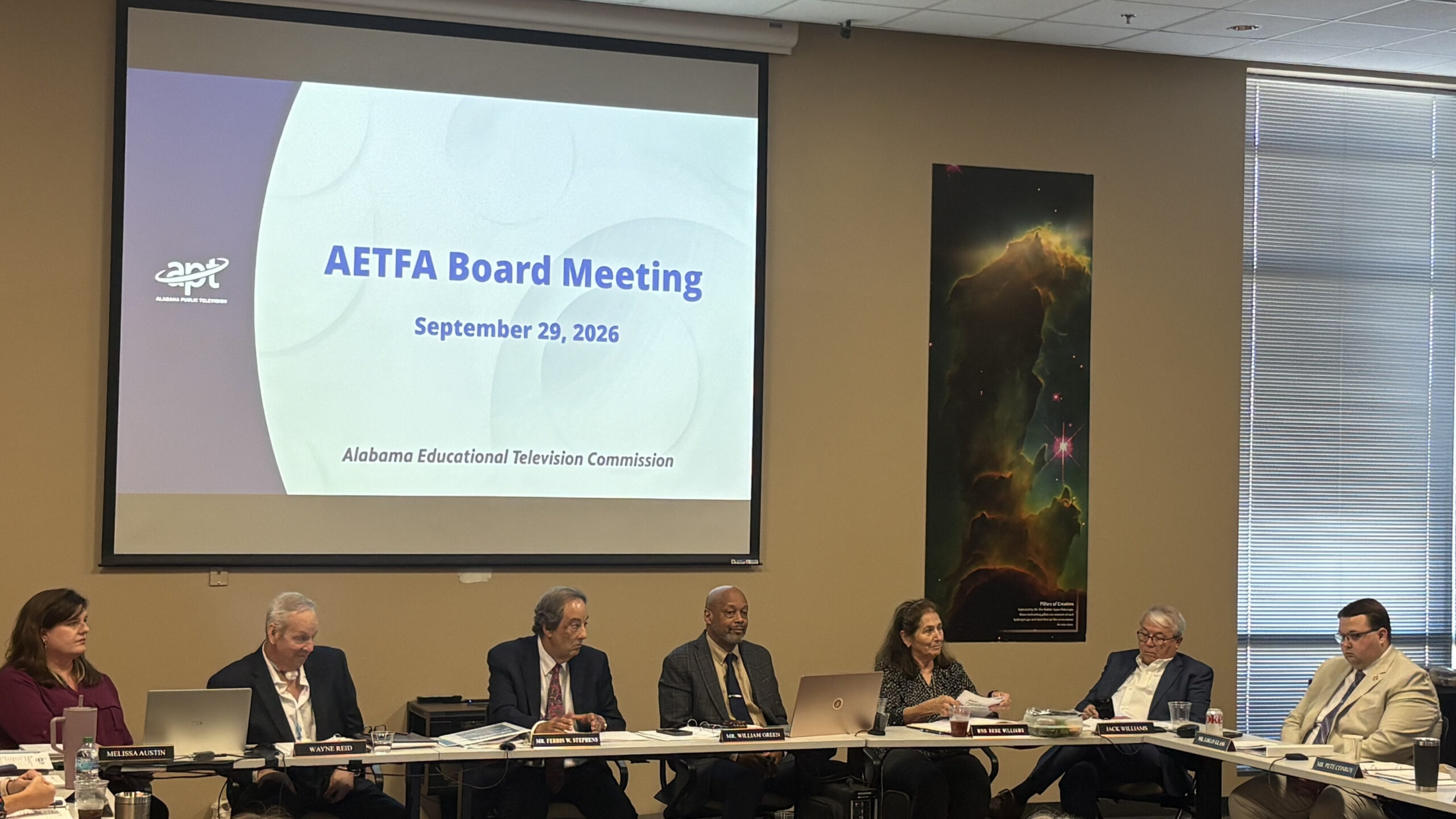
The Alabama Educational Television Commission and the Educational Television Foundation Authority announced they will release a survey on Alabamians’ perceptions of Alabama Public Television content following their Tuesday meetings.
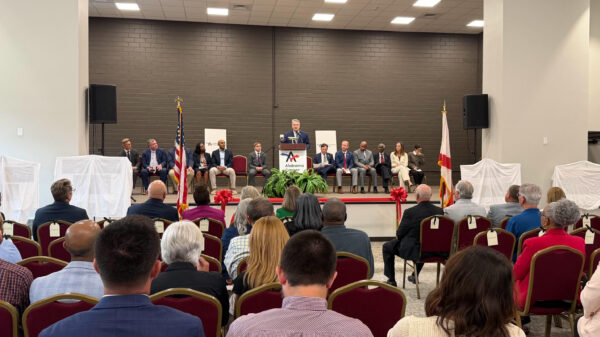
The regularly scheduled commission and foundation meetings, held at Huntsville’s U.S. Space and Rocket Center, followed controversy over a $39,500 contract to poll Alabamians on their perceptions of Alabama Public Television programming.
Last November, Alabama Governor Kay Ivey requested a poll to gauge audience perceptions of APT content amid discussions about the future of APT’s relationship with PBS. Ivey’s request followed commissioners Les Barnett and AETC Chair Ferris W. Stephens raising the possibility last year of dropping PBS programming in response to Trump administration cuts to the Corporation for Public Broadcasting.
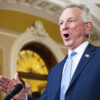
Cygnal, a polling firm that primarily works with Republican candidates, including United States Senator Tommy Tuberville, R-Alabama, was contracted to conduct the study.
At the AETFA meeting, members unanimously approved a motion by Foundation Board Chair William A. Green to release the Cygnal report publicly and discuss its findings at the foundation’s February meeting.
Commissioner Pete Conroy, who had previously criticized the selection of Cygnal as the pollster at recent commission meetings, highlighted key findings from the poll compiled by ChatGPT.
Of those polled by Cygnal, 54.2 percent said APT should continue its relationship with PBS, compared with 17.7 percent who said the station should stop carrying PBS programming. Another 28 percent were unsure.
Sixty-seven percent of respondents said they considered APT valuable to Alabama families and students, including 40 percent who said its offerings were very valuable. Sixteen percent said APT programming was not valuable to families and students.
Cygnal reported that 49.3 percent of respondents viewed APT favorably and 8.7 percent viewed it unfavorably. Meanwhile, 60.3 percent viewed PBS favorably, compared with 16 percent who viewed it unfavorably.
The survey also found that 29 percent of respondents felt APT was politically balanced, 20 percent said its coverage skewed liberal and 12 percent said it skewed conservative. Forty percent were unsure whether they considered APT biased.
Perceptions of liberal bias at APT were also stronger among men, with 26 percent of men reporting a liberal lean compared with 14 percent of women. Among men 55 or older, 40 percent viewed APT as liberally biased, compared with 12 percent of women under 55.
Weekly viewers were also more likely to consider APT’s coverage balanced, with 49 percent reporting no lean to the left or right and 11 percent reporting a liberal skew. Forty-nine percent of all perceptions of a liberal lean came from individuals who do not watch APT.
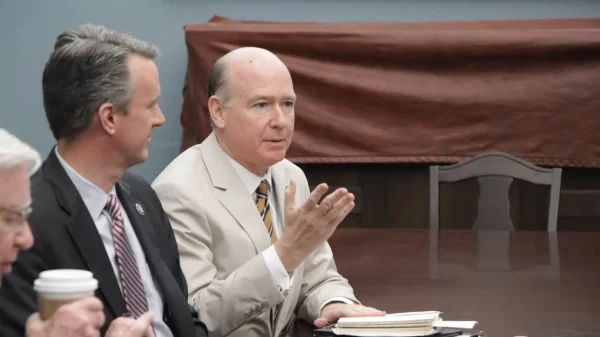
The AETC meeting took place immediately before the AETFA meeting. Commissioners discussed and heard public comments about the future of NPR and PBS programming at APT.
AETC members also debated the nomination process for filling AETFA vacancies after Stephens moved to appoint Cameron Reynolds to the AETFA board, drawing opposition from Conroy.
Conroy argued that Stephens bypassed the AETC Nomination Committee, established in January, by nominating Reynolds directly.
“I have a problem with the way this came about,” Conroy said. “You created the Nomination Committee, and I guess this candidate’s bypassing that nomination committee.”
“[Reynolds’] background’s not a problem. I’ll tell you that,” Conroy said. “The way you brought this to us is the problem.”
The commission voted 4-1 to approve Reynolds’ nomination, with Conroy opposed and commissioners Logan Glass and Tijuanna Adetunji abstaining.
The AETC Nomination Committee’s purpose, as defined by the commission in January, is to “recommend officers of the AETC and if deemed appropriate recommend officers to the AETFA.”
Stephens maintained that the committee is not the sole vehicle for appointing AETFA board members.
Green recommended that commissioners bring nominees for AETFA’s remaining vacancy through the committee during the commission’s next meeting.
“I think if we’re gonna apply this process next time, why didn’t we apply the process this time? I do think that,” Glass said.
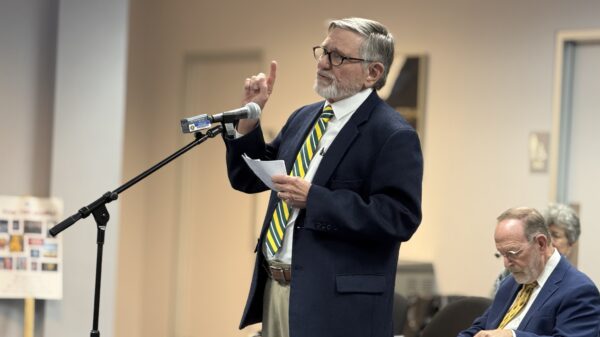
AETC members heard more than an hour of public comments focused on the Cygnal poll and the political climate surrounding PBS and NPR coverage.
State Representative Marilyn Lands, D-Huntsville, spoke before the commission in opposition to public radio station 89.3 FM WLRH’s decision to stop carrying NPR programming last year after the loss of federal funding in 2025 through the Corporation for Public Broadcasting.
Since disaffiliating from NPR, the station’s local programming has grown to 72 percent of its content, compared with 15 percent last year.
“I’m here today as a representative, because I have heard from my constituents over and over, especially in the last year,” Lands said.
Lands described the station’s disaffiliation from NPR as a decision “made without input from the community, without input from long-term station staff and without input from the donors that had sustained this station for decades.”
“This is not a criticism of the staff who have worked hard under a difficult situation,” Lands said. “This is a question for the commission about process and accountability.”
Lands said WLRH has experienced a roughly 42 percent decline in membership since dropping NPR programming.
“When a format change of this magnitude produces such a drop in membership, the responsible move is not to defend the experiment,” Lands said. “It’s to listen to the people who are voting with their wallets and their intention.”
Despite the decline in membership since dropping NPR, WLRH General Manager Erich Brukner reported that the station exceeded its fall fundraising goal by 41 percent. The station has also seen a 49 percent increase in social media followers since 2025 and a 102 percent increase since 2024.
During public comments, Commissioner Bebe Williams, who represents Alabama’s 5th Congressional District, and Green both argued that APT could provide more “balanced” coverage by diversifying the news providers featured on public television and radio.
Williams, who said her conservative constituents have voiced concerns about what they viewed as bias at PBS, suggested adding other providers. She emphasized, however, that she does not want APT to disaffiliate from PBS.
“The conservatives I talk to say they can’t handle it,” Williams said. “Why can’t we come back with a program where there’s two sides to the stories, two different hours, feeding two different paths of people?”
“I wouldn’t have a problem with NPR if there was a balance,” she said.
“I understand that you all love NPR,” Green told commenters. “But what I’m saying is if we can look at other sources and balance it out, I think [APT] would do better if we were more balanced.”
Of the 26 public speakers who followed Lands, all but two spoke against either WLRH’s disaffiliation from NPR or the possibility of APT disaffiliating from PBS.
“As a taxpayer, a new taxpayer in the state of Alabama, I appreciate my tax is not going toward very partisan reporting,” speaker Anna Young said. Young accused NPR of bias in its coverage of climate change and former President Ronald Reagan.
Democratic nominee for Alabama House of Representatives District 20 James Linderholm argued against claims of bias at PBS or NPR while criticizing the process used to appoint Reynolds to the AETFA.
Linderholm emphasized that although he did not oppose Green’s proposal to add additional news providers at APT, the commission had not identified providers it believed could address perceived bias.
“I have no opposition, and I don’t think many people here would have any opposition if you said, ‘Right, we’ve got NPR on, and we’re gonna bring on something else.’ What is your something else? I haven’t heard,” Linderholm said.
Huntsville resident Zebulun Worlund urged the commission to continue providing PBS programming through APT. Worlund also thanked commissioners for saying at their previous meeting that disaffiliation from PBS was not immediately under consideration.
“Keep it that way,” Worlund said. “We believe in the power of public media, and we want to have faith in you guys. There is some conflict going on that is dissolving the trust we have. We want to support you. We want to continue maintaining this wonderful public media for our wonderful state.”
Eric Land, former vice president and general manager of ABC 33/40, criticized the commission for using money from its rainy-day fund to finance the Cygnal poll and questioned the pollster’s impartiality.
“We talk about bias—you know, my biggest question is that once you’ve chosen Cygnal to do your research project, you inflicted bias into that process,” Land said. “You talk about not wanting to politicize content, and you absolutely politicized a research project.”
The full Cygnal poll will be available to the public on APT’s website.