
































Americans often speak of the Constitution as though it were a single inheritance from the Founders.
The reality is more complicated.
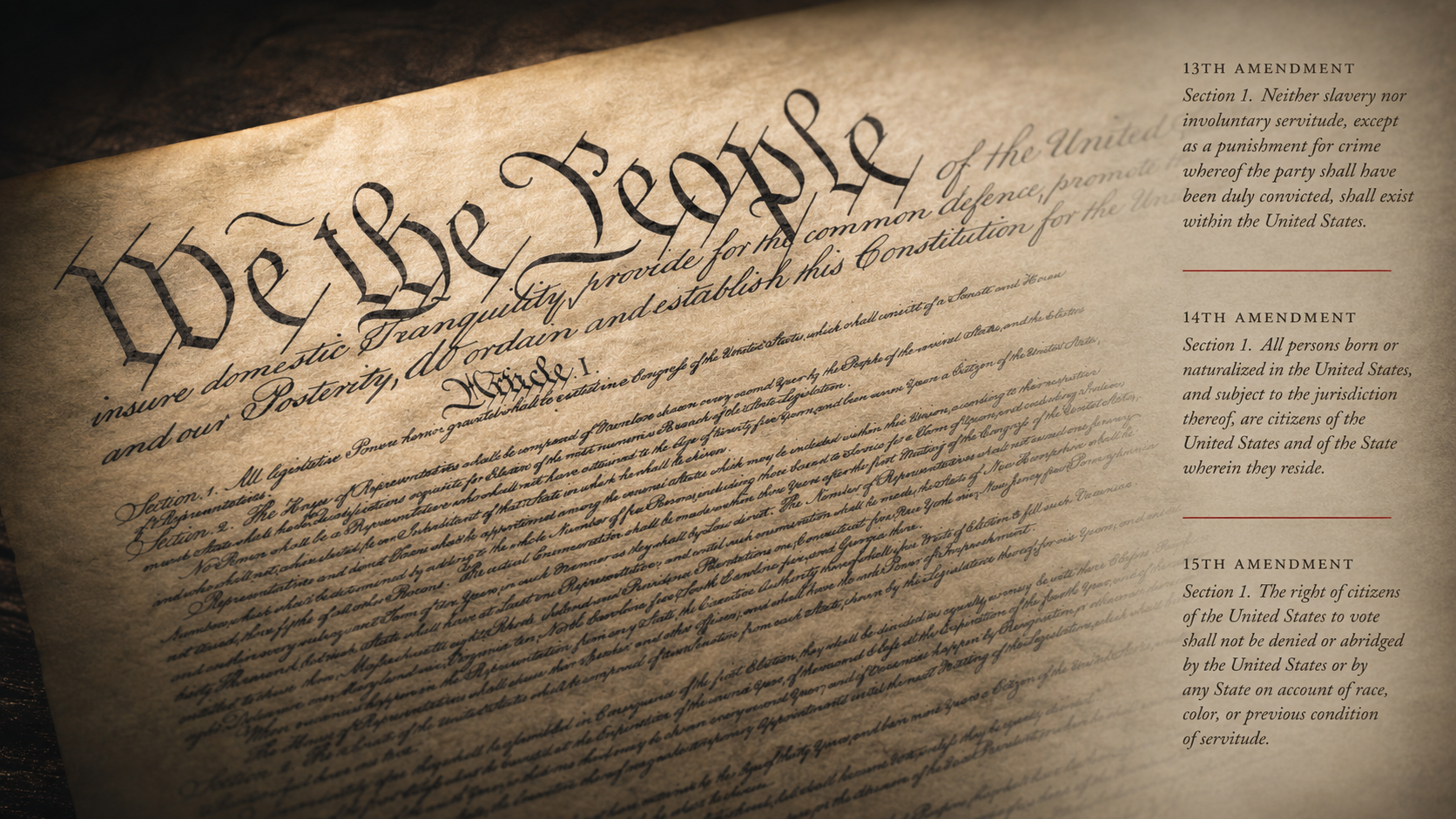
There is, of course, only one written Constitution. But the Civil War and Reconstruction changed its moral and legal center of gravity. Historians and legal scholars have often described Reconstruction as a second founding. Some have gone further, referring to the 13th, 14th and 15th Amendments as creating a kind of Second Constitution.
That phrase describes a constitutional transformation rather than a separate document. The Reconstruction Amendments did more than add language to the founding order. They attempted to remake it.
The first Constitution created the Union. The Reconstruction Constitution tried to redeem it.
That distinction reaches beyond history. It is central to understanding the constitutional struggle that still defines American life, because much of what Americans fight over today—voting rights, citizenship, equal protection, federal power, state authority and the meaning of liberty itself—flows from the unresolved tension between those two constitutional visions.
The Constitution of 1787 was a remarkable achievement. But it was also a document of compromise, evasion and contradiction. It spoke of liberty while tolerating slavery. It created a national government while leaving enormous power in the hands of states. It offered no clear national guarantee of citizenship. It gave no equal protection clause. It left voting largely to state control. And for much of the nation’s early history, the promises of American freedom were filtered through race, gender, property and power.
That was deliberate. It was the operating structure of the original constitutional order.
The Founders built a constitutional republic with remarkable capacity for self-correction. But the original order did not extend its promises equally. It protected representative government while also protecting human bondage. It left citizenship uncertain, voting restricted and millions outside the circle of constitutional belonging.
The Civil War broke that arrangement. Reconstruction tried to replace it.
Alabama stood inside this history. It was part of the slaveholding order that Reconstruction was designed to restrain, part of the Jim Crow order that Reconstruction failed to defeat, and part of the voting rights struggle that forced the nation to enforce Reconstruction nearly a century later.
That is why the Reconstruction Amendments matter so profoundly. They did more than correct one moral wrong, as monumental as that would have been. They attempted to change how the nation itself was to operate.
Reconstruction did more than expand the list of rights. It changed who had power to protect them.
The 13th Amendment abolished slavery and involuntary servitude, except as punishment for a crime. But it did more than end the formal institution of slavery. It gave Congress the power to enforce that freedom.
That enforcement clause mattered. The framers of Reconstruction understood something essential: Emancipation without federal power would leave freedom at the mercy of the very states that had defended bondage.
Freedom had to mean more than the absence of chains. It had to mean the destruction of slavery’s legal architecture. It had to mean former slave states could not simply recreate slavery under another name. It had to mean Congress had the constitutional authority to act when states, local governments, private actors or organized violence sought to reduce freedom to a hollow phrase.
The 14th Amendment went even further. It answered the question the original Constitution had avoided and the Supreme Court had disgraced itself by answering in Dred Scott: Who is a citizen of the United States?
The answer after Reconstruction was direct and revolutionary: All persons born or naturalized in the United States, and subject to its jurisdiction, are citizens of the United States and of the state in which they reside.
That sentence changed America.
Citizenship was no longer something states could define for themselves. It was no longer a gift of local power. It was no longer a privilege reserved for those whom the founding order deemed worthy. It was national. It was constitutional. It was rooted in birthright, not caste.
The 14th Amendment also promised due process and equal protection. Those words are now so familiar that their radicalism is easy to miss. But in the aftermath of slavery, they meant states could no longer treat some people as lesser beings under law. They meant a state could not claim sovereignty as a shield for oppression. They meant individual rights were no longer left entirely to the mercy of state legislatures.
That was a profound reordering of American government.
Before Reconstruction, the great fear embedded in much constitutional thinking was the abuse of federal power. After Reconstruction, the nation was forced to confront another truth: States could also be tyrants.
Alabama knew that. Mississippi knew that. Georgia knew that. The former Confederacy knew that.
The 14th Amendment was written with that knowledge in mind. It was a constitutional response to the Black Codes, racial violence, state defiance and the determination of former slaveholding states to preserve as much of the pre-Reconstruction order as possible.
The 15th Amendment completed the Reconstruction triad by addressing political power itself. It prohibited denying or abridging the right to vote on account of race, color or previous condition of servitude.
That, too, was radical, because freedom without political power is always vulnerable.
The authors of Reconstruction understood that emancipation could not survive if former enslavers retained control over lawmaking, courts, policing, labor, education and elections. The ballot carried protective power, not symbolism. It was the instrument by which newly freed citizens could defend their freedom.
And like the 13th and 14th Amendments, the 15th Amendment gave Congress enforcement power. That point cannot be overlooked. The Reconstruction Amendments were written as commands with machinery attached. They gave the federal government the authority to protect freedom, citizenship, equality and voting rights when states refused to do so.
Taken together, these amendments changed the operating system of the country.
The 13th Amendment attacked slavery. The 14th Amendment established national citizenship, due process and equal protection. The 15th Amendment sought to protect political participation from racial exclusion.
Together, they said freedom was no longer merely what states allowed. Citizenship was no longer merely what states recognized. Voting rights were no longer merely what states chose to protect. The federal government now had constitutional authority—indeed, constitutional responsibility—to protect liberty against state abuse.
That is what the idea of a Second Constitution captures. It recognizes that Reconstruction changed what the Constitution means and whom it protects, while remaining part of the written Constitution.
And many Americans at the time understood exactly how dangerous that transformation was to the antebellum order.
That is why resistance began almost immediately.
The battle over Reconstruction never truly ended. It simply moved from the battlefields of the Civil War to courtrooms, legislatures and constitutional interpretation.