



















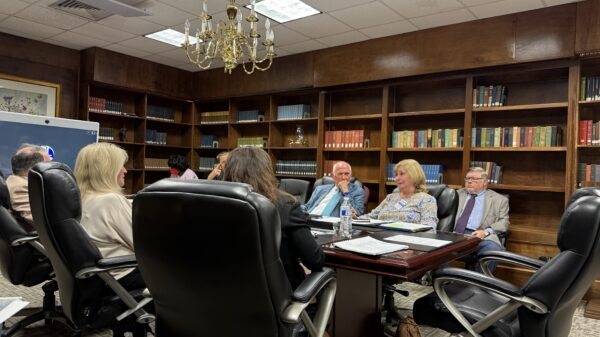








The Alabama Ethics Commission delayed action on a proposed advisory opinion clarifying how the state’s “revolving door” law applies to retiring officials who establish private consulting businesses after leaving state government.
The request came from Antoine Dunklin, producer licensing director for the Alabama Department of Insurance. Dunklin told the commission he plans to retire in 2027 and establish a consulting firm offering insurance licensing compliance management, strategic planning and regulatory consulting to insurance companies, agencies and government entities.
He also asked whether he could contract directly with the Department of Insurance to provide consulting services on issues including disaster relief, emergency adjuster deployment, artificial intelligence integration, licensing examinations and producer licensing.
Commission staff concluded that Alabama’s revolving door law would prohibit Dunklin from personally representing private clients before his former agency for two years after leaving state employment.
However, under existing advisory opinions, the restriction applies only to the former employee—not to the business itself. Other employees of Dunklin’s consulting firm could interact with the Department of Insurance on behalf of clients as long as Dunklin did not personally participate in those communications.
Staff also said previous advisory opinions suggest that the two-year prohibition on contracting with a former agency does not prevent agencies from hiring former employees to perform personal or professional services on the agency’s behalf.
Staff cited previous opinions involving former public officials who returned as consultants and concluded that Dunklin’s proposed services would likely fall within that exception.
The discussion prompted questions from commissioners about where to draw the line between permissible behind-the-scenes work and prohibited direct representation.
Staff said the revolving door statute is intended to prevent former officials from using relationships developed during public service to influence their former agencies—not to prevent them from continuing to work in their field.
A former employee may advise colleagues or employees internally, staff said, provided someone else handles all direct communications with and representation before the former agency.
Commission staff compared the situation to former Alabama Department of Transportation engineers who leave state employment to work for private engineering firms. Those employees may continue working internally on transportation projects but cannot personally communicate with ALDOT on behalf of the firm during the two-year restriction.
Vice Chair George Pierce asked how state agencies prepare employees for revolving door restrictions as a change in administration approaches.
“As we approach going through an election year, we’re gonna be going through changes coming up after the first of the year,” Pierce said. “You may very well have people leaving departments, going to other places. What’s the program to make sure that these employees are aware of the revolving door system?”
Staff said required ethics training for elected officials and many state employees covers revolving door restrictions. Staff also noted that requests for informal guidance on the issue are among the commission’s most common inquiries.
“The most common informal requests that we get are revolving door issues,” Alabama Ethics Commission Chief Counsel Brian Paterson said. “We answer several of them every week. So we’re certainly giving advice as much as we can on specific instances for individuals.”
Near the end of the discussion, Commissioner David R. Pruet expressed concern that allowing a former employee to establish a one-person business and direct an employee to solicit contracts with the former agency could undermine the statute’s intent.
Pruet said the advisory opinion should make clear that a former official cannot circumvent the law simply by hiring another employee to perform activities the former official is personally prohibited from performing.
“I’m looking at the statute, and it says that the employee shall not enter into, solicit, negotiate a contract, et cetera,” Pruet said. “And I think we should make it clear, if we’re gonna provide this opinion, we should make it clear that that doesn’t mean that the employee can circumvent that rule by hiring an employee and then directing that employee to go do exactly what he can’t do.”
The commission voted to continue consideration of the proposed advisory opinion until its next meeting so staff can revise the draft.