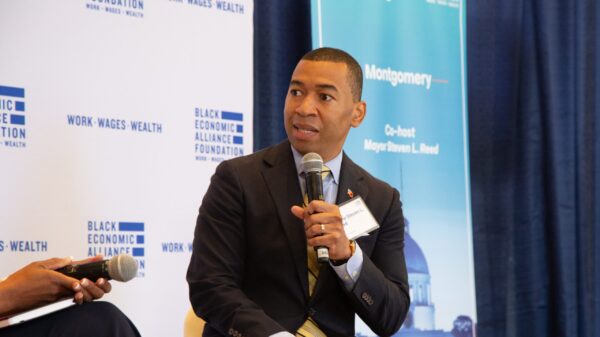























The long saga of former Montgomery Police Chief Ernest Finley’s legal battle against the city and Mayor Steven Reed has come to an end.
On Monday, a federal appeals court denied Finley’s appeal of a lower court’s summary judgment in his conspiracy and discrimination lawsuit. The ruling effectively dismisses Finley’s case and ends the five-year legal battle that ensnared Reed and exposed a deep rift between the Alabama Ethics Commission and the Alabama Attorney General’s Office.
In an opinion written by 11th U.S. Circuit Court of Appeals Chief Judge and former Alabama Attorney General Bill Pryor, the appeals court affirmed a June 2025 decision by U.S. District Judge Kristi DuBose of the Middle District of Alabama, saying Finley had “failed to provide sufficient evidence” of the alleged conspiracy.
The case began shortly after Finley resigned under pressure in 2021. At the time, numerous Montgomery Police Department officers had aired public grievances against the chief, claiming, among other things, that he had given preferential treatment to his second-in-command, Jennifer Reaves, who is white, and that she had retaliated against officers who filed complaints. They also claimed Finley had handed down unfair punishment to several Black officers.
Finley had apparently planned to fire five Black officers for infractions related to off-duty work, but Reed intervened on behalf of the officers and insisted that Finley instead punish them with suspensions.
One of the officers then filed an ethics complaint against Finley and Reaves, claiming Finley had altered the guidelines of a firearms training program to help Reaves pass the required training after she initially failed. The Alabama Ethics Commission found that both Finley and Reaves had committed one minor violation of the ethics code.
Finley claimed that the finding—which Alabama Attorney General Steve Marshall later used as an example of an Ethics Commission that had abused its authority—was part of a conspiracy involving two Ethics Commission investigators, the commission’s executive director and Reed. Finley alleged the conspiracy was intended to provide Reed with cause to terminate him or force his resignation.
However, DuBose wrote in her opinion that Finley provided no evidence of the conspiracy and that documents and witness testimony showed Reed and his office were actively trying to help Finley and smooth over what had become a contentious situation within MPD. The city told the Ethics Commission that it could find no evidence that Finley or Reaves violated ethics laws or benefited financially from the situation, and the city also provided legal defense to both.
Marshall later intervened in the case, dismissing the ethics charges against Finley and Reaves and stripping the two Ethics Commission investigators of their authority. He publicly claimed that the investigators and the commission had “mishandled” the case by failing to disclose exculpatory evidence. The Attorney General’s Office later filed a lawsuit against the Ethics Commission seeking to require it to disclose exculpatory evidence in future cases.
Finley appealed the portion of the case dealing specifically with the Ethics Commission, claiming the two investigators fabricated evidence to charge him and that the executive director was aware of their actions.
However, Pryor said the appeals court could find no evidence of such a conspiracy and instead found fairly clear evidence that the parties involved acted in good faith during the investigation.