



































The nation’s second-largest research park now has the country’s only university-led space electronics testing facility, courtesy of Auburn University.
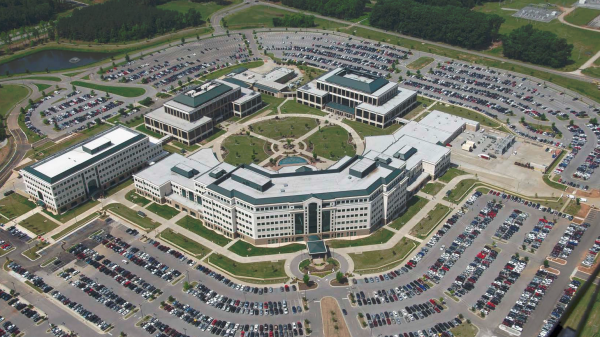
With a large contingent of university and government officials on hand, the 50,000-square-foot Auburn University Applied Research Institute Laboratory officially opened Tuesday in Huntsville’s Cummings Research Park. The state-of-the-art facility will assist the U.S. Department of War, along with the defense and space industries, with research and testing.
The $30 million facility, which was built with expansion in mind, will support advanced manufacturing, rapid prototyping, space development and operations capabilities. Its university-led testing facility, which will evaluate the effects of radiation on equipment used on spacecraft that play a role in missile defense, is the first of its kind.
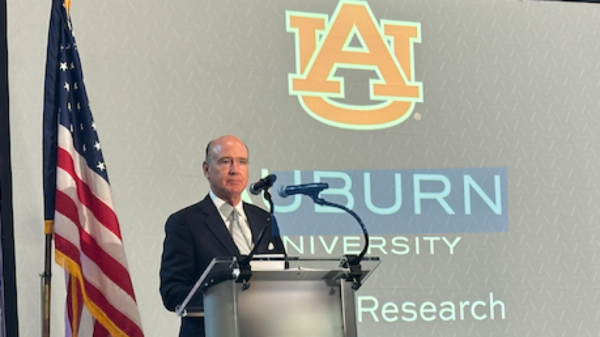
“This is a momentous day for Auburn and for the security of our nation,” Dr. Steve Taylor, Auburn University’s senior vice president for research and economic development, said. “Auburn’s work in Huntsville, particularly the radiation effects testing, will meet an urgent need for our Department of War partners.
“We take our mission to serve the people of Alabama very seriously and are proud to answer the call to strengthen national security and be a valuable partner for the Huntsville aerospace and defense ecosystem.”
The facility’s location in Huntsville was strategically selected, placing it near Redstone Arsenal, NASA’s Marshall Space Flight Center and U.S. Space Command. Auburn officials said the laboratory’s work would assist those entities, along with other government agencies and private-sector clients, on projects directly tied to national security and defense.
The event drew hundreds of attendees and included a long list of political and education leaders. Attendees included U.S. Senator Tommy Tuberville, R-Alabama, who is running for governor; U.S. Representatives Dale Strong, R-Alabama, Robert Aderholt, R-Alabama, and Mike Rogers, R-Alabama; and university presidents from Auburn, Alabama A&M and UAH.
Much of the work at the facility will focus on radiation testing, specifically the effects of radiation on space electronics used in military and space systems. Researchers at the Auburn facility will use a device called a cyclotron to create the effects of radiation that equipment will experience during low Earth orbit. Such testing will be vital to determining the effectiveness of key defense systems, specifically the Golden Dome.
Working with the Missile Defense Agency, which is located at Redstone Arsenal, on such systems is why Auburn officials chose the Cummings Research Park location.
“To provide for a highly reliable defense of our nation and our armed forces, we need to test every microelectronic component for its performance in space,” Major General Jason Cothern said. “Going forward, we will have priority access to Auburn’s proton cyclotron facility to ensure timely radiation testing of the microelectronics our cutting-edge systems depend on.”
Testing operations at Auburn’s new laboratory are set to begin in early 2027.