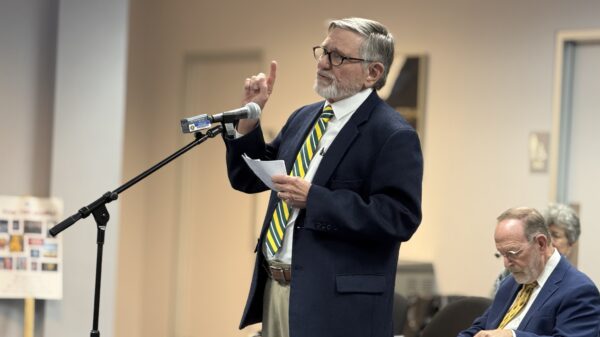







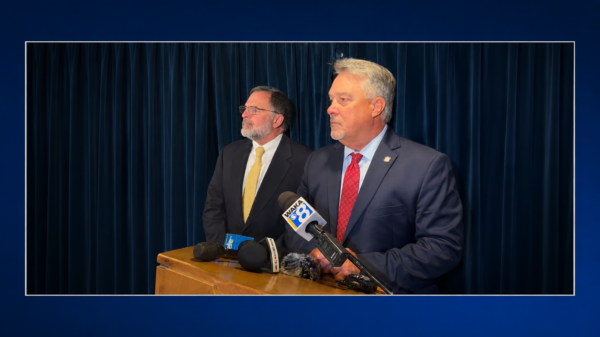





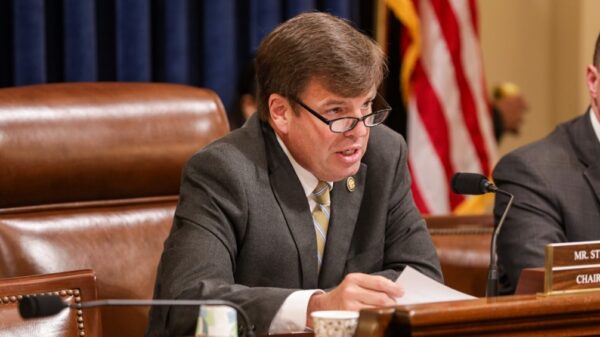






Before the Alabama Educational Television Foundation Authority voted September 16 to spend $39,500 from APT’s Rainy Day Fund on a statewide survey, Commissioner Pete Conroy described an email exchange with Foundation Chair William Green.
Conroy had urged board members to reconsider the survey. Green responded by asking what Conroy was afraid of, according to Conroy’s account at the meeting.
Standing before the board, Conroy gave his answer.
“I’m afraid that we’re losing public trust,” Conroy said. He was afraid of the short turnaround. He was afraid of the political bias. He wished the committee would consider an alternative: letting APT’s own “brilliant staff” conduct the survey instead.
That exchange contains the whole story.
The Authority voted 5-2 to hire Cygnal, a Republican-oriented political polling firm, to question 600 Alabamians about APT programming and its relationship with PBS. Conroy and Commissioner Tijuanna Adetunji voted against the resolution.
The resolution also calls for a second survey in 2027 and directs the Foundation to set aside at least the same amount in next year’s regular budget.
The disagreement involves more than the choice of a pollster. It includes the survey’s political origins, the questions being asked, the vendor-selection process, the use of emergency reserves and an undisclosed overlap between APT’s news leadership and the publication that obtained a draft questionnaire.
APT lost more than $2 million in annual federal support after Congress rescinded funding for the Corporation for Public Broadcasting. The loss contributed to the elimination of 11 positions.
In that atmosphere, commissioners Les Barnett and Ferris Stephens urged APT to consider severing its relationship with PBS, which provides roughly 80 to 90 percent of the network’s programming. The proposal produced public opposition and immediate questions about how APT could replace most of its existing lineup.
Governor Kay Ivey urged the commission to survey Alabamians and develop a replacement plan before making such a consequential decision. The commission subsequently voted to retain PBS programming indefinitely unless a demonstrated financial reason warranted reconsideration.
The survey nevertheless continued.
Its political origins are relevant.
“PBS right now carries a negative connotation,” Green said, “and there’s no telling what they will do, how they will do it, and then if they make a statement or move a certain way, APT is going to be thrown in with them.”
Barnett went further. Even if federal funding were fully restored, he said, he still would not support the relationship: “PBS has made themselves an atma [sic] to the President and a sizable chunk of the state legislature, and probably a sizable chunk of the 65 percent of people voted for Trump, and I’m one of those people in both categories. I just, I don’t want to fund it. PBS has made themselves the enemy of what I stand with, and so I do not like them, and I don’t follow the philosophy of feeding the beast.”
Those statements explain why this survey’s independence and methodology deserve careful scrutiny.
Green has rejected the suggestion that the board intends to destroy APT’s relationship with PBS, calling it a “false narrative.”
But assurances of good intent do not answer questions about process.
Stephens has also defended the project. He described Cygnal as reputable and said the questions “speak for themselves.” He previously told Alabama Daily News that the survey script was not written to produce a particular response.
The public cannot determine that for itself.
Stephens said releasing the questionnaire before the survey could taint the results. That explanation may justify protecting the complete script during the survey. It does not explain why APT withheld the contract, sampling plan, weighting methodology or any legal review of the expenditure before the vote.
Alabama Daily News obtained a draft containing at least 35 questions and published portions of it. One question asks respondents whether APT programming is liberal, conservative or generally balanced based on what they have “seen or heard”—wording that does not require respondents to have watched APT, so their answers could reflect direct viewing, secondhand information or broader political attitudes toward public broadcasting.
Another question explains that PBS supplies approximately 80 to 90 percent of APT’s programming and asks whether APT should continue or end the relationship—a question that comes after the commission voted to retain PBS unless a demonstrated financial reason justified reconsidering the partnership. Most of the other questions concern awareness of APT programming and respondents’ political values, according to Alabama Daily News.
The ADN report raises a separate question about disclosure.
Todd Stacy is the founder and publisher of Alabama Daily News. He is also the host of APT’s “Capitol Journal” and APT’s director of news and public affairs.
The September 15 ADN report containing the draft questions did not disclose Stacy’s APT position.
The Society of Professional Journalists’ Code of Ethics advises journalists to avoid real or perceived conflicts of interest and disclose unavoidable conflicts. It also calls on news organizations to explain their ethical choices and processes to their audiences.
Claire Harrison wrote the ADN article. The public record does not establish that Stacy wrote or influenced the survey questions, participated in the reporting or provided the draft.
The issue is disclosure.
Alabama Daily News did not tell readers that its founder and publisher simultaneously serves as APT’s director of news and public affairs while the publication reported on an APT document that had not been publicly released. That dual role required disclosure.
Cygnal is the second Republican-oriented political polling firm selected for the project. That history raises the bar for APT to demonstrate that the questionnaire, sample and methodology are designed to measure public opinion rather than validate a predetermined political objective.
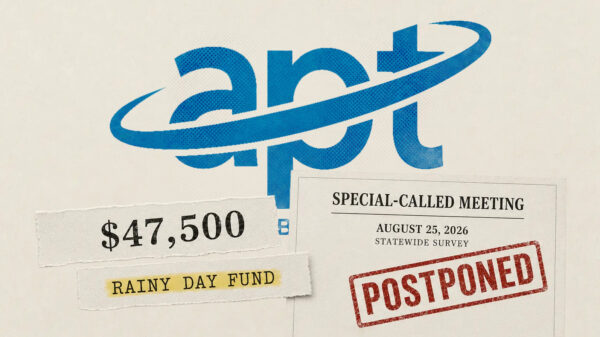
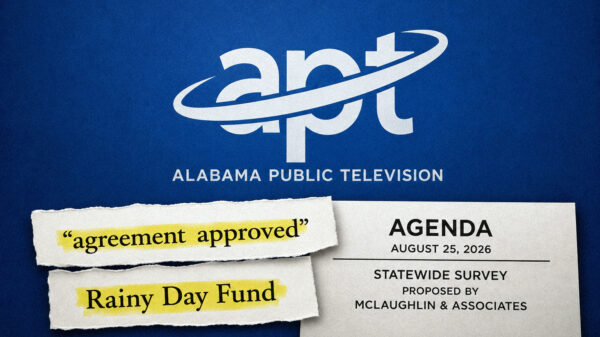
The first firm, McLaughlin & Associates, proposed a $47,400 agreement that went far beyond polling—it included advice on advertising, fundraising, staffing and press strategy and named McLaughlin as APT’s media buyer. APR requested the revised contract, questionnaire and methodology; APT provided none of it, and the McLaughlin arrangement quietly ended.
The Cygnal contract is lower, at $39,500.
APT has disclosed no request for proposals or competing bids. APT did not publicly release the contract or complete questionnaire before the vote.
The funding source creates another problem.
APT’s Rainy Day Fund policy describes a reserve for emergency purchases that cannot be covered through the regular budget, new revenue or spending reductions. Examples include proration, transmission failures and the loss of federal operating support.
Austin noted during the July meeting that the reserve had not been used to prevent the elimination of 11 positions. She asked whether the survey could be placed in the regular budget.
Conroy asked whether the Foundation was treating the poll as an “emergency survey.”
Stephens responded that the Foundation had created the policy and could change it.
At the September meeting, Conroy called the proposed use “untested” and said he did not know whether the contract had received legal review. Those comments show that board members disagreed over whether the expenditure fits the reserve’s stated purpose and whether it had received sufficient review.
The Foundation may possess the authority to spend the money. That does not relieve it of the responsibility to explain how this survey qualifies under the reserve’s stated policy.
APT conducted a statewide survey in 2023 through Troy University, Samford University and the University of Alabama for less than $10,000. The Cygnal survey costs roughly four times that amount.
The public record does not explain the methodological or contractual differences accounting for the higher price.
Several essential documents remain unavailable: the complete Cygnal contract, full questionnaire, sampling plan, weighting method and any written legal review of the Rainy Day Fund expenditure.
The survey may ultimately produce useful information about APT’s audience and programming, but useful results are not enough.
For a politically sensitive survey to command public confidence, the process producing it must also be credible. That requires transparency, independence and a willingness to answer legitimate questions before the results are used to justify consequential decisions.
There is also a larger principle at stake.
Alabama Public Television serves all Alabamians. Its programming decisions should be guided by its educational mission, the needs of its viewers, responsible stewardship and reliable evidence—not by whether PBS pleases a president, a political party, a legislative faction or the temporary majority of a governing commission.
PBS provides most of APT’s programming, including children’s education, public affairs, history, science and cultural programming that would be difficult and expensive to replace.
That relationship should be judged on its value to the people APT serves—not on whether its programming conforms to the political preferences of those who happen to hold power.
Commissioners have every right to examine the relationship, question its cost and demand accountability. They do not have the right to turn a public broadcaster into a political instrument.
APT’s leaders appear to believe a survey can restore confidence in the institution.
It cannot.
Public trust is not created by polling people. It is earned by showing them the questions, explaining how their money is being spent, disclosing institutional relationships and demonstrating that conclusions have not been decided in advance.
That returns the matter to Conroy’s answer to Green.
Conroy said he was not afraid of what an honest survey might reveal. He was afraid that APT was losing the public’s trust.
That fear cannot be dismissed with another poll.
And APT cannot poll its way out of a crisis of trust created by its own refusal to show its work.