























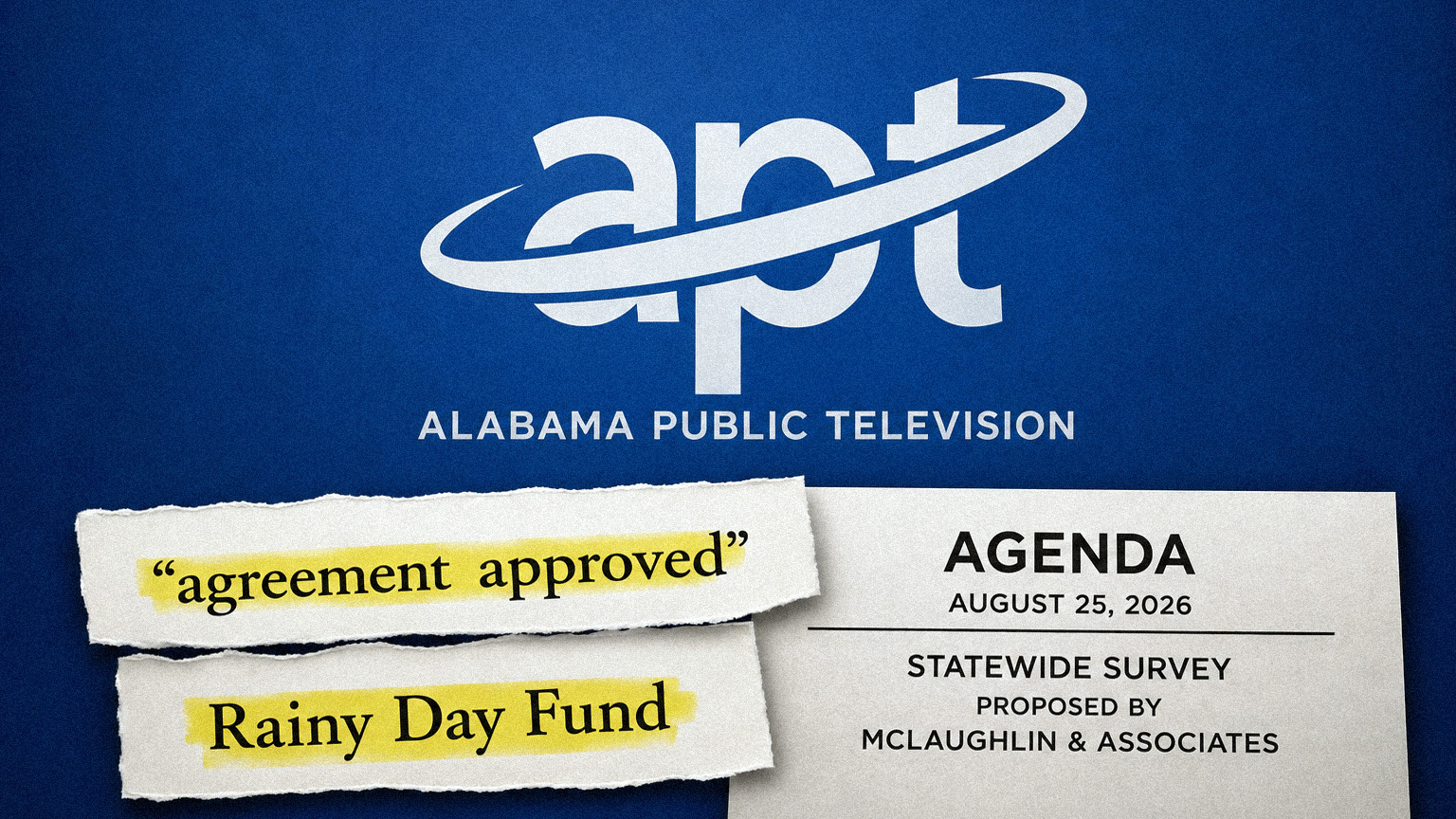
Leaders of Alabama Public Television’s Foundation told the public last month that it was “not committing” to any contract with McLaughlin & Associates. The Foundation has now called a special meeting for Tuesday to approve spending from its Rainy Day Fund for what the new agenda describes as an “agreement approved” at that same July 21 meeting.
The Alabama Educational Television Foundation Authority will meet at 11:30 a.m. August 25 at APT’s Montgomery studio, 1255 Madison Ave. The only substantive item on the agenda is approval of the amount to be spent on a statewide survey proposed to be conducted by McLaughlin, one of the Republican Party’s longtime polling firms.
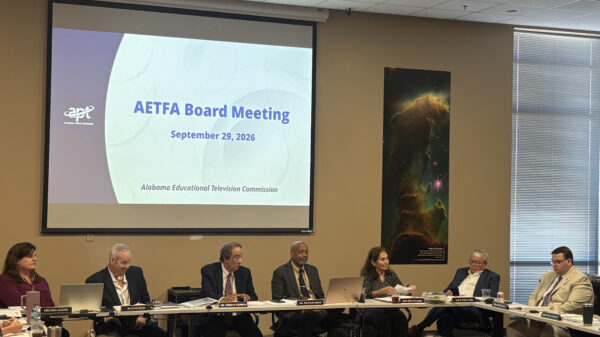
The Foundation’s next meeting had been scheduled for September 29. APT has offered no public explanation for why the expenditure now requires a special meeting five weeks earlier, who requested the meeting or what changed after July 21.
Alabama Political Reporter sent those questions to Foundation Chairman William Green, along with requests for the revised contract, proposed survey questions and documentation explaining the poll’s methodology and purpose. Green had not responded as of publication.
A meeting hidden in plain sight
The Foundation appears to have satisfied the minimum notice provision of Alabama’s Open Meetings Act. A notice was submitted to the secretary of state at 9:47 a.m. August 18 for the August 25 meeting—the last calendar date that would satisfy the law’s seven-day requirement for statewide governmental bodies.
Legal notice, however, is not the same as meaningful public notice.
As of Thursday morning, APT’s Board of Directors page, which covers both the Educational Television Commission and the Foundation Authority, still identified September 29 in Huntsville as the next meeting. It did not mention the August 25 special meeting or provide a link to its agenda. APT’s meeting archive directs anyone seeking information about upcoming meetings to that same page.
The agenda exists as a PDF in APT-controlled web storage and is available to anyone possessing its direct address, but APR could not locate it through APT’s regular board page, events calendar or pressroom.
APT’s board page says meeting notices are posted on its website and the secretary of state’s website at least seven days in advance and “announced on-air on APT 10 days prior to each meeting.” The first documentary notice APR could verify appeared August 18, seven days before the meeting. APR could not independently verify whether the stated 10-day on-air announcement occurred.
The agenda expressly includes public comment, contrary to initial concerns that citizens would not be allowed to speak. But “PUBLIC COMMENTS” appears after “NEW BUSINESS,” where the Foundation will take up—and could vote on—the survey expenditure.
Unless Green changes the order from the chair, citizens are scheduled to speak only after the board considers its sole substantive item. The agenda contains no speaker rules, registration instructions or livestream information.
Alabama’s Open Meetings Act guarantees the public’s right to attend and observe covered meetings but does not generally require a board to permit public comment. The legal question is therefore different from the transparency question: Once the Foundation places public comment on its agenda, hearing citizens only after a decision would sharply limit the value of their participation.
Earlier this year, the Educational Television Commission voted 4-2 to allow public comments at its quarterly meetings after Commissioners Ferris Stephens and Les Barnett opposed the proposal. Commissioners also voted unanimously to continue livestreaming Commission meetings. Those actions do not clearly control this special Foundation meeting, and APT has not said whether Tuesday’s proceedings will be streamed.
An agreement that was not supposed to be an agreement
At the Foundation’s July 21 meeting, according to Alabama Daily News, board member Dick Brewbaker said, “We’re not committing ourselves to any contract.” Green agreed, saying the final price was unknown and that the project might not proceed if questions about the proposed agreement could not be resolved.
The preliminary contract raised multiple concerns within APT. Chief Financial Officer Melissa Austin said staff received it July 16, only five days before the meeting, and had not completed a thorough review.
The $47,400 proposal, plus possible travel expenses, called for a survey of 600 people lasting approximately 20 minutes and containing 45 to 50 questions. But the document went well beyond conducting and analyzing a poll. It included consulting on advertising, fundraising, programming schedules, staffing and press strategy, while designating McLaughlin as APT’s media buyer.
The contract also referred to drawing text-message participants from a voter file, even though Austin said the firm had agreed to survey Alabama adults rather than only registered voters.
Green said removing the unrelated provisions might reduce the price to approximately $27,500. The Foundation ultimately approved using the Rainy Day Fund for an amount not to exceed $47,500 and directed APT to budget for a similar poll approximately one year later. Pete Conroy and Logan Glass voted no.
The August 25 agenda now characterizes the July action as approval of an agreement. It does not disclose the proposed expenditure, attach a revised contract or say whether McLaughlin has begun drafting questions, constructing a sample or consulting with APT.
Nothing in the public record shows that the survey has been conducted. APT has not answered whether a contract has since been signed or whether McLaughlin has started work.
A political pollster for a public broadcaster
McLaughlin & Associates is not simply a commercial market-research company. Its own client list includes President Donald Trump, the Republican National Committee, the Republican Governors Association, the Alabama Republican Party and numerous Republican officeholders.
Its promotional materials say the firm helped former Alabama House Speaker Mike Hubbard and former Senate President Pro Tem Del Marsh increase Republican legislative supermajorities. McLaughlin also conducted polling for Hubbard’s campaign before Hubbard was convicted of felony ethics violations and sent to state prison.
That history does not prove the APT survey will be biased. It does make the undisclosed questionnaire, sampling plan and oversight process essential to determining whether the poll will measure Alabamians’ views or reinforce a conclusion already favored by some commissioners.
The survey grew directly from the Commission’s dispute over whether APT should reduce or end its relationship with PBS. During the October debate, Barnett said, according to The Associated Press, that PBS had “made themselves the enemy of what I stand with” and that he did not believe in “feeding the beast.”
Governor Kay Ivey intervened in November, urging the Commission not to make such a sweeping decision without thorough planning and a clear understanding of public opinion. She called for an extended survey and said any separation plan should be available for public review for a considerable period before a vote.
The Commission later voted to continue its PBS partnership indefinitely unless a proven financial reason justified reconsideration. Every commissioner supported that motion except Barnett. A Commission-created advisory committee also unanimously recommended retaining PBS, with committee member Eric Land warning that disaffiliation would be a “catastrophic financial disaster.”
Nevertheless, the Commission voted 4-3 in April to proceed with the survey. Stephens, Barnett, Green and Bebe Williams voted yes. Conroy, Tijuanna Adetunji and Glass voted no.
Green has said the survey is no longer intended to determine whether APT should leave PBS but to learn what Alabamians want from public television. At the same time, he told Alabama Daily News that he wants to reduce APT’s reliance on PBS programming from roughly 90 percent to 30 or 40 percent over five years.
Conroy has rejected the claimed separation between the survey and the PBS dispute.
“I’m certain that it has something to do with his desire to disaffiliate with PBS,” Conroy told Alabama Daily News of Stephens after the July meeting. “There are a lot of disingenuous things happening today.”
Emergency money after layoffs
The proposed funding source adds another layer to the controversy.
The Foundation’s investment policy describes the Rainy Day Fund as a reserve for emergency purchases that cannot be covered through the existing budget, new revenue or spending reductions. The policy identifies circumstances including proration, transmission outages and the loss of APT’s federal operating grant.
APT lost more than $2.5 million in annual federal support and eliminated 11 positions. During the July meeting, Austin noted that the Rainy Day Fund had not been used to prevent those layoffs and asked whether the survey could instead be placed in the next regular budget.
The reserve held approximately $4.7 million at the end of the third quarter, while the Foundation’s endowment held just under $6 million. When Conroy asked whether the poll was being treated as an “emergency survey,” Stephens did not identify an emergency. He argued instead that the Foundation, having created the policy, had the authority to use the money differently.
APT announced August 5 that it had renewed its PBS contract for another year while asking viewers for additional donations to help replace the lost federal support. Less than three weeks later, the Foundation is preparing to approve Rainy Day spending for a Republican polling firm’s survey.
APR asked Green why the board could not wait until September 29; who requested the special meeting; whether a contract has been signed or work has begun; what the final cost will be; why the Rainy Day Fund is being used; whether the revised contract and proposed questions will be released; whether citizens will be heard before the vote; and whether the meeting will be livestreamed.
APR will update this report if Green or APT provides answers or the requested documents.