


























The Birmingham City Council voted Tuesday to approve an ordinance regulating data center zoning.
During a lengthy and at times heated public hearing, council members heard concerns from residents, including objections to revisions made since April that removed special exception requirements for hyperscale data centers that comply with the ordinance.
Special exceptions require zoning boards to hold public hearings where the public may ask project proposers questions before a project is approved.
The council approved the ordinance 6-3, with City Council President Wardine T. Alexander and council members Sonja Smith and Darrell O’Quinn voting against the measure.
The vote came after the council enacted a 180-day suspension March 3 on the consideration of new data center proposals. The council previously discussed the proposal and held a public hearing during its April 28 meeting, then delayed a vote on the draft for further consideration.
Residents filled the council chamber and waited in overflow rooms to give public comments. They overwhelmingly urged the council to further revise the ordinance, objecting to the removal of the special exception requirement and proposing additional safeguards.
The meeting came amid public controversy surrounding a data center proposal approved for Birmingham’s Oxmoor Valley community. The project is backed by the AI cloud company Nebius.
Before the vote, council members Hunter Williams, Clinton Woods and Josh Vasa expressed support for voting on the ordinance during the meeting. Each said that, according to the city attorney, if the council delayed a vote, exempt facilities such as the Nebius development could seek to expand without being subject to the ordinance’s requirements.
“The concern there is if we do not act today, there is room for growth from those entities that are currently permitted,” Vasa said.
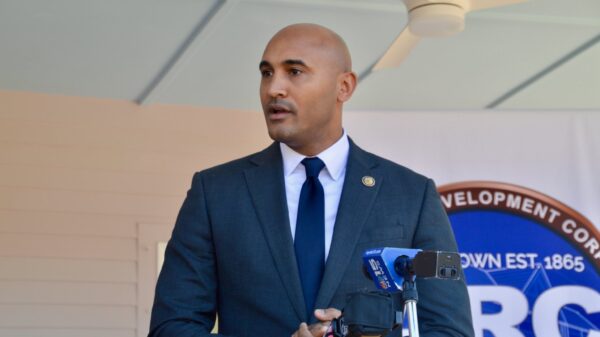
Birmingham Mayor Randall Woodfin spoke in favor of the ordinance, thanking Department of Planning, Engineering and Permits staff and Mayor’s Office of Resilience and Sustainability staff who drafted the measure.
“I think they’ve done a tremendous amount of work on this emerging trend,” Woodfin said. “And we believe our staff has produced one of the nation’s strongest data center ordinances.”
Kim Speorl, city zoning administrator for the Department of Planning, Engineering and Permits, and Hunter Garrison, deputy director of the Mayor’s Office of Resilience and Sustainability, presented an outline of the draft ordinance to the council.
“The impetus behind developing this ordinance is due to the explosive growth and concern around data centers, nationally in the United States,” Garrison said. “We recognize that. We share many of those concerns.”
“Data centers have existed in the city of Birmingham for decades. However, with the advent of AI computing, those data centers at a national scale have rapidly grown in intensity and impact on the surrounding community,” Garrison added.
City presenters described the proposal as drafted in response to public concerns about decreased air quality, lower property values and increased energy bills in communities adjacent to hyperscale data centers.
The ordinance defines classes of data centers based on scale and provides zoning requirements for each classification. Data center classifications range, in ascending size, from fiber huts to accessory data centers, micro data centers, medium data centers and hyperscale data centers.
However, discussion among council members and public comments focused almost exclusively on zoning requirements for hyperscale facilities.
The ordinance defines hyperscale data centers as centers that require extensive cooling systems, electrical substations, backup power generators and related infrastructure, and that occupy more than 200,000 square feet of gross floor area or have an aggregate electrical demand exceeding 30 megawatts.
The ordinance outlines 20 requirements that hyperscale data centers in the city must meet. The facilities must use a closed-loop water-cooling system, be at least 500 feet from any residential zoning or urban neighborhood district and be at least 1,000 feet from any fixed guideway transit system or station.
Hyperscale facilities also must be located on a lot containing at least five acres, must contain backup power generators and may not generate on-site power except from solar power and fuel cells for purposes other than emergencies. The ordinance also requires noise studies before and after construction of hyperscale centers.
Additional revisions made to the draft presented in April include the inclusion of fuel cells as a viable on-site energy source and a requirement that developers send written notification to property owners within 500 feet of all new or expanded hyperscale data centers.
Despite many community speakers expressing support for the council’s effort to regulate data center zoning, more than 50 speakers urged the council to revise the draft proposal.
Speakers primarily called on councilors to reinstate special exception requirements for hyperscale data centers, increase the mandatory setback from residential properties from 500 feet to 1,000 feet and add quantifiable limits on noise, air pollution and heat emitted by data centers.
Council members emphasized that the ordinance does not apply to the Nebius development because the ordinance cannot interfere with current permitting processes. Garrison also said the council cannot use its power to ban data centers outright.
“If it’s a legal land use in the United States, we have to allow it to happen somewhere within the city of Birmingham,” he said. “We cannot ban data centers. We can only put meaningful guardrails around them to protect our citizens.”
During the public hearing, which lasted nearly three hours, residents and leaders of local environmental and civic organizations urged the council to require public hearings for hyperscale facilities and enact further regulations.
Charles Miller, policy director for the Alabama Rivers Alliance, commended the council for considering the ordinance and including water-use requirements, while calling for the reinstatement of special exceptions for hyperscale centers.
“We do agree with the majority of the people who have spoken here today that the special exception requirement that gives citizens a voice in this process is incredibly, incredibly important,” Miller said.
“I know that this council and the planning department has worked diligently on this ordinance, and I know that we’re kind of running up against the clock when it comes to the moratorium,” he continued. “But I believe that if we want to see a durable ordinance, it has to include some element of public participation, and I believe that our city can do that.”
Julianne Tharp, field and advocacy fellow for the Greater Birmingham Alliance to Stop Pollution, or GASP, also urged the council to further revise the ordinance while commending community members for sharing their thoughts on the proposal during the hearing.
“It’s only June, halfway through the allotted six-month suspension, and there is still more work to do on this ordinance to truly incorporate best practices and not make the same mistakes other cities have made at the expense of its citizens. We cannot rush this process,” Tharp said.
Tharp urged the council to increase the 500-foot residential setback for hyperscale facilities, reinstate the special exception requirement, promote the use of solar or propane emergency generators and require that no more than two traditional diesel generators be used at a time.
“I strongly implore you not to approve this ordinance as it’s currently written,” Tharp said.
Additional public speakers included residents of Birmingham and surrounding municipalities, as well as representatives of local organizations including Black Warrior Riverkeeper, the Greater Birmingham Humane Society, Voters Legal Justice Watch Group, the Southern Environmental Law Center and the South Titusville Association.