



















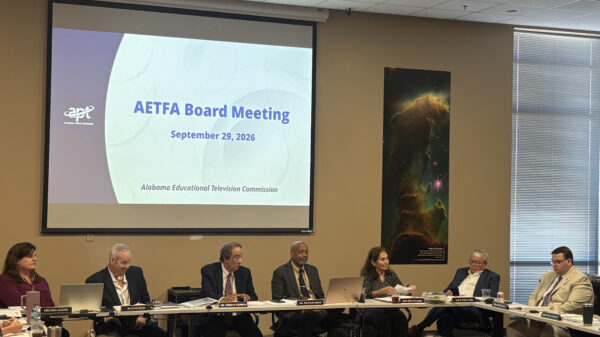








The Alabama State Board of Education reported at their monthly meeting last week that more students are meeting College and Career Readiness benchmarks.
From 2024 to 2025, Alabama students who completed a CCR benchmark increased from 87.88 percent to 90.7 percent, a 2.82 percent increase.
This school year was the first year that high school seniors were required to meet one CCR benchmark to receive their diplomas. For the graduating class of 2026, students could demonstrate college and career readiness by meeting at least one of nine state-approved indicators, including earning a benchmark score on a subject-area subtest of the ACT, scoring Silver or higher on ACT WorkKeys or earning a 3 or better on an Advanced Placement exam.
“With that, you’ll see that our students not only increased from the graduation rate, but also well over a 2 percent change with an increase in our college and career readiness rate,” said Sean Stevens, Instructional Services Coordinator for the Alabama State Department of Education. “This is remarkable. We continue to see that increase, and we’re really, really proud of this.”
Melissa Shields, assistant state superintendent of education, emphasized that narrowing the gap between the percentage of students who graduate and the percentage who are college and career ready has been a long-term focus.
“To see us getting so close to that alignment, if you look at previous historical data, this is something we have been getting closer and closer,” said Shields.
In earlier years, that gap was as wide as 12 to 20 percentage points. State Superintendent Eric Mackey said part of the discrepancy stemmed from incomplete data reporting, with some districts not entering credential information into state systems. Over time, the department worked with districts to streamline reporting processes.
Mackey described how these indicators align with real-world expectations.
“Not just benchmarks, but benchmarks that mean something to industry, or mean something to college. They mean something out there,” said Mackey.
During the board’s discussion, Mackey directly addressed concerns about the slight decline in ACT WorkKeys scores, saying the shift reflects an expanded range of ways to earn a CCR credit rather than weaker student preparation.
“Our WorkKeys score actually went down, and I thought that concerned a lot of people. Why is that going down?” Mackey said. “Well, essentially, we’ve created so many other opportunities, and so many of our students now are doing dual enrollment, where WorkKeys has become less of a thing.”
Mackey said that ALSDE saw double-digit gains in dual enrollment, Advanced Placement, International Baccalaureate performance, postsecondary credit attainment and career technical education completers.
Mackey also discussed the state’s effort to secure federal approval for an accountability waiver that would give greater weight to ACT WorkKeys achievement in Alabama’s A–F school report card system.
Currently, the largest portion of a school’s grade is driven by academic achievement and growth, which are measured primarily through the ACT in high school. Mackey said that structure can unintentionally narrow a school’s focus.
“Principals are smart enough; they know what gets measured,” Mackey said. “And if we’re only measuring one thing, and that is college readiness, then they’re going to put all of their eggs in that basket.”
Mackey said the change is part of a broader effort to create a “more balanced portfolio” within the state’s accountability model.