










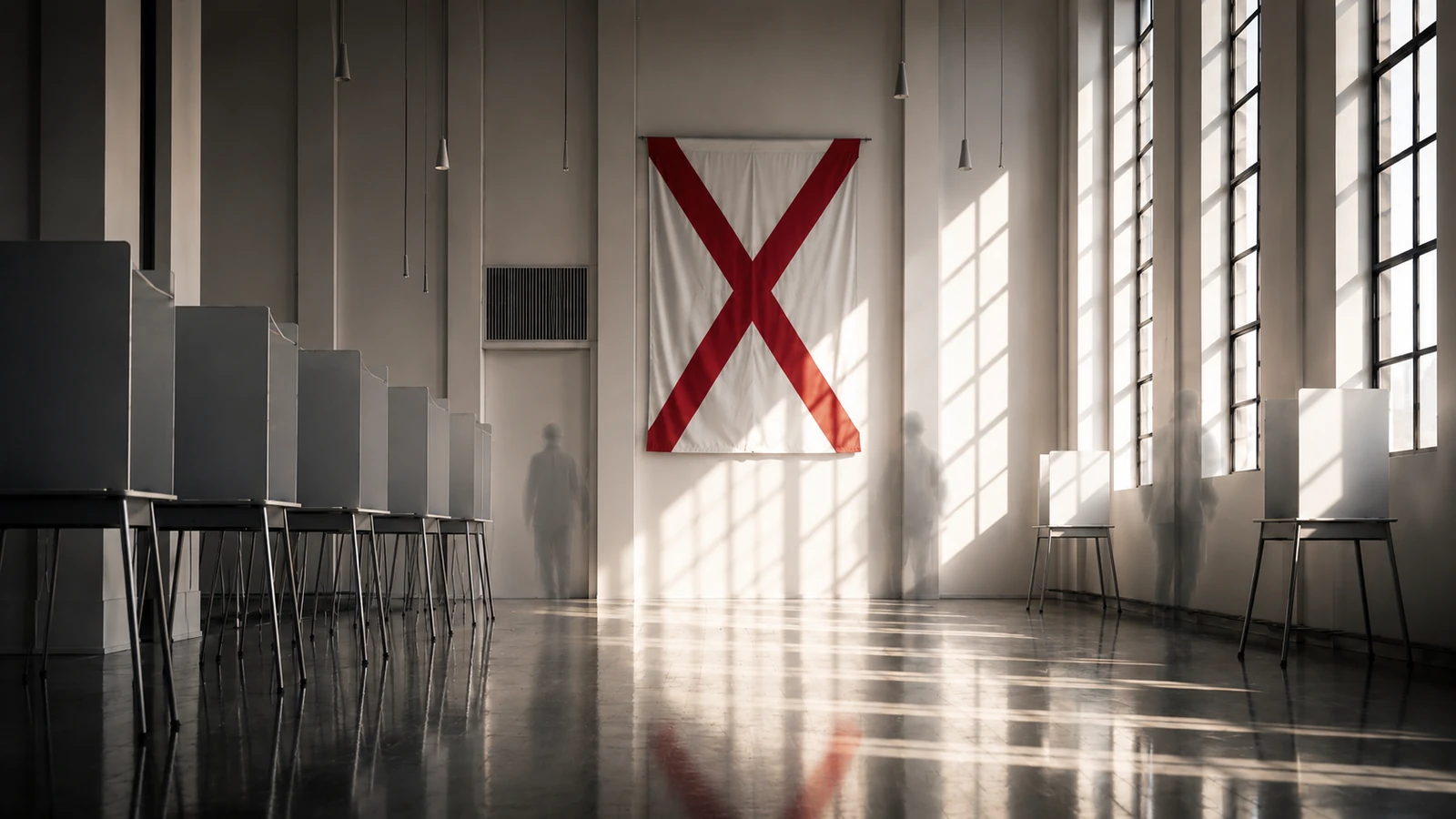
Over the last decade, Americans have been told to fear voter fraud. The accusation has become a drumbeat, repeated after losses, raised before elections and used again and again to justify making voting harder, narrower and more suspect.
Alabama has heard the same sermon. But here, the numbers preach a different truth.
Alabama does not have a crisis of too many people voting illegally. Alabama has a crisis of too many legal voters not voting at all. That is not an accident without consequences. In this state, low turnout has always served somebody. It serves the organized over the ordinary, the powerful over the frustrated and the political class over the people who believe Montgomery stopped listening long ago.
They do not have to steal your ballot if they can steal your belief that the ballot matters.
That is the theft Alabama should be talking about. Not the phantom voter. Not the imaginary caravan of illegal ballots. Not the conspiracy whispered after every loss. The real election story in Alabama is absence—citizens who are registered, eligible and silent.
The numbers are not subtle. In the 2024 general election, Alabama had 3,861,929 registered voters and 2,272,911 ballots cast—a turnout of 58.85 percent, meaning nearly 1.6 million registered voters stayed home in a presidential election, according to the Alabama secretary of state’s official election data.
In the 2022 midterm, turnout fell to 38.60 percent, with 3,687,753 registered voters and only 1,423,409 ballots cast. More than 2.2 million registered Alabama voters did not vote.
And in the 2026 primary runoff, unofficial Alabama Votes totals showed just 408,740 ballots cast out of 3,812,426 registered voters—10.72 percent turnout.
That is not a footnote. That is the story.
That is not democracy at full strength. That is democracy by attrition. In Alabama, the largest political party is not Republican or Democrat. It is the people who no longer believe voting matters.
That should bother anyone who still believes Alabama belongs to its people and not merely to its political class. When millions stay home, government does not stop. Budgets are still written. Taxes are still collected. Laws are still passed. Judges are still elected. Schools are still funded or neglected. Roads are still built or forgotten. Hospitals still close. Prisons still fill. The machinery of government keeps moving. The only question is who is moving it.
When citizens give up on voting, power moves into fewer hands. It moves toward the organized, the angry, the wealthy, the connected, the ideological and the intensely motivated. It moves toward those who understand something most citizens forget: A small electorate is easier to manage than a large one.
A low-turnout Alabama is easier to govern from the inside. It is easier for lobbyists, party machines, trade associations, courthouse networks and well-funded interests to shape outcomes when most citizens never enter the fight. That is why low turnout is not merely a statistic. It is a transfer of power.
In Alabama, power has always preferred a smaller room. Fewer voters mean fewer questions. Fewer voters mean fewer surprises. Fewer voters mean the same people keep deciding the future for everyone else. That is not cynicism. That is history.
Alabama does not have to guess what voter suppression looks like. We wrote it into our fundamental law. The 1901 Constitution was not an accident of history. It was a deliberate act by men who understood that political power could be preserved by narrowing the electorate. Alabama’s own Bicentennial Park history says elites called for the 1901 constitutional convention on the premise of “promoting honest elections,” but the result was literacy tests, a poll tax and other barriers that disenfranchised most Black Alabamians and many poor white Alabamians.
That is worth remembering. The language then was clean. The purpose was not. The men who built that system understood that if they could control who voted, they could control Alabama.
The methods change, but the logic does not.
The old method said: You cannot vote.
The new method says: Why bother?
Both serve the same end if enough people believe it. Today, the tools are softer but still effective: cynicism, exhaustion, confusion, inconvenience, distrust and the constant suggestion that elections are rigged, politicians are all bought, government is hopeless and one vote cannot possibly matter.
Some of that frustration is earned. Alabama politics has given people plenty of reasons to be cynical. Corruption did not arrive here yesterday. Insider government is not a theory. Special interests, party machines, lobbyists and well-financed factions often have had more influence in Montgomery than ordinary citizens.
But cynicism is not a plan. Staying home is not a protest. Silence is not reform. When citizens do not vote, they are not punishing the system. They are rewarding those who already control it.
No serious person is arguing for sloppy elections. Voter rolls should be accurate. Ballots should be secure. Laws should be followed. Every lawful vote should count, and every unlawful vote should be prevented. But election integrity cannot become a polite phrase for making lawful voters feel unwanted.
A secure election is not one where fewer citizens participate. A secure election is one where every eligible citizen can cast a ballot, every lawful ballot is counted, and the public can trust the result. By that standard, Alabama has work to do.
Even Alabama’s own secretary of state has said as much. When the State Canvassing Board certified the 2024 general election, Wes Allen said Alabamians had cast their ballots in a “fair, secure, and transparent election.” If Alabama’s chief election official says the election was fair, secure and transparent, then the greater crisis is not imaginary fraud. The greater crisis is real nonparticipation.
The voter fraud drumbeat has consequences. It teaches people to suspect the act of voting itself. It tells citizens that if their side loses, the election must have been stolen. It tells them that if their side wins, the system worked only because fraud was overcome. It turns elections from a civic act into a conspiracy test, and over time that does damage.
It damages trust in election workers, most of whom are not political operatives but ordinary citizens doing an exhausting job for little praise. It damages confidence in local institutions. It damages the willingness of decent people to participate. It makes the loudest voices louder and the quietest citizens even more silent. That is how a republic weakens—not all at once, not with one stolen ballot or one corrupt precinct, but slowly, as more citizens decide the act of voting is useless.
A citizen who stays home because he forgot may be reminded. A citizen who stays home because she was busy may vote next time. But a citizen who stays home because he believes the system is hopeless has lost something deeper. He has lost faith that self-government still belongs to him.
That is the theft we should be talking about.
Voting is not magic. It does not fix every injustice. It does not make bad leaders good or dishonest systems pure. It does not guarantee wisdom, fairness or courage from those elected. But voting is still the first claim of citizenship. It is the moment when ordinary people remind the powerful that public office is borrowed, not owned. It is the one act that says government is not the private property of parties, factions, donors, lobbyists or political machines.
A ballot is small. That is why the powerful have always feared it.
In Alabama, too many citizens have been convinced that their small act does not matter. They have been told the outcome is already decided, the parties are the same, politics is corrupt, government is bought, nothing changes and one vote cannot matter. But the people who benefit from low turnout are not afraid of apathy. They count on it. They build campaigns around it. They draw districts around it. They survive because enough people have decided the fight is not worth showing up for.
The people who run Alabama are not afraid of voter fraud. They are afraid of voters who still believe their voice matters.
That is why the missing voters are the real election story in Alabama: the working mother who believes politics has nothing to do with her life; the young man who thinks both parties have written him off; the rural voter who believes Montgomery will ignore him no matter what; the Black Belt voter who has inherited generations of reasons to distrust the system; the suburban voter who thinks government is something that happens somewhere else.
They are not powerless. They are absent. And absence is exactly what the powerful prefer.
Alabama has never been changed by those who stayed home. Every inch of progress in this state came because somebody believed enough to act. Somebody organized. Somebody marched. Somebody registered. Somebody stood in line. Somebody cast a ballot when the powerful wished they would disappear.
The vote is not the whole of democracy. But without it, democracy becomes theater. Citizens become spectators. They watch other people decide. They complain about the outcome, but they have surrendered the instrument that could have changed it.
Power does not disappear when citizens stop voting. It simply moves into fewer hands.
That is why the loudest lie in politics is not always that an election was stolen. Sometimes the loudest lie is that voting does not matter.
The lie does not have to convince everyone. It only has to convince enough people to stay home.
Once that happens, no one has to steal their ballot.
They have already surrendered it.
And Alabama’s powerful will gladly count the silence.