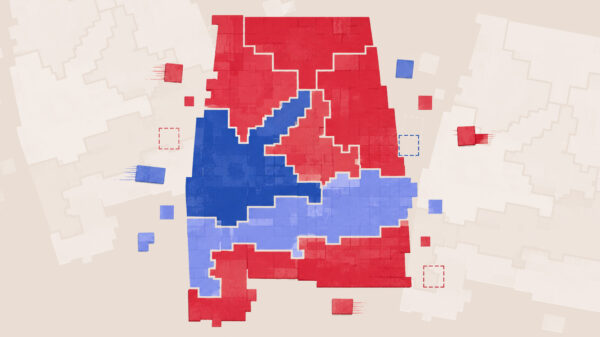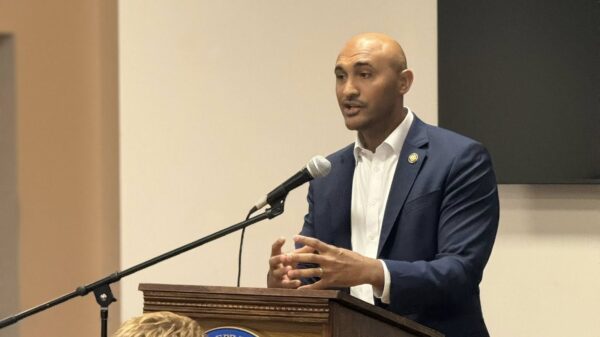


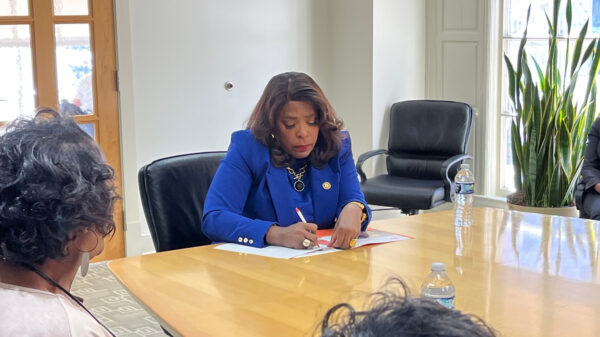















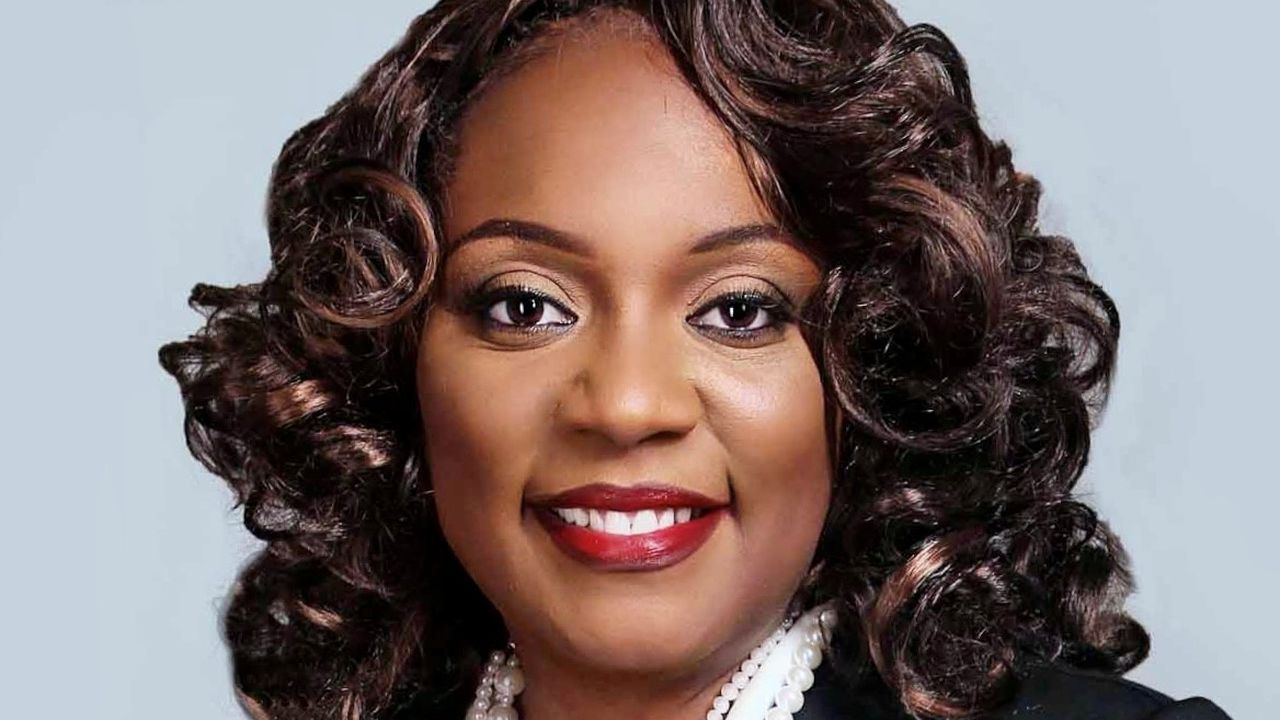
In light of successful efforts to redistrict the state in favor of Republicans, longtime Alabama lawmaker Senator Merika Coleman, D-Birmingham, is calling for expanded coalitions between Democratic politicians and voting rights advocates to prevent the GOP from further dominating state politics.
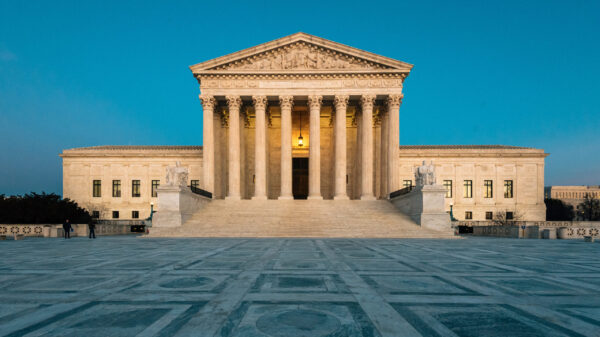
The U.S. Supreme Court’s decision in Louisiana v. Callais and subsequent Supreme Court and lower federal court decisions have been seen as Republican victories, allowing Alabama to return to congressional and state Senate maps previously struck down as racially discriminatory and favorable to the GOP. However, following the decision, turnout among Democratic voters also increased in 60 of the state’s 67 counties, and large demonstrations against redistricting efforts came in response to the state’s special session.
In an interview last Thursday focusing on the Callais decision and Democrats’ plans to respond to Republican redistricting, Coleman told APR that despite districts increasingly favoring the rival party, Democrats plan to build on the increased engagement seen among Alabama’s Democratic voters alongside voting rights and minority advocates in response to Republican-led redistricting.
Coleman has served in the state Legislature for more than two decades, first as a representative from 2002 to 2022 and then as a senator. During the conversation, which has been edited for length and clarity, she reflected on past experiences as a legislator and leader in Alabama’s civil rights district, while arguing for the necessity of her party building strength through collaboration with voting rights advocates, leaders in communities of color and civic and faith-based organizations from across the state.
What are your key takeaways from the Callais decision, including citizens’ demonstrations against redistricting and conversations between lawmakers during the special session?
“For the Supreme Court to have ruled in the manner that it did in Callais, but also applying Callais now to the Milligan case—people are mad. But mad is energized also. I would be less than truthful if I didn’t say that it was quite disappointing. I was a military brat—grew up having life then very inclusive, went to school with lots of different people and had a very diverse childhood. But I remember the stories my mother told me about the things they had to do, to even be able to protest, and the risks they had to take as young people to be able to stand up. But now here it is. I’m 52 years old. And now fighting the same battle that my mother fought, that my grandparents and other forefathers fought.
“Here we are in 2026 with a legislative body, and remember, these are supposed to be my colleagues that have said to us through their vote, ‘We do not believe that you deserve a voice, and people that look like you deserve to have representation of their choosing, to have the opportunity to really be able to pick representation of their choosing.’ I hate we have to do this, but to serve with folks that don’t have the political courage, that’s a big thing. Yes, we are representatives in a representative democracy, but a part of that too is having the courage to do the right thing. We talk in our caucus about folks; they come up to us and say that this is not right. If they don’t feel it’s right, then they ought to have the courage to say that, even if it costs you something, because that’s political courage.”
How would you respond to Republican leaders such as the attorney general, who have said the state is attempting to draft “race neutral” districts in response to the Callais decision?
“I would laugh. I mean, I was there when these maps were passed. I was a part of the floor discussion during the original session when those 2023 and 2021 maps were passed. But also, during the special session, I was both on the committees and had to endure the floor sessions as well. We know for a fact in the court itself, the three-judge panel determined that those maps were deliberately discriminatory. And the court drew racially neutral maps.
“One of the other arguments that they had during the session was that they wanted to pass, how did they say it? Pass Alabama-drawn maps, that’s what they were saying. Well, the Alabama-drawn maps were holding out the public. It was not about trying to do what’s best for the citizens of the state of Alabama. It wasn’t about trying to lower the cost of prescription drugs, and the cost of groceries, gas, any of those things. It was about making the president of the United States happy.
“One of the statements I have made multiple times since the Republicans took over in 2010, but especially during the Trump administration, has been, ‘We do just fine in Alabama.’ We get along fine in Alabama when we leave Washington, D.C., out of Alabama. Every single time that Washington, D.C., puts pressure on the Republicans in the state, that’s when everything kind of gets mucked up.”
Have Democrats been able to engage in any productive conversations with Republicans to demonstrate why they are so opposed to their calls for redistricting?
“In Alabama right now, because of gerrymandering, Democrat pretty much means Black. We do have four white Democrats that serve with us. My [Republican] colleagues try to make it a partisan issue, not a racial issue. But the impact is racial, and they know that. They’re afraid of the White House. We know that the White House leans on our state. It’s a rumor, but if they get it their way and get a 7-0 congressional delegation, of course our two senators are already Republican, and if the Democrats win in the next presidential election, we don’t have a pipeline into the White House. When Joe Biden was there, we had our one member, Congresswoman Terri Sewell, who was a lifesaver, just getting direct pipeline on all these appropriations and all these other things that work directly with the White House to secure for the state of Alabama. If we have no one who does that for Alabama and vice versa, if it was all Democrats and we have a Republican in, who is the pipeline?”
What are Democrats’ plans for voting rights legislation next session, and how will the party’s approach differ from previous years?
“We kind of get afraid of people knowing the playbook. But there is a beautiful thing that’s going on right now with advocates, all of these voting rights advocates, organizations, Black and brown churches, all kinds of nonprofits, along with lawmakers to come up with the plan, right? The plan is not only legislation itself. A lot of it won’t be different than some of the things that folks have introduced in the past, you know, curbside voting, Saturday voting, same-day registration, some of the things that make it easier for people to vote, not harder. But we also have to do the statewide organizing collectively. It’s not just having a big mass meeting all the time. It is going to where people are, speaking to them about the issues that they care about. And so there is a movement.”
What will it take for your party to use upticks in Democratic voter engagement seen following Callais and during the special session in light of new state and U.S. district maps further favoring Republicans?
“Our numbers were up. We were very excited about that. A lot of it is kind of letting folks know through their algorithm what was going on. One of the reasons I believe we were successful with the turnout of people during this last special session is because some of us went live and showed things in real time. Our legislative session is streamed. But it’s different, of course, when somebody is live and, you know, they’re connected to you through social media contacts and so all of these people now were exposed to the legislature that had not been exposed prior to.
“Part of that is our fault. There are people when they post on social media, they’re posting, when their bills have passed, they’re posting some checks that they’ve given out or something they’re doing in the community and they’re smiling. Some people are not really letting folks know the level of hardship that we’ve had to endure. We’ve got to stop shielding them from the hard thing, the types of legislation that detrimentally impact the Black community and other communities of color. But there’s a coalition there as well: women, senior citizens, when they’re trying to block them from doing curbside voting. But we also need to listen to them. You know, we got to break it all the way down to how it impacts a particular person and all of that takes time. We’ve got to keep the energy there. The organizing is we got to give them a thing to do.
“We got them fired up now. They understand that we have some major challenges because of the makeup of the Legislature. They understand now that the Supreme Court is not our friend. That’s another piece of it. We can’t just get them fired up. We can’t just register people to vote and don’t ask them to come back. We have to give them the tools they need in order to organize at the lowest level: their home, their own family, their churches, their civic groups. So that is the work that is going on now is to give them the tools so they can stay connected, stay excited, understand the real impact that their vote has, even when the odds are stacked against you.”