
































Some elections decide who will govern. Others test whether a nation can still govern itself.
The election of 1876 did both.
The country was only 11 years removed from the Civil War. Federal troops stood in contested states, rival governments claimed authority, political violence marred the ballot box, and Congress could not agree on who had won the presidency. The Constitution offered no clear way forward.
Historians remember the contest as the Great Electoral Crisis of 1876, yet most Americans have never heard the story. That is unfortunate because no disputed election reveals more about the strengths, weaknesses and moral compromises of constitutional government than the struggle between Samuel J. Tilden and Rutherford B. Hayes.
Tilden was a lawyer and reform governor of New York whose national reputation rested on fighting corruption. He helped bring down Boss Tweed’s political machine and campaigned for president, promising honest government after years of scandal in Washington.
His Republican opponent, Rutherford B. Hayes, was a Union general wounded several times during the Civil War and widely regarded as a man of integrity. This was not an election between a patriot and a villain. It was an election between two respected men asking a deeply divided nation to trust them.
That nation was anything but stable. Reconstruction remained unfinished, and Black citizens possessed the constitutional right to vote but often required extraordinary courage to exercise it. White supremacist organizations used intimidation, violence and murder to suppress Republican voting throughout much of the South.
Republicans argued that federal protection remained essential if Black Americans were to enjoy the rights promised by the Constitution. Democrats insisted Republican state governments survived only because they rested upon federal bayonets.
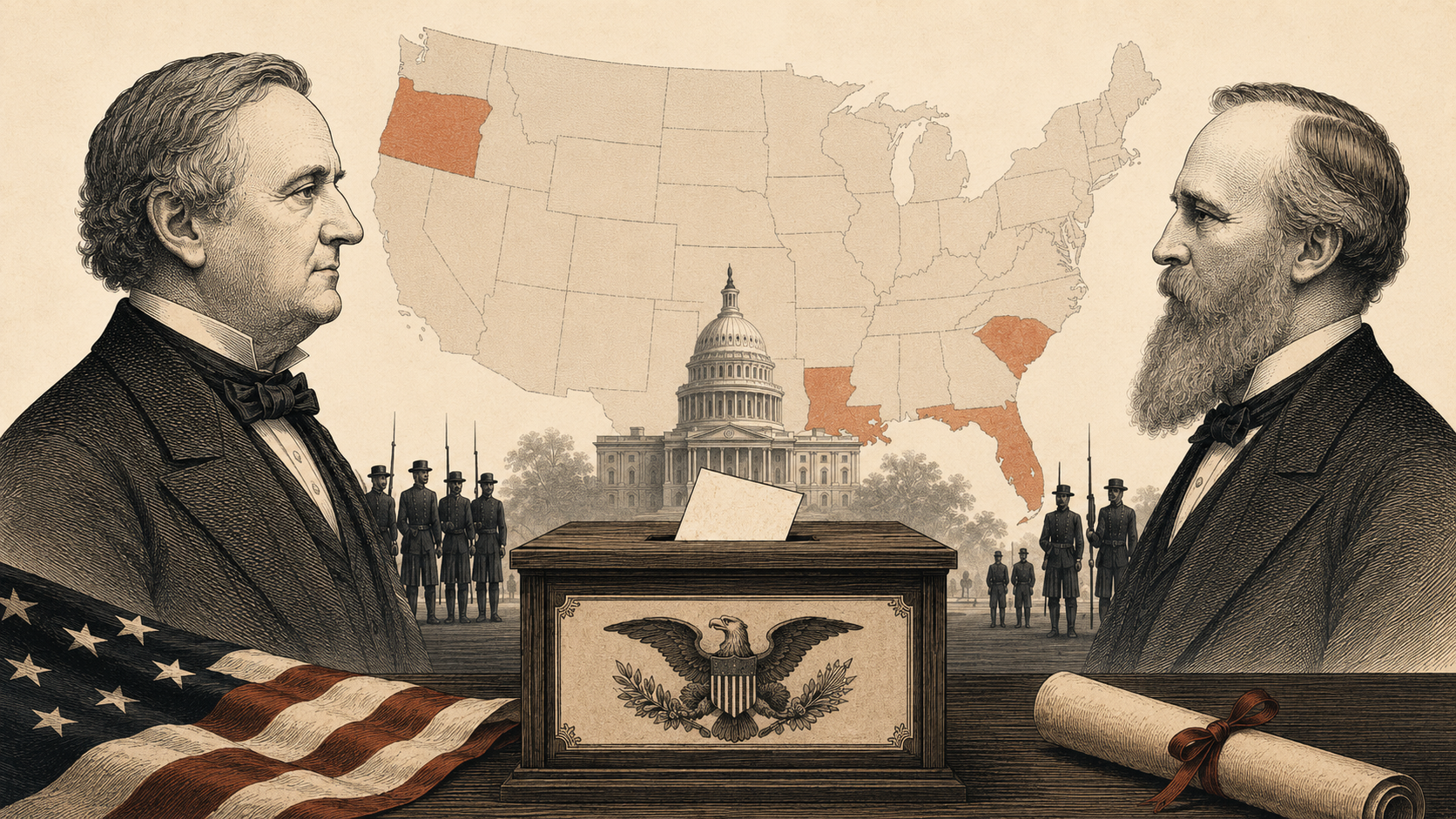
When Americans voted in November 1876, Tilden appeared to have won. He carried a majority of the national popular vote by more than 250,000 votes and secured 184 undisputed electoral votes. At the time, 185 were required to become president.
Hayes had 165, and 20 electoral votes remained contested: those in Florida, Louisiana and South Carolina, along with one disputed elector from Oregon. He had to win every one of them.
What followed was not simply a recount. It was a struggle over who possessed the constitutional authority to decide a presidential election.
Both parties claimed victory in the disputed states. Rival officials certified rival returns. Lawyers, party leaders and political operatives flooded into the South.
In South Carolina, competing legislatures claimed to be the lawful government. Two governors declared themselves the rightful executive. Federal troops guarded the statehouse while the nation waited to learn whether ballots—or force—would decide the presidency.
President Ulysses S. Grant reinforced the federal military presence in the contested South. His supporters argued that troops were necessary to protect lawful governments and Black citizens from organized political violence. His critics believed those same soldiers helped preserve Republican control long enough to secure Hayes’ election.
History has never entirely settled that debate, and the facts do not permit an easy verdict. Violence and voter intimidation were real. So was partisan manipulation.
Republican returning boards possessed broad authority to reject election returns they believed had been tainted by fraud or intimidation. Democrats charged that the boards abused their power to manufacture a Hayes victory. Republicans answered that counting votes obtained through terror would reward the terror itself.
Both arguments contained uncomfortable truths, which is precisely what made the crisis so dangerous.
The Constitution provided no clear procedure for resolving competing electoral returns. Democrats controlled the House, Republicans controlled the Senate, and neither trusted the other to decide who should become president.
Congress finally created a 15-member Electoral Commission composed of five senators, five representatives and five Supreme Court justices. It was supposed to include seven Republicans, seven Democrats and Justice David Davis, whom both sides regarded as politically independent.
Before the commission began its work, however, the Illinois legislature elected Davis to the United States Senate. He declined to serve, and Republican Justice Joseph Bradley took his place.
The intended political balance disappeared. In 8-7 votes, the commission awarded every disputed electoral vote to Hayes. Florida, Louisiana, Oregon and South Carolina all went to the Republican nominee by the same partisan margin.
The final count was Hayes 185, Tilden 184.
To Republicans, constitutional government had prevailed. To Democrats, the presidency had been stolen. Hayes carried the derisive nickname “Rutherfraud,” and his opponents called the outcome the Great Fraud.
Ten years later, Congress enacted the Electoral Count Act in an effort to ensure that the nation would never again enter a presidential election without clearer rules for resolving disputed returns.
The controversy of 1876, however, did not end with the commission. Behind the public arguments came private negotiations. What history remembers as the Compromise of 1877 allowed Hayes to assume the presidency while federal troops were withdrawn from the remaining Republican-controlled governments in the South.
Historians still debate whether there was one formal bargain or a series of understandings. The result is not in doubt: Hayes became president, Reconstruction ended, and white Democrats regained control throughout the South.
The nation found a way to settle the presidency, but it did so by bargaining with the constitutional rights of Black Americans.
The withdrawal of federal protection abandoned millions of citizens to decades of disfranchisement, segregation and racial terror. The Republic preserved an orderly transfer of presidential power, but the price was measured in broken constitutional promises that would haunt America for generations.
Republicans received the White House. Southern Democrats received what they called home rule. Black Americans received abandonment.
That is the great moral stain of 1876. Constitutional order was preserved, but justice was not.
Samuel Tilden believed he had been denied the presidency, and millions of Americans agreed with him. He had won the popular vote, stood one electoral vote from the White House and watched an improvised commission divide along party lines and award every disputed vote to his opponent.
If any defeated presidential candidate had reason to believe history had treated him unjustly, it was Samuel Tilden.
He did not suddenly decide the process had been fair. He did not accept that every disputed vote had been honestly resolved. He went to his grave believing he had been elected president.
But he did not summon the country to violence. He did not demand that his supporters make the transfer of power impossible. And he did not insist that the Republic remain forever captive to his grievance.
He allowed the government to go on.
That does not excuse what happened in 1876. It does not make the Electoral Commission fair, absolve the political leaders who bargained away Black citizens’ rights or settle the debate over whether Tilden should have become the 19th president of the United States.
It does reveal something about the character self-government requires.
Every candidate has the right to challenge an election, and every citizen has the right to demand honesty, transparency and adherence to law. Credible allegations should be investigated. Lawful challenges should be heard. Valid votes should be counted. Fraud should be exposed, and violence and intimidation should never be rewarded.
But constitutional government demands something more: the process must eventually produce a final answer.
A republic cannot survive if every disputed election remains forever disputed. It cannot endure if every defeat becomes proof of betrayal and every transfer of power becomes another stage in an endless political war.
Samuel Tilden never became president.
Whether history treated him fairly is a question scholars will continue to debate. But on one point there should be little disagreement.
He understood that the office of the presidency, important as it is, is still less important than the Republic itself.
Elections matter.
So does the Constitution.
And sometimes the greatest service a disappointed candidate can render the nation is not winning the final argument, but allowing the nation to have a final answer.