

















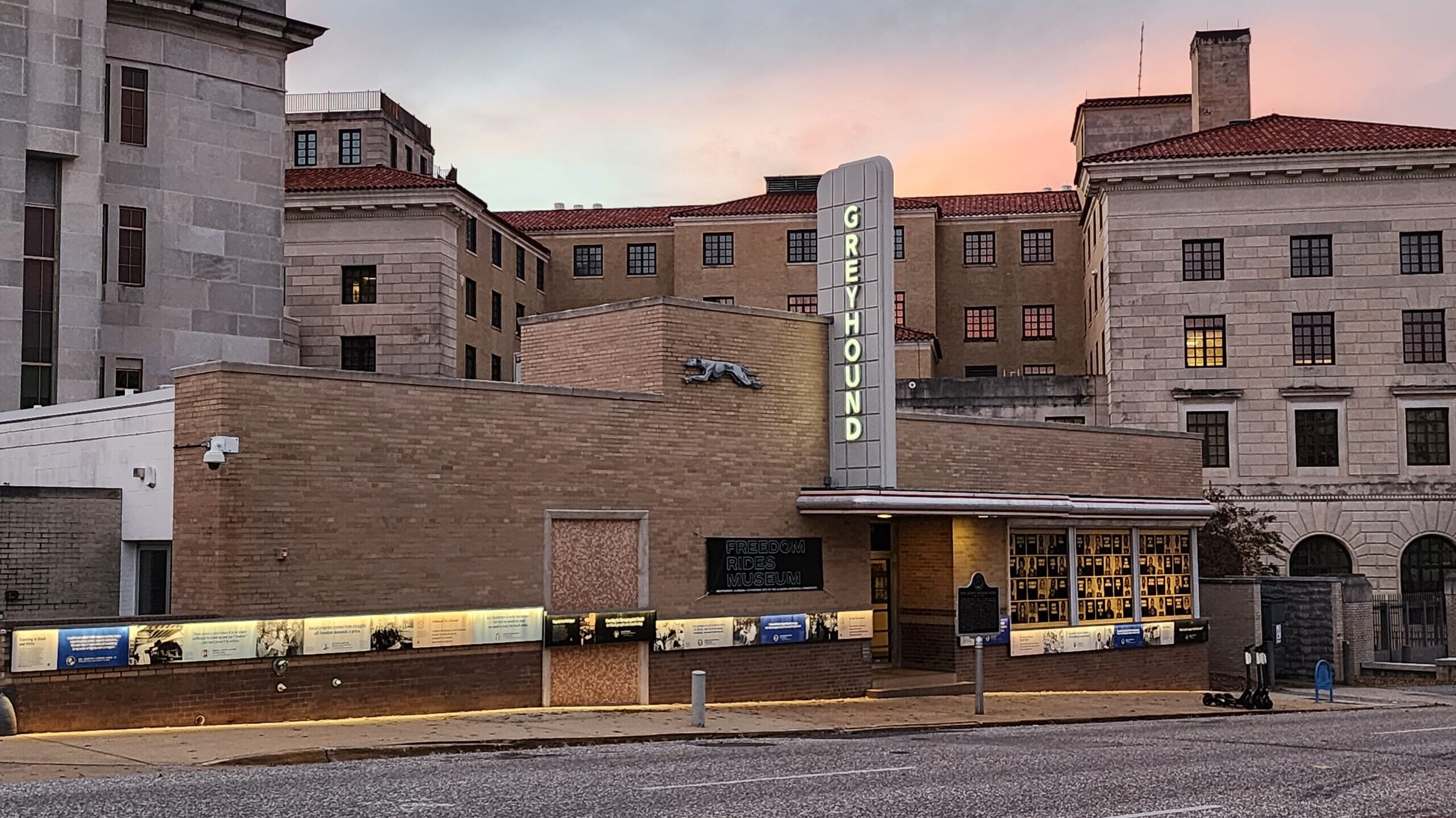
On May 4, 1961, a group of 18 men and women, both Black and white, the youngest at 18-years-old and the oldest at 61-years-old, boarded a bus in Washington, D.C., and headed south to confront Jim Crow segregation.
In organizing the Freedom Rides, the Congress of Racial Equality sought to test the U.S. Supreme Court rulings that required desegregated interstate transportation in the South.
Americans would soon know who the Freedom Riders were once they entered the Deep South. Crossing state lines into Alabama, Klansmen confronted the riders with fists, bats, iron pipes and chains, and firebombed one of their buses in Anniston.
A photo of the burning bus with billows of black smoke streaming from the top of the bus covered the front pages of newspapers around the world, becoming one of the most iconic photos of the Civil Rights Movement.
Other leading civil rights organizations did not approve of the Freedom Riders’ confrontational approach. Nor did Kennedy administration officials who attempted to end the rides to maintain America’s reputation as the preeminent champion of human rights worldwide.
Not deterred by the Klan violence in Anniston, Birmingham and Montgomery, the riders entered Mississippi, where the state highway patrol protected them from Klansmen. But awaiting them in Jackson, on the orders of Governor Ross Barnett, were arrests and incarceration at Mississippi’s notorious Parchman Penitentiary, where guards had free reign to assault them.
However, their prison experience in Mississippi only served to cement the Freedom Riders’ resolve to continue on their journey.
The riders achieved their first big success when the Interstate Commerce Commission’s desegregation ruling went into effect on November 1, 1961.
On the 65th anniversary of the Freedom Rides, former Freedom Riders and civil rights experts remember the courage of the Freedom Riders and their impact on the Civil Rights Movement.
“We wanted change, and we weren’t going to accept anything less. They tried to stop us, degrade us, and even kill some of us, but we were not going to stop,” said Joan Trumpauer Mulholland, 84, in an email about her experience as a Freedom Rider.
The Freedom Riders will be recognized at events this week in Anniston, Birmingham, Montgomery and Selma commemorating the 65th anniversary.
“It really shows just what a small group of people can accomplish… and it’s still true today,” Mulholland said. “So go out and change your world because history isn’t finished. It’s waiting for you.”

Fred Shuttlesworth with Freedom Riders in front of a bus at the Greyhound station in Birmingham, Alabama. / Alabama Department of Archives and History. Donated by Alabama Media Group. Photo by Robert Adams and Ed Jones, Birmingham News.
Origins of the Freedom Riders
Organized by the Congress of Racial Equality in 1961, the Freedom Riders sought to force southern states to adhere to the U.S. Supreme Court decisions in interstate transportation, such as the Morgan v. Virginia decision in 1947. The December 1960 decision in Boynton v. Virginia served as the catalyst for the 1961 Freedom Rides.
“Those Supreme Court decisions weren’t being enforced and the goal of the Freedom Rides was to draw attention to that and to get those Supreme Court decisions enforced,” said Alexander Strickland, site director of the Freedom Rides Museum in Montgomery, in an interview in December 2025. “Their stated goal was the desegregation of interstate transit.”
Starting on May 4, 1961, the Freedom Riders started their journey by bus from Washington, D.C., and traveled through Virginia, North Carolina, South Carolina and Georgia.
“The night before, they’d had dinner in Atlanta with Dr. Martin Luther King, who’d taken the leader of the Freedom Riders, CORE Director James Farmer, aside after that dinner, and warned him against going into Alabama,” Strickland said.
Heeding King’s warning, Farmer gave the Freedom Riders a chance to back out before heading into Alabama. Farmer himself ended up not going. He received news later that evening that his father had died. All the other Freedom Riders continued on their journey without Farmer to Alabama where King’s warnings materialized.
“We felt we could count on the racists of the South to create a crisis so that the federal government would be compelled to enforce the law,”Farmer wrote in his 1985 memoir, “Lay Bare the Heart.”
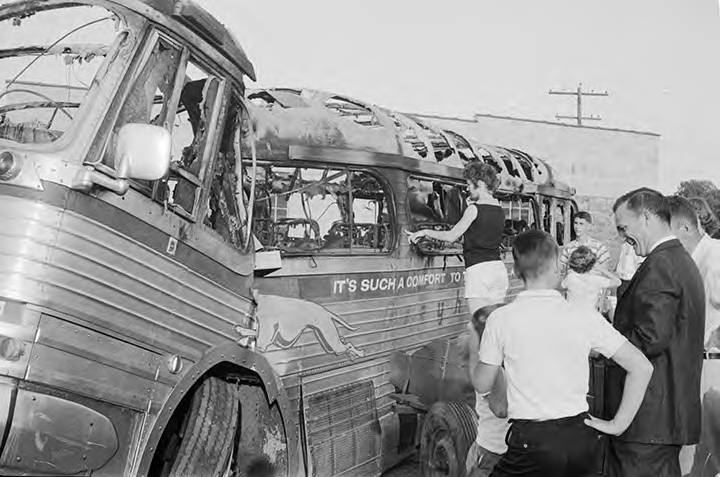
Remains of the bus bombed during an attack on the Freedom Riders in Anniston, Alabama / Alabama Department of Archives and History. Donated by Alabama Media Group. Photo by Hornsby Birmingham News.
Klan violence in Alabama
Dozens of Klansmen attacked the Freedom Riders in Anniston and firebombed their bus, while law enforcement stood by, intervening right away to give the Klan time to work over the riders.
When the Freedom Riders arrived in Birmingham and Montgomery, Klansmen assaulted them. Law enforcement watched instead of intervening to stop the violence.
The Klan violence in Alabama dominated the headlines throughout the state and in press outlets around the world.
After leaving Alabama, the rides continued to Mississippi.
Unbeknownst to the Freedom Riders, U.S. Attorney General Robert Kennedy made an informal arrangement with Mississippi Senator James O. Eastland to assure that local law enforcement would protect the Freedom Riders from Klansmen as they made their way through Mississippi.
But Eastland could not guarantee that there wouldn’t be arrests and incarceration.
As the attorney general’s priority was to stop Klan violence against the riders, he implicitly agreed to this arrangement, according to Raymond Arsenault in his book, “Freedom Riders: 1961 and the Struggle for Racial Justice.”
Barnett, Mississippi’s governor, used his authority to issue an executive order as the basis to arrest and incarcerate the Freedom Riders at Parchman Penitentiary.
“There appears to be imminent danger of a breach of peace, resistance to the execution of the laws of the State, with threatened unlawful assembly and possible violence and destruction to private property and loss of life,” Mississippi Governor Ross Barnett wrote in an executive order on May 24, 1961, about the Freedom Riders.

Greyhound bus terminal in Jackson, Mississippi / Liz Ryan photo
Arrests in Jackson
Joan Trumpauer Mulholland, a 19-year-old white student at Tougaloo College, boarded a train from New Orleans to Jackson, Mississippi on June 8, 1961.
Similar to the waves of Freedom Riders before her, police arrested Trumpauer Mulholland.
Trumpauer Mulholland and eight of her companions refused bail and joined the more than 70 Freedom Riders at Parchman, according to Raymond Arsenault in “Freedom Riders.”
Jackson police continued to arrest Freedom Riders as they entered the city, including 13-year-old Hezekiah Watkins, who police mistook for a Freedom Rider a month after Trumpauer Mulholland’s arrest.
Even though his school principal had warned him not to get involved, Watkins and his friend Troy went to the Greyhound bus station on Lamar Street in downtown Jackson on July 6, 1961 to see the Freedom Riders.
Being told not to go made Watkins want to go even more.
“We just knew these individuals had to be supernatural humans based on what we witnessed on TV that took place in Alabama,” wrote Watkins in his autobiography “Pushing Forward.” “The images we watched on the news showed how they were being beaten, kicked, sprayed with water hoses, bitten by dogs…yet they couldn’t be stopped. Every time they got knocked down or beaten, they kept coming back for more.”
As Watkins peered into the window of the front door of the bus station, his friend Troy pushed him into the door. Watkins fell onto the floor in the lobby where there were 11 Freedom Riders. Watkins was the youngest in the group.
“Your name and place of birth?” asked a Jackson city policeman.
Watkins responded with his name and Milwaukee, Wisconsin, as his birthplace.
Thinking that Watkins was an agitator from out-of-state who’d come to Jackson as a Freedom Rider, the policeman arrested Watkins.
While the police officer booked Watkins on a charge of delinquency in juvenile court, the full consequences of the mistaken identity weren’t clear to Watkins. He hadn’t been on a bus with the other Freedom Riders, but he soon faced the same consequences as they did.
Parchman
The governor attempted to break the Freedom Riders by directing law enforcement to incarcerate them at Parchman where guards subjected the riders to violence and inhumane conditions.
However, the riders’ incarceration only served to strengthen the movement. The Freedom Riders refused to be bailed out, choosing to stay incarcerated for weeks instead.
“At that point, the goal of the Freedom Rides shifted from getting to New Orleans to filling the jails of Jackson, Mississippi, then Hinds County, Mississippi and eventually to the state penitentiary of Mississippi to keep the Freedom Rides in the news and keep the pressure up,” Strickland said.
After Watkins’ arrest, a police officer drove Watkins more than 100 miles north to Parchman without telling Watkins where they were headed.
Watkins vividly recalled entering Parchman and being taken to Cell Block 17—death row.
“You could hear those doors closing,” said Watkins. “It is a sound one never forgets.”
At that time, Mississippi law should have made it rare for children to be placed at Parchman except for specific violent offenses handled in criminal court or juvenile cases transferred to criminal court.
Neither was the case for Watkins. Police officers charged Watkins with a delinquent act and placed him under the jurisdiction of the juvenile, rather than the criminal, court.
But that did not protect Watkins from Parchman. Guards beat him daily in the head and on the legs, Watkins recalled.
Watkins recounted being interviewed by a U.S. Department of Justice attorney who’d been tasked with inspecting the status of the Freedom Riders at Parchman.
Upon discovering that Mississippi officials had incarcerated a 13-year-old at the prison, Watkins recalled being told that DOJ officials intervened with the governor’s office to request removal of Watkins from Parchman.
On July 13, 1961, Mississippi corrections officials released Watkins from Parchman.
A Jackson police officer drove Watkins from Parchman to the Jackson Police Department. On the ride, Watkins recalled that the officer told him that Barnett had ordered his release from Parchman.
At the Jackson police station, Watkins remembered reuniting with his mother and that officials requested that his mother sign a document.
“My mom didn’t want to sign it,” Watkins said.
The document, from a Jackson juvenile court judge, required Watkins to attend school daily and to abide by an evening curfew as part of a year-long probation term, according to records of the Mississippi Sovereignty Commission.
“I recall telling my mother to go on and sign because I wanted to get out of there,” he said.
For the remainder of the summer, Watkins, who was now on probation and under a strict curfew, stayed inside his home, while waves of new Freedom Riders continued their journeys all over the South.
ICC ruling
In late September, the Interstate Commerce Commission issued a ruling in favor of U.S. Attorney General Robert Kennedy’s petition. Taking full effect on November 1, 1961, the ruling banned segregation in interstate travel and at facilities such as waiting rooms at bus terminals and airports, lunch counters and restrooms.
“Over the next couple of months after that, there were several test rides to make sure that the new ICC ruling was being enforced,” Strickland said.
The last ride concluded on December 10, 1961 in Albany, Georgia.
With the new regulation in effect and being enforced by the federal government, the Freedom Riders succeeded in achieving their goal to desegregate interstate travel.
It would take seven more years for the ruling to be fully implemented across the South.

Hezekiah Watkins at the Mississippi Civil Rights Museum / Liz Ryan photo
Freedom Riders and the Civil Rights Movement
“The other significance of the Freedom Rides is how it served as a training ground for activists,” Strickland said. “This was the first major nationwide civil rights campaign. You had activists from almost every state participating in this.”
That was the case for Watkins, too.
“The first day after school was out, I met a man named James Bevel, not knowing at the time that this man was going to be my mentor,” Watkins said.
James Bevel, a student activist with the Student Nonviolent Coordinating Committee and later the Southern Christian Leadership Conference, recruited Watkins to become active in the movement despite his mother’s objections.
For the next few years, Watkins participated in numerous civil rights demonstrations and direct actions where police arrested Watkins over 100 times. Watkins recalled that police arrested him for the last time in 1970.
Watkins now serves as a docent at the Mississippi Civil Rights Museum, where he talks with museum goers about his experiences as a civil rights activist and his autobiography, “Pushing Forward,” is available in the museum’s bookstore.
Standing next to an exhibit about the Freedom Riders in the museum, Watkins proudly showed off his arrest photo.
“But if I had known that I was going to be arrested, I would have said Jackson, Mississippi,” Watkins said. “I wasn’t ready for Parchman prison.”

Freedom Riders Joan Trumpauer Mollholland and Dion Diamond / Liz Ryan photo
Remembrances
Altogether 436 Freedom Riders of all ages, men and women, and Black and white riders participated in the 1961 rides. The Freedom Rides Museum exhibits display the mugshots of the riders, available because the Mississippi Sovereignty Commission spied on the civil rights movement, Strickland said.
Even though Watkins still experiences migraines from his incarceration at Parchman, he returned to the prison in 2023 as a special guest. Watkins was the only civil rights activist to show up for the ceremony commemorating the Freedom Riders with a historical marker.
Earlier this year, Jackson Mayor John Horhn issued a formal apology in a public ceremony, on behalf of the city of Jackson, to Watkins.
“Mistaken for a Freedom Rider because of your out-of-state birth certificate, you were unjustly arrested at the age of thirteen, transported to Parchman, and placed on death row, where you were held alongside adults in one of the most notorious prisons in America,” wrote Horhn in his letter to Watkins. “The City of Jackson deeply regrets the suffering you endured and honors you for your lifelong dedication to civil and human rights.”
Watkins appreciated the apology and the recognition of Freedom Riders and civil rights activists.
“We paved the way, made it possible for every citizen to be treated equally,” Watkins said. “There is no place that I know of in Mississippi—and Mississippi was a battle ground—where a Black person can’t go.”