


















Alabama leaders on Wednesday asked the U.S. Supreme Court to allow the state to use a Republican-backed congressional map that a federal court ruled intentionally discriminates against Black voters.
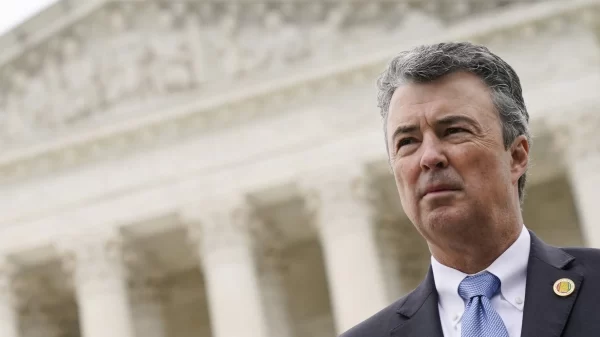
The emergency application, filed by Alabama Attorney General Steve Marshall, came one day after a three-judge federal panel blocked the Legislature’s 2023 congressional map and ordered the state to continue using a court-drawn map that created two districts where Black voters have an opportunity to elect candidates of their choice. Marshall asked the U.S. Supreme Court to block the federal court order to allow Alabama to use the 2023 congressional map and continue special primary election preparations.
After the 2020 Census, Alabama lawmakers approved a congressional map with a single majority-Black district despite Black residents making up roughly 27 percent of the state population. Civil rights groups and Black voters sued, arguing the plan diluted Black voting strength in violation of Section 2 of the Voting Rights Act.
In 2023, the U.S. Supreme Court upheld a lower court ruling in Allen v. Milligan, which found that Alabama likely violated the Voting Rights Act. The ruling forced lawmakers into a special session to redraw district lines.
The Legislature’s replacement map again included only one majority-Black district and a second district with a Black voting-age population of roughly 40 percent. Judges later appointed a special master to draw a remedial map that ultimately produced a second opportunity district used in the 2024 elections. Republicans have argued ever since that the map improperly prioritized race and weakened GOP representation in a conservative state.
In Wednesday’s filing, Alabama officials leaned on the Supreme Court’s recent decision in Louisiana v. Callais, which narrowed the use of race in redistricting. Alabama argued the lower court improperly ignored that ruling and accused the panel of treating partisan mapmaking as racial discrimination.
“While straining to see racial animus in the legislative findings, the district court overlooked numerous lawful explanations. Only by presuming bad faith could the district court transform those lawful explanations into the most odious form of discrimination,” the application states.
The filing further argues that Alabama is being unfairly punished for refusing to “district on the basis of race, persist[ing] in keeping a community of interest whole, and declin[ing] to redistrict black voters in Mobile with black voters 200-some miles away.”
“A stay is warranted so that Alabama is not again precluded from using its legislatively enacted 2023 Plan based on a decision that defies Callais, manipulates the Purcell principle, and offends the Constitution’s promise of equal protection for all,” the application states.
In a statement, Marshall said that he believes Alabama’s congressional map should preserve an all-Republican delegation and expressed confidence the U.S. Supreme Court will ultimately side with the state.
“The Supreme Court made it clear in Callais that courts should not impose or require states to draw racially gerrymandered congressional maps. But the three-judge district court set that rule aside and once again replaced Alabama’s map with one that sorts voters based on race,” Marshall said.
The three-judge panel disagreed in Tuesday’s ruling, writing that evidence gathered throughout the litigation showed the Legislature intentionally diluted Black voting strength even after being ordered to remedy the violation.
“The Legislature’s conduct and that concession made this case unique: we were not (and still are not) aware of any other case in which a legislature—faced with a federal court order declaring that its electoral plan unlawfully dilutes minority votes and requiring a remedy that provides an additional opportunity district—responded with a plan that the state conceded did not provide that district,” the panel wrote.
The state’s filing also raises concerns about election administration ahead of the 2026 midterms. Alabama officials argued that another late-stage map change could create voter confusion and strain election offices already preparing for candidate qualifying and ballot administration.
Justice Clarence Thomas ordered plaintiffs to respond to Alabama’s request by Monday afternoon.