





























Tommy Tuberville won an important legal victory this week. That should be said plainly and fairly.
Montgomery Circuit Judge Brooke Reid dismissed a challenge to his eligibility to run for governor, finding that the plaintiffs’ remaining claim—a quo warranto action—was not the proper legal vehicle at this stage of the election process.
The court did not remove Tuberville from the ballot. It did not declare him eligible or ineligible. It did not decide whether he meets Alabama’s residency requirement.
That distinction matters because this case should not be treated as a political weapon against one man or one candidate. The law should never work that way. The Constitution should never work that way.
Tuberville deserves fairness. He deserves the same process every citizen deserves. He has the right to defend his residency, make his case and reject what he considers a political attack.
But Alabama has rights, too.
The people of this state have a right to know whether a candidate for the highest office in state government meets the qualifications written into the Alabama Constitution.
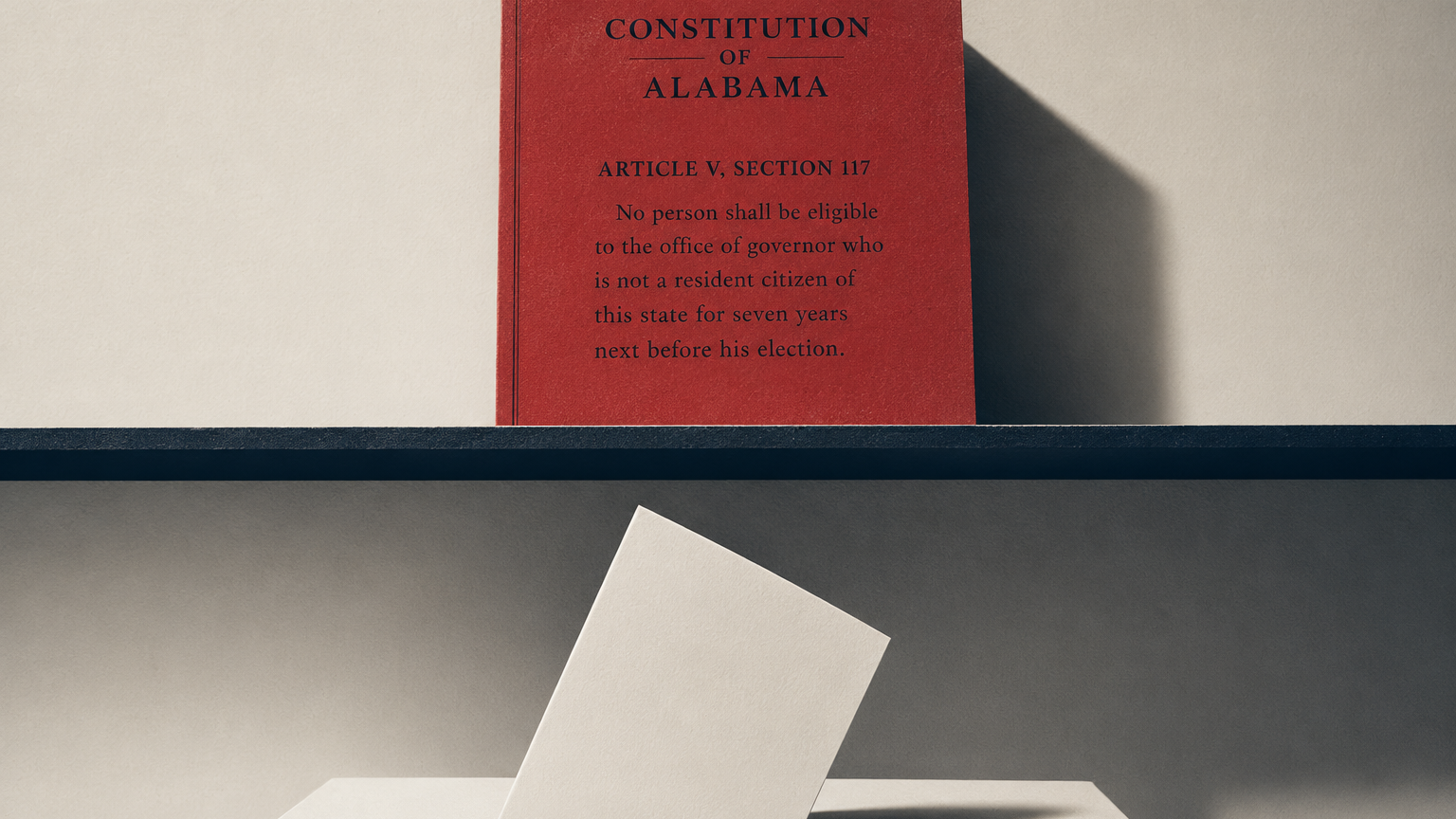
Article V, Section 117 requires a governor to be at least 30 years old, a citizen of the United States for 10 years and a “resident citizen” of Alabama for at least seven years immediately before the election. Those are not suggestions. They are not campaign talking points. They are constitutional commands.
That is why Reid’s order deserves careful attention.
Her ruling was not a sweeping declaration that Tuberville is eligible. It was not a finding that he is ineligible. It was a narrow ruling about whether this particular legal claim could be used at this particular point in the election process.
Reid framed the issue as whether a circuit court has jurisdiction over a quo warranto action challenging the eligibility of a certified major-party nominee under Section 117. She noted there was “no Alabama case directly on point,” leaving the court to work through statutes and cases that did not perfectly fit the question before it.
That is important.
Reid did not say the Constitution does not matter. Quite the opposite.
She wrote that Section 117’s requirements are “clearly set forth and unambiguous,” that courts have a “solemn and exclusive duty” to interpret and apply the Alabama Constitution and that the suggestion that courts lack authority, when properly asked, to rule on a nominee’s constitutional eligibility “is lacking in merit.”
That is the heart of the matter.
Tuberville received a ruling on the process. Alabama still needs a ruling on the Constitution.
Reid dismissed the case not because the court found Tuberville eligible or ineligible, but because the plaintiffs proceeded under quo warranto, a legal action generally used to determine whether someone is unlawfully holding or exercising a public office.
Tuberville is not currently governor. He is the Republican nominee for governor.
Reid noted that Alabama courts have recognized a certified nominee as having “quasi-officer” status, but she found no Alabama case holding that such a nominee is a public officer for the purposes of quo warranto. That distinction proved decisive.
This question did not begin with Democrats, the press or this lawsuit.
Questions about Tuberville’s residency were raised publicly during his 2020 Republican Senate race against Jeff Sessions. The Associated Press reported that Sessions aired a television advertisement describing Tuberville as a “Florida Man” and that Tuberville faced similar accusations during that campaign.
At the time, that was mostly a political issue. A United States Senate race does not carry the same Alabama constitutional residency requirement as a race for governor.
But when Tuberville chose to seek Alabama’s highest office, the question changed.
It became constitutional.
That is why the press covered it. That is not a conspiracy. That is not a witch hunt. That is the work of the Fourth Estate.
When a man seeks the governorship and the Constitution sets a residency requirement for that office, asking whether that requirement has been met is not partisan. It is journalism.
Asking a court to answer the question is not personal. It is the rule of law.
The Alabama Republican Party has already answered the question for its purposes.
Reid’s order notes that the party held a post-primary election contest hearing on the same residency issue and issued a final decision finding that Tuberville met Section 117’s “resident citizen” duration requirement before certifying him as its nominee.
That party process should be acknowledged. Tuberville made his case there. The party reviewed materials.
The Associated Press reported that the Alabama Republican Party rejected the challenge filed by former primary opponent Ken McFeeters after Tuberville submitted state tax records, property and homeownership records, driver’s licenses, voter registration records and other materials.
But a political party should not be the final judge of what the Alabama Constitution means.
A party can nominate a candidate. It can certify a candidate. It can defend its nominee.
But constitutional qualifications do not belong to a party. They belong to the people.
The people deserve certainty before they vote.
Reid appeared to understand that concern.
Her order states that “public interest certainly weighs in favor” of resolving constitutional eligibility before the general election. She also wrote that there is a “very strong argument” that quo warranto should be available to test the eligibility of a certified major-party nominee before the election, even though she concluded she lacked authority under existing Alabama law to extend it in this case.
That is not a small thing.
The court saw the problem. It saw the public need. It saw the importance of answering constitutional questions before Election Day.
But Reid held that this lawsuit, in its current posture, could not provide that answer.
The court also left open the possibility that other legal avenues may exist.
Reid wrote that declaratory or injunctive relief “may be available” to challenge a certified nominee’s eligibility under the Alabama Constitution. But those claims were not before the court after the plaintiffs dismissed their declaratory relief claim against Secretary of State Wes Allen before the hearing.
The matter may now move to the Alabama Supreme Court.
Reid’s order says it is final and that an immediate appeal may be taken. The Associated Press reported that an attorney for the plaintiffs plans to appeal.
If the case reaches the Alabama Supreme Court, the justices should understand what is truly at stake.
This is not about whether Tuberville is liked or disliked. It is not about whether he is popular or controversial. It is not about whether he is a Republican or whether his opponent is a Democrat.
It is about whether Alabama has a meaningful way to enforce its Constitution before the people vote.
If the Constitution can be tested only after an election, voters may be asked to choose first and learn later whether the winner was qualified to serve.
That is backward.
The rule of law should not depend on timing, technicalities or political convenience.
Tuberville deserves fairness under the law. So do the plaintiffs. So do the voters. And so does the Constitution.
The law should not bend because a candidate is powerful. It should not harden because a candidate is controversial. It should not change depending on party, pressure or political consequence.
The law must be steady, or it is not law at all.
That is what makes this case matter.
Not one man. Not one campaign. Not one party.
The Constitution.
Alabama’s highest office belongs to the people. The qualifications for that office are written in the people’s Constitution. The people have a right to know whether every candidate seeking that office meets the requirements the Constitution demands.
Tommy Tuberville is entitled to fairness under the law.
So are the voters.
And so is the Constitution.
Alabama still needs an answer.