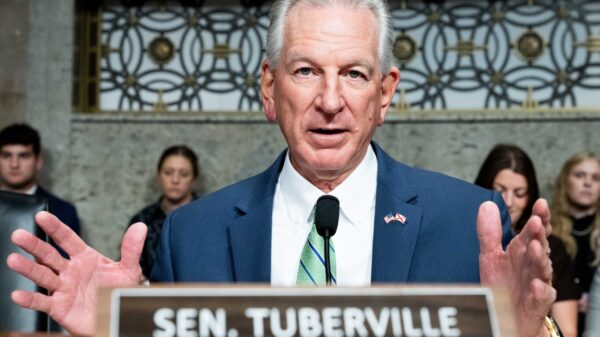


































A Montgomery County circuit judge on Thursday dismissed a legal challenge to Republican gubernatorial nominee Tommy Tuberville’s constitutional eligibility, giving Tuberville a significant procedural victory while leaving unresolved the larger question of whether he meets Alabama’s residency requirement to serve as governor.
In an eight-page order, Circuit Judge Brooke E. Reid granted Tuberville’s motion to dismiss the case brought by Brooke Lynn Dorgan and Justin Jude LeBlanc. The plaintiffs challenged Tuberville’s eligibility under Article V, Section 117 of the Alabama Constitution, which requires the governor to be at least 30 years old, a U.S. citizen for 10 years and a “resident citizen” of Alabama for at least seven years next before the election.
But Reid’s ruling did not decide whether Tuberville satisfies that constitutional requirement.
Instead, the judge found that the plaintiffs’ sole remaining claim — a quo warranto action — was not the proper legal vehicle to challenge a certified party nominee before the general election. Reid ruled that the court lacked jurisdiction over that claim “at this time” and granted Tuberville’s motion to dismiss.
The order states that it is a final order from which an immediate appeal may be taken, meaning the case could next be taken to the Alabama Supreme Court.
The case, Brooke Lynn Dorgan and Justin Jude LeBlanc v. Thomas Hawley Tuberville and Wesley Allen, centered on whether a court may hear a quo warranto challenge to the eligibility of a certified major-party nominee who has not yet been elected or taken office. Reid described that as the “central issue” before the court.
Quo warranto is typically used to determine whether someone is unlawfully holding or exercising a public office. Tuberville, however, is not currently governor. He is the Republican nominee for governor.
That distinction proved decisive.
Reid noted that Alabama courts have recognized a certified nominee as having “quasi-officer” status, but she found no Alabama case holding that a nominee is a public officer for purposes of quo warranto.
The court also emphasized that Alabama law gives political parties broad authority to resolve primary-election contests, including challenges based on a candidate’s eligibility. In this case, Reid wrote, the Republican Party had already held a post-primary contest hearing on the same residency issue and issued a final decision finding that Tuberville met the “resident citizen” duration requirement before certifying him as the party’s nominee.
But the order is not a sweeping victory on the merits for Tuberville.
Reid expressly rejected the broader argument that courts are powerless to address constitutional eligibility questions simply because an election is involved. The judge wrote that the requirements for governor in Section 117 are “clearly set forth and unambiguous” and that courts have a “solemn and exclusive duty” to interpret and apply the Alabama Constitution.
“The suggestion that Courts are without authority, when properly invoked, to rule upon the Constitutional eligibility of a nominee to hold office is lacking in merit,” Reid wrote.
That language could become central if the plaintiffs appeal.
Reid also acknowledged the public importance of resolving constitutional eligibility questions before voters go to the polls. She wrote that “public interest certainly weighs in favor” of judicial resolution before the general election and that there is a “very strong argument” that quo warranto should be available to test the constitutional eligibility of a certified major-party nominee.
Still, Reid concluded that, under existing Alabama law, she did not have the authority to extend quo warranto to a certified nominee before the general election.
The judge also appeared to leave open other possible legal avenues. Reid wrote that declaratory or injunctive relief “may be available” to challenge a certified nominee’s eligibility under the Alabama Constitution, but those claims were not before the court after the plaintiffs voluntarily dismissed their declaratory-relief claim against Secretary of State Wes Allen before the hearing.
The practical effect of Thursday’s ruling is clear: Tuberville remains the certified Republican nominee for governor, and this challenge has been dismissed.
But the constitutional question remains unresolved.
The court did not rule that Tuberville is eligible. It ruled that the plaintiffs’ quo warranto claim was not the proper mechanism to decide the issue at this point in the election process.
An appeal to the Alabama Supreme Court could determine whether Alabama voters will get a judicial answer before the general election on whether Tuberville meets the state Constitution’s seven-year “resident citizen” requirement.
This is a developing story.